How to File a Confirmation Statement (CS01) in 2027 and 2028
Everything you need to file your company's confirmation statement correctly and on time in 2027, from finding your review period to verifying directors and updating shareholders.
MyCompanyLookup Editorial TeamUpdated 6 Sept 2026 14 min read
In this article
- What is a confirmation statement?
- When is a confirmation statement due?
- How much does a confirmation statement cost?
- What you need before you start
- Step-by-step: filing your confirmation statement online
- Updating shareholders on the confirmation statement
- Choosing the right SIC codes
- What happens if you file late?
- Common mistakes and how to avoid them
- Confirmation statement versus annual accounts
- Should you file it yourself or use an agent?
- A filing checklist you can copy
- Planning ahead for 2027 and 2028
- Worked example: a company's first two confirmation statements
- Which changes need their own form?
- Confirmation statements for LLPs and dormant companies
- How the public sees your confirmation statement
- Managing confirmation statements for several companies
- Where to find official guidance
- Quick recap
Every UK company must file a confirmation statement with Companies House at least once every twelve months. It is one of the simplest filings a company makes, yet it is also one of the most commonly missed, and since the Economic Crime and Corporate Transparency Act reforms it asks for more than it used to. This guide explains exactly what the confirmation statement (form CS01) is, when it is due, what it costs, what you need before you start and how to file it step by step in 2027.
If you prefer to hand it over, you can order a confirmation statement filing through our Filing Centre and our filing partner will prepare and submit it for you. If you want to do it yourself, read on.
What is a confirmation statement?
A confirmation statement is a declaration, made by the company, that the information Companies House holds about it is correct and up to date at a specific date. It replaced the old "annual return" in June 2016. The form is called CS01.
The statement covers:
- The registered office address and, since March 2024, the registered email address.
- The directors and any company secretary.
- The people with significant control (PSCs).
- The SIC codes that describe the company's business activities.
- The statement of capital: the number, class and value of shares issued.
- The shareholders, for private companies that are not traded on a market.
- A statement of lawful purpose: confirmation that the company's intended future activities are lawful. This was added in March 2024 and must be made on every confirmation statement.
Some of this information can be updated within the confirmation statement itself (SIC codes, statement of capital, shareholder details). Other changes, such as appointing a director or moving the registered office, must be filed on their own forms first, and the confirmation statement then confirms the updated position.
The confirmation statement is not a set of accounts and has nothing to do with tax. It does not ask about turnover or profit. Accounts are filed separately, usually on a different date. Our article on late filing penalties explains the difference in deadlines.
When is a confirmation statement due?
Each company has a review period of up to twelve months. The first review period starts on the date of incorporation. You must file a confirmation statement made up to a date no later than the end of the review period, and you have 14 days after the end of the review period to deliver it.
For example, a company incorporated on 10 March 2026 has a first review period ending 9 March 2027, and must file its confirmation statement by 23 March 2027.
After each filing, the next review period starts the day after the "made up to" date of the statement you filed. That has an important consequence: you can file early, and doing so moves your future review periods. If you file on 1 January instead of 9 March, your next statement is due twelve months and fourteen days after 1 January.
You can see your next due date on any company's profile in our UK company search. The Deadlines panel shows the confirmation statement due date and flags it in red when overdue.
How much does a confirmation statement cost?
Companies House charges a fee once per review period. From 1 February 2026 the fee for filing online is £50. The paper filing fee is higher, and paper filing is slower, so almost everyone files online.
If you file more than one confirmation statement in the same review period, for example to update shareholders twice, only the first one is charged.
If you use an agent, they will add a service fee on top of the government fee. Through our Filing Centre the price is £70 service fee plus the £50 government fee, and the order includes a check of your officers, PSCs and shareholders before filing.
What you need before you start
Gather these before you log in:
- The company number (eight characters).
- The authentication code, a six-character code Companies House sends to the registered office address when the company is incorporated. It acts like a signature for online filing. If you have lost it, you can request a new one, but it is posted to the registered office, so allow several days.
- Identity verification details for every director. Since 18 November 2025, Companies House has been rolling out mandatory identity verification. Existing directors must verify by the time of the company's first confirmation statement after that date. Each verified person receives a personal code, and you will be asked to confirm that every director has verified. Our identity verification guide covers this in detail.
- An up-to-date list of shareholders with the number and class of shares each holds, and any transfers since the last statement.
- Your SIC codes, if your business activities have changed.
- Your registered email address, which must be an address where Companies House can contact the company. It is not shown on the public register.
Step-by-step: filing your confirmation statement online
Step 1: Check what has changed since the last statement
Open your company on the register and compare every detail with reality: registered office, directors, PSCs, SIC codes and shares. Write down anything that is out of date.
If a director has joined or left, or the registered office has moved, file those changes first using the relevant forms (AP01 to appoint a director, TM01 to terminate an appointment, AD01 to change the registered office, PSC forms for PSC changes). The confirmation statement cannot make these changes for you. Our Filing Centre handles director appointments, resignations, address changes and PSC changes if you need help.
Step 2: Make sure directors have verified their identity
As the identity verification regime beds in through 2026 and 2027, this is the step that catches people out. Each director must verify, either directly with Companies House through GOV.UK One Login or through an Authorised Corporate Service Provider (ACSP), and obtain a personal code. Do this before you sit down to file. If a director cannot verify in time, speak to an adviser.
Step 3: Sign in and start the filing
Go to the Companies House online filing service from GOV.UK's file your confirmation statement page. Sign in, enter your company number and authentication code, and choose to file a confirmation statement.
Step 4: Confirm or update each section
You will be shown each part of the company's information in turn:
- Registered office address: confirm it. It must be an "appropriate address", which means post sent there should be expected to come to the attention of a person acting on behalf of the company and its delivery can be acknowledged. A PO box alone is not acceptable. Our article on registered office address rules explains this.
- Registered email address: confirm or provide one.
- Officers: confirm the list and directors' verification.
- PSCs: confirm the list is correct.
- SIC codes: confirm or change them. You can have up to four.
- Statement of capital: confirm or update the share capital.
- Shareholders: confirm the list, or upload or enter changes.
- Lawful purpose: confirm that the company's intended future activities are lawful.
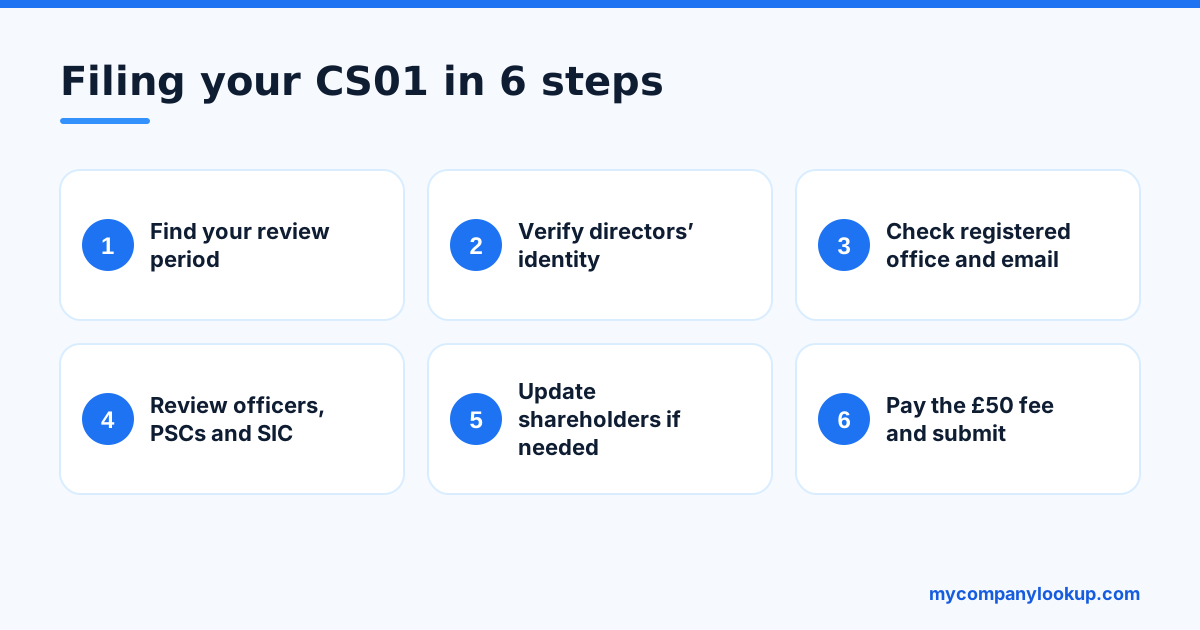
Step 5: Choose the made-up date and pay
Choose the date the statement is made up to. In most cases this is the last day of the review period, but you can choose an earlier date. Pay the fee by card or with a Companies House account.
Step 6: Submit and check the acceptance email
Companies House usually accepts online confirmation statements within a day. You will receive an email when it is accepted, and the filing appears in the company's filing history. If it is rejected, the email explains why. Fix the issue and resubmit promptly, because a rejected filing does not count as filed.
Updating shareholders on the confirmation statement
For private companies, the confirmation statement shows the shareholders. If shares have been transferred during the review period, you need to provide the details: who transferred shares, to whom, how many and on what date.
Remember that the confirmation statement records transfers; it does not make them. A share transfer needs a properly completed stock transfer form, an update to the company's own register of members and, in many cases, stamp duty. Only then should it be reflected on the confirmation statement.
If new shares were issued (allotted), you should have filed a return of allotment (SH01) within one month of the allotment. The confirmation statement's statement of capital should match.
Choosing the right SIC codes
SIC codes (Standard Industrial Classification) describe what your company does. They are used by government for statistics and by people searching the register. You can choose up to four. Pick the codes that best describe your main activities rather than the most general code. For example, "62012 Business and domestic software development" is clearer than "82990 Other business support service activities not elsewhere classified".
If your company has stopped trading and is dormant, use 99999 "Dormant Company". Our guide to dormant company accounts and nil CT600 returns explains what else a dormant company must file.
What happens if you file late?
Unlike late accounts, a late confirmation statement does not trigger an automatic financial penalty. But it is still serious:
- It is a criminal offence not to file. The company and its officers can be fined.
- Companies House can start striking the company off the register. A first notice is published in The Gazette, the company's status changes to "proposal to strike off", and if nothing is filed the company is eventually dissolved and its assets pass to the Crown.
- Your public record suffers. Customers, banks and suppliers who check your company will see the overdue statement in red and any strike-off notice.
If you realise you are late, file immediately. In most cases filing the overdue statement stops strike-off action.
Common mistakes and how to avoid them
| Mistake | What goes wrong | How to avoid it |
|---|---|---|
| Trying to change directors on the CS01 | The change is not made | File AP01 or TM01 first |
| Directors not verified | Filing is delayed or rejected | Verify identity before filing |
| Lost authentication code | Cannot file until the new code arrives by post | Store the code securely and request a new one early |
| Shareholder transfers not recorded properly | Register and confirmation statement disagree | Complete stock transfer forms and update the register of members first |
| Wrong made-up date | Review period shifts unexpectedly | Check the date before submitting |
| Registered office is a PO box or unmanned | Address may be challenged by Companies House | Use an appropriate address or a registered office service |
| Forgetting the lawful purpose statement | Filing cannot be completed | Confirm it every time |
Confirmation statement versus annual accounts
Many owners confuse the two. They are separate filings with separate deadlines:
| Confirmation statement | Annual accounts | |
|---|---|---|
| Form | CS01 | AA (various types) |
| What it covers | Company details, officers, PSCs, shares | Financial position and performance |
| Frequency | At least every 12 months | Every financial year |
| Deadline | 14 days after review period ends | 9 months after accounting reference date for private companies (21 months after incorporation for the first accounts) |
| Fee | £50 online | No Companies House fee |
| Late filing | Offence and strike-off risk | Automatic penalty from £150 |
You also need to file a Company Tax Return (CT600) with HMRC every year. That is a third, separate obligation. Our late filing penalties guide explains the HMRC deadlines.
Should you file it yourself or use an agent?
Filing a confirmation statement yourself is straightforward if nothing has changed and every director has already verified their identity. It takes about fifteen minutes.
Consider using an agent if:
- Directors or shareholders have changed during the year.
- You are unsure whether your registered office counts as an appropriate address.
- Directors need help verifying their identity. An Authorised Corporate Service Provider can verify identity on their behalf.
- You manage several companies and want deadlines tracked for you.
- You are already late and want to stop strike-off action quickly.
Through our Filing Centre you enter your company number and authentication code once, and our filing partner Biz E-Formations Inc. checks your record, files the statement and emails you the confirmation. You can follow the order status at any time from your account.
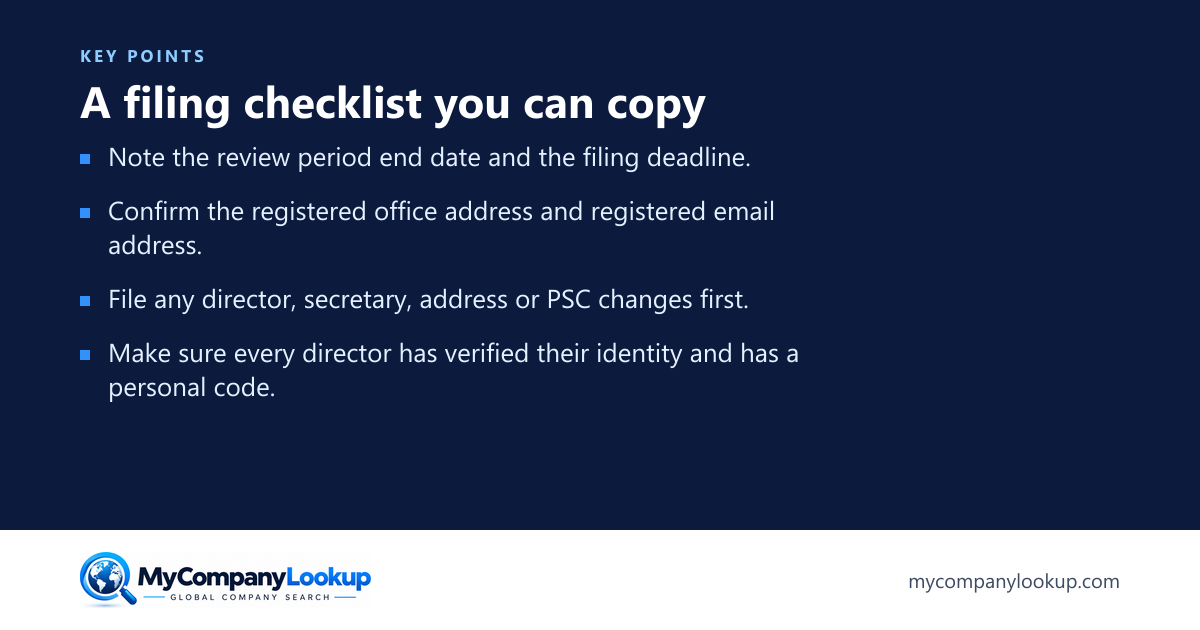
A filing checklist you can copy
Use this checklist each year:
- Note the review period end date and the filing deadline.
- Confirm the registered office address and registered email address.
- File any director, secretary, address or PSC changes first.
- Make sure every director (and PSC) has verified their identity and has a personal code.
- Update the register of members for any share transfers or allotments.
- Review SIC codes.
- Have the authentication code ready.
- File online, pay £50 and keep the acceptance email.
- Diary the next deadline.
Planning ahead for 2027 and 2028
Companies House continues to roll out changes under the Economic Crime and Corporate Transparency Act. Identity verification is the biggest change affecting the confirmation statement, and the transition period means that many companies' first statements after November 2025 are where verification is enforced in practice. Companies House has also signalled further changes to filing methods and to the information companies provide. Keep an eye on our News and Fees page, where we post fee changes and rule changes as they are announced.
The simplest way to stay compliant is to treat the confirmation statement as an annual health check of your company's public record, file it a little early each year, and keep your own registers up to date in between.
Worked example: a company's first two confirmation statements
Seeing the dates laid out makes the rules easier to follow. Take a company incorporated on 20 May 2026.
| Event | Date |
|---|---|
| Incorporation | 20 May 2026 |
| End of first review period | 19 May 2027 |
| Last day to file the first statement | 2 June 2027 |
| Director verification | Must be complete before filing |
| Statement filed (made up to 19 May 2027) | 25 May 2027 |
| Start of next review period | 20 May 2027 |
| End of next review period | 19 May 2028 |
| Last day to file the second statement | 2 June 2028 |
Now suppose the directors decide to file the second statement early, on 1 March 2028, made up to that date. The next review period then starts on 2 March 2028 and ends on 1 March 2029, with a filing deadline of 15 March 2029. Filing early is useful if you want to align the confirmation statement with your accounts work, but remember that every early filing pulls the following deadline forward too.
Which changes need their own form?
The confirmation statement is a snapshot, not a way to change most details. This table shows where each change is made:
| Change | Form | Can it be made on the CS01? |
|---|---|---|
| Appoint a director | AP01 (individual), AP02 (corporate) | No |
| Director resigns or is removed | TM01 | No |
| Change director's details (name, address) | CH01 | No |
| Appoint or remove a company secretary | AP03, TM02 | No |
| Move registered office | AD01 | No |
| New PSC, PSC change or PSC ceases | PSC01 to PSC09 | No |
| New shares issued | SH01 return of allotment | No (statement of capital confirmed on CS01) |
| Shares transferred between shareholders | No separate form | Yes, shareholder changes are reported on the CS01 |
| SIC codes | No separate form | Yes |
| Registered email address | Can be updated separately | Yes |
If several changes are needed, file the separate forms first and wait for them to be accepted before filing the confirmation statement. Otherwise you may confirm out-of-date information.
Confirmation statements for LLPs and dormant companies
Limited liability partnerships also file a confirmation statement every year, using form LL CS01. The principles are the same: a review period, a 14-day filing window, the same fee and confirmation of members, PSCs and the registered office. LLPs have no shares or SIC-code shareholder sections in the same way, but members must verify their identity in the same way directors do.
Dormant companies are not exempt. A company that has never traded must still file a confirmation statement every year, choose SIC code 99999 if appropriate, and pay the £50 fee. If you are keeping a company dormant to protect a name, factor this cost in or consider closing it. Our guide to closing a UK company explains how.
How the public sees your confirmation statement
Once accepted, your confirmation statement becomes part of the company's public filing history. Anyone can download it free of charge. That means:
- Shareholder names and holdings for private companies are visible.
- The date of filing shows whether you are organised or late.
- The next due date is calculated and displayed.
Banks, landlords, investors and customers increasingly check companies before working with them, and an overdue confirmation statement is one of the first things they notice. The PSC register you confirm on the statement also forms part of their ownership checks. Filing on time is a cheap way to look reliable.
Managing confirmation statements for several companies
Accountants, company secretaries and founders with group structures often juggle many review periods. Practical tips:
- Keep a master list of company numbers, review period end dates and authentication codes, stored securely.
- Align dates by filing early once, so that companies in a group fall due in the same month.
- Track director verification per person, since one verified director with one personal code may sit on many boards.
- Use reminders: Companies House offers email reminders, and our company profiles show each due date at a glance.
- Batch your checks: review officers, PSCs and shareholders for all group companies at once.
Our B2B plans suit teams that look up many companies every month, and the Filing Centre lets you order statements for each company and follow them from one account.
Where to find official guidance
The official sources for the rules in this guide are the GOV.UK pages on filing your confirmation statement, people with significant control and identity verification. Companies House updates its guidance as the reforms progress, so check it whenever a filing looks different from last year.
Quick recap
- File a confirmation statement at least every 12 months, within 14 days of the end of the review period.
- The online fee is £50 per review period.
- Directors must verify their identity; have personal codes ready.
- Make director, address and PSC changes on their own forms first.
- Late filing is an offence and can lead to the company being struck off.
Setting up a new company, verifying a director's identity or opening a business bank account? Biz E-Formations Inc. handles company formation, Companies House identity verification and business bank account setup in the UK, USA, Canada and the UAE.
Want it done for you? Order your confirmation statement and track it from your account.
Frequently asked questions
+How much does it cost to file a confirmation statement in 2027?
The Companies House fee for filing online is £50 per review period, following the fee increase on 1 February 2026. Through our Filing Centre the total is £70 service fee plus the £50 government fee.
+When is my confirmation statement due?
Within 14 days after the end of your review period, which is normally 12 months after incorporation or after the made-up date of your last statement. Our company search shows the exact due date.
+Can I file a confirmation statement early?
Yes. Filing early is allowed and starts a new 12-month review period from the made-up date you choose.
+Can I change directors on the confirmation statement?
No. Director appointments and resignations, registered office changes and PSC changes must be filed separately before the confirmation statement.
+What happens if I do not file my confirmation statement?
It is a criminal offence, and Companies House may begin action to strike the company off the register and dissolve it.
+Do directors need to verify their identity before the confirmation statement?
Yes. Under the identity verification rules that started in November 2025, existing directors must verify by the time of the company's next confirmation statement, and the statement asks you to confirm this.