How to Find Who Owns a UK Company in 2027 and 2028: The PSC Register
Directors run a company but they are not always the owners. Learn how to find the real people behind any UK company using the people with significant control register.
MyCompanyLookup Editorial TeamUpdated 18 Sept 2026 13 min read

In this article
- Who owns a UK company? Directors versus owners
- What is the PSC register?
- The five PSC conditions
- How ownership is shown on the register
- When the PSC is a company: following the chain
- Shareholders: the other half of the picture
- Statements instead of PSCs
- How reliable is the PSC register?
- Ownership of UK property by overseas entities
- Practical examples
- Why ownership checks matter
- Keeping your own PSC register right
- Indirect ownership: how the 25% test works through chains
- LLPs and other entities
- A ten-minute ownership check
- Using the PSC register for KYC and anti-money laundering
- Official sources
- Historic ownership: who owned the company before?
- When the owner is a trust
- Common misunderstandings about UK company ownership
- Ownership in other countries
- Summary
"Who owns this company?" is one of the most common questions people ask about a business, and one of the most misunderstood. The people you meet, the directors on the register and the owners of the shares can all be different people. Fortunately, the UK has one of the most open ownership registers in the world. This guide explains how to find out who owns a UK company using the register of people with significant control (PSCs), shareholder lists and other public records, and where the limits of that information lie.
You can follow along on any company using our free UK company search. Each company profile shows its current PSCs with the nature of their control.
Who owns a UK company? Directors versus owners
A limited company is a separate legal person. It is owned by its shareholders (members) and managed by its directors. In many small companies the same person is both, but not always:
- An investor can own most of the shares without being a director.
- A director can manage a company without owning a single share, for example a hired managing director or a professional nominee.
- A parent company can own 100% of a subsidiary, and the people who control the parent are the real owners.
That is why looking only at the directors list is not enough. You need the ownership information, which comes from the PSC register and the shareholder details filed with Companies House.
What is the PSC register?
Since 2016, UK companies and LLPs have had to identify the individuals who ultimately own or control them, record those people in their own PSC register, and report them to Companies House, which publishes them on the central public register. A person with significant control is someone who meets one or more of five conditions.
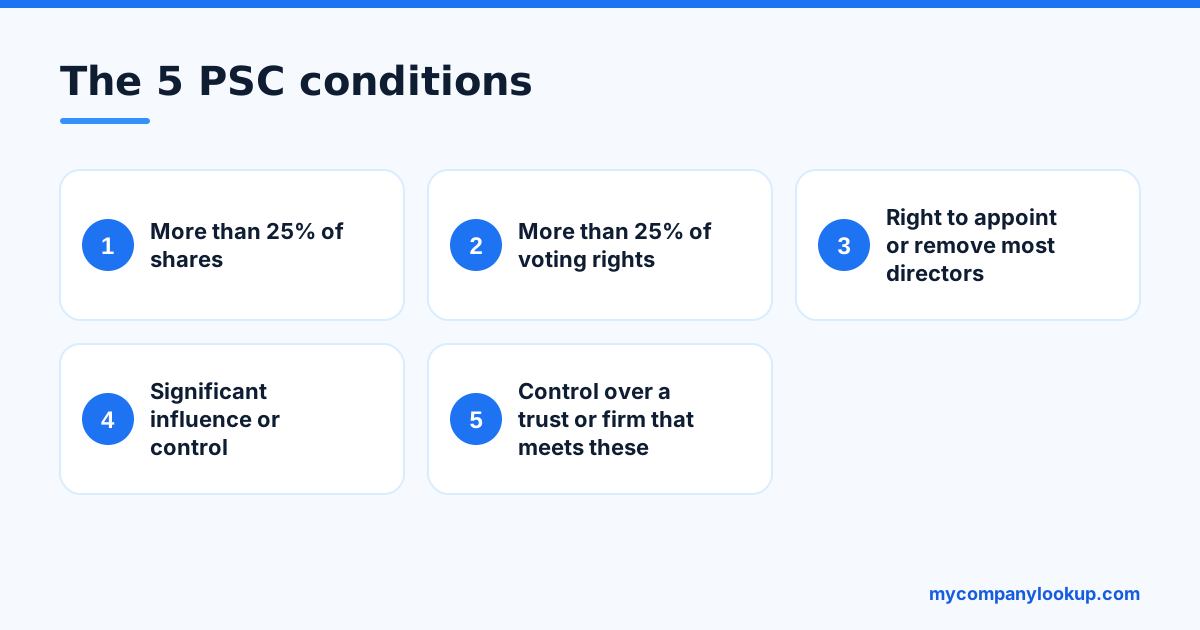
The five PSC conditions
1. More than 25% of the shares
The person holds, directly or indirectly, more than 25% of the company's shares. Exactly 25% does not count; it must be more.
2. More than 25% of the voting rights
The person holds, directly or indirectly, more than 25% of the votes at general meetings. Usually shares and votes go together, but some companies have non-voting shares or shares with extra votes, so the two can differ.
3. The right to appoint or remove a majority of the board
The person can appoint or remove directors who hold a majority of the votes at board meetings. This can come from shares, from a shareholders' agreement or from the articles of association.
4. Significant influence or control
The person has the right to exercise, or actually exercises, significant influence or control over the company, even without meeting the first three conditions. Examples include a founder who has given away most of their shares but still directs how the business is run, or a person whose agreement is needed for major decisions under a contract.
5. Control over a trust or firm
The person has the right to exercise, or actually exercises, significant influence or control over a trust or partnership that itself meets one of the other conditions in relation to the company.
How ownership is shown on the register
Companies House does not publish the exact percentage. It shows bands:
| Nature of control on the register | Meaning |
|---|---|
| Ownership of shares – more than 25% but not more than 50% | Significant minority shareholder |
| Ownership of shares – more than 50% but less than 75% | Majority shareholder |
| Ownership of shares – 75% or more | Controls special resolutions |
| Voting rights – same bands as above | Control of votes |
| Right to appoint and remove directors | Board control |
| Significant influence or control | Control by other means |
The 75% band matters because a 75% majority can pass special resolutions, such as changing the articles or the company name, or putting the company into voluntary liquidation.
For each individual PSC the public register shows their name, month and year of birth, nationality, country of residence, a service address, the date they became a PSC and the nature of their control. The day of birth and residential address are kept private. People at serious risk of violence or intimidation can apply to have their details protected.
When the PSC is a company: following the chain
Sometimes the PSC listed is not a person but a company. The law calls this a relevant legal entity (RLE). An RLE is a company that would be a PSC if it were an individual and that is itself subject to its own disclosure requirements, such as another UK company.
To find the real owners, follow the chain:
- Note the RLE's name and registration number from the PSC entry.
- Search for that company in our company search and open its PSC tab.
- Repeat until you reach individuals.
If the chain leads to a company outside the UK, the trail may continue on a foreign register. Our Global Company Finder links to the official registries in the USA, Canada, the UAE, Singapore and Hong Kong. Some jurisdictions publish beneficial owners; many do not.
Shareholders: the other half of the picture
The PSC register only lists people above the 25% threshold or with other forms of control. To see all shareholders of a private company, look at the filing history:
- The incorporation documents (form IN01 or equivalent) list the first shareholders, called subscribers.
- Each confirmation statement includes shareholder information for non-traded companies, either as a full list or as changes since the last statement. Our confirmation statement guide explains what companies must report.
- A return of allotment (SH01) shows when new shares were issued, though not always to whom.
Combine the PSC entries with the latest full shareholder list for the clearest view.
Statements instead of PSCs
Sometimes a company has no PSC entries but a statement instead. Common statements include:
- "The company knows or has reasonable cause to believe that there is no registrable person or registrable relevant legal entity in relation to the company." For example, a company owned by five unrelated people with 20% each, none of whom controls it.
- "The company has not yet completed taking reasonable steps to find out if there is anyone who is a registrable person." Acceptable for a short time after a change, but a red flag if it has been on the register for years.
- "The company has issued a notice to a person but they have not complied." The company is trying to identify a PSC who will not respond.
A statement that has been on the register for a long time, especially combined with recent changes of directors or registered office, is a reason to dig deeper. Our guide to checking a UK company lists other red flags.
How reliable is the PSC register?
The register has improved considerably, and identity verification will make it more reliable still. Under the Economic Crime and Corporate Transparency Act reforms, PSCs must now verify their identity with Companies House, and Companies House can query and remove information it believes is wrong.
It still has limits:
- Thresholds: someone with exactly 25% or less, and no other control, is not a PSC.
- Nominee arrangements: the law requires the real owner to be registered, not a nominee, but this depends on people telling the truth.
- Timing: companies must update their own register and then notify Companies House, so changes can take a few weeks to appear.
- Overseas structures: ownership through foreign companies or trusts may stop at a jurisdiction that does not publish owners.
For regulated businesses carrying out Know Your Customer checks, the PSC register is a starting point. You must still verify ownership yourself, and you should report discrepancies you find between your own checks and the register where the rules require it.
Ownership of UK property by overseas entities
If your question is "who owns this building?" rather than "who owns this company?", the Register of Overseas Entities may help. Since 2022, overseas companies that own or buy UK land must register with Companies House and disclose their registrable beneficial owners. These entities have identifiers beginning with OE. Land ownership itself is recorded by HM Land Registry in England and Wales, Registers of Scotland and Land and Property Services in Northern Ireland.
Practical examples
Example 1: a simple family company
A company has two directors, a married couple, each holding 50% of the shares. Both appear as PSCs with "ownership of shares – more than 25% but not more than 50%" and the same for voting rights. Straightforward.
Example 2: a startup with investors
A founder holds 40%, an investor holds 35% and employees share 25% through small holdings. The founder and investor are PSCs. The employees are not. If the shareholders' agreement gives the investor the right to appoint a majority of the board, the investor's entry will also show board control.
Example 3: a group subsidiary
An operating company's only PSC is "Example Holdings Limited", which is an RLE. Searching Example Holdings shows its PSCs: two individuals, each with 50%. Those two individuals are the ultimate owners of the operating company.
Example 4: no PSC, five equal owners
Five unrelated people each own 20% and none has any special rights. The company files a statement that it has no registrable person. That is legitimate.
Why ownership checks matter
| Situation | Why ownership matters |
|---|---|
| Signing a large contract | Know who is ultimately responsible |
| Lending or extending credit | Understand who might guarantee or support the company |
| Buying a business | Confirm the seller can actually sell the shares |
| Anti-money laundering checks | Required to identify beneficial owners |
| Avoiding conflicts of interest | Spot when a supplier is owned by an insider |
| Detecting phoenix companies | See the same owners behind failed and new companies |
Keeping your own PSC register right
If you run a company, you must:
- Identify anyone who meets the PSC conditions and take reasonable steps to confirm details.
- Record them in the company's own PSC register, which must be kept up to date.
- Notify Companies House of changes using the PSC forms within the legal time limits (in general, update your own register within 14 days and file with Companies House within a further 14 days).
- Make sure PSCs verify their identity and link their personal code.
- Confirm the position on each confirmation statement.
Failing to keep the register is an offence for the company and its officers. Our Filing Centre handles PSC changes for £30, prepared and submitted by our filing partner Biz E-Formations Inc.
Indirect ownership: how the 25% test works through chains
Ownership is often held through other companies. The PSC rules look through these structures, but with a specific test. A person holds an interest indirectly if they hold a majority stake in a legal entity that itself holds the interest in the company, or are part of a chain of such entities each with a majority stake in the next.
Two examples make this clearer:
- Alex owns 60% of HoldCo, and HoldCo owns 80% of OpCo. Alex has a majority stake in HoldCo, so Alex indirectly holds HoldCo's 80% interest in OpCo. Alex is a PSC of OpCo with "ownership of shares 75% or more". (HoldCo, if it is a UK company, is registered as an RLE, and Alex appears on HoldCo's own PSC register.)
- Sam owns 40% of HoldCo, and HoldCo owns 80% of OpCo. Sam does not have a majority stake in HoldCo, so Sam does not indirectly hold HoldCo's interest in OpCo through the shareholding test. Sam may still be a PSC of OpCo through another condition, such as significant influence or control, and is likely to be a PSC of HoldCo.
This is why you should never multiply percentages through a chain to decide who is a PSC. The law uses the majority-stake test instead.
Joint interests and arrangements
Two or more people who hold shares jointly, or who have an arrangement to exercise their rights together, are each treated as holding the combined interest. Three siblings who each hold 10% but have agreed always to vote together may each be treated as holding 30%, making each of them a PSC. Similarly, a person who has an agreement with a nominee shareholder is treated as holding the nominee's shares.
LLPs and other entities
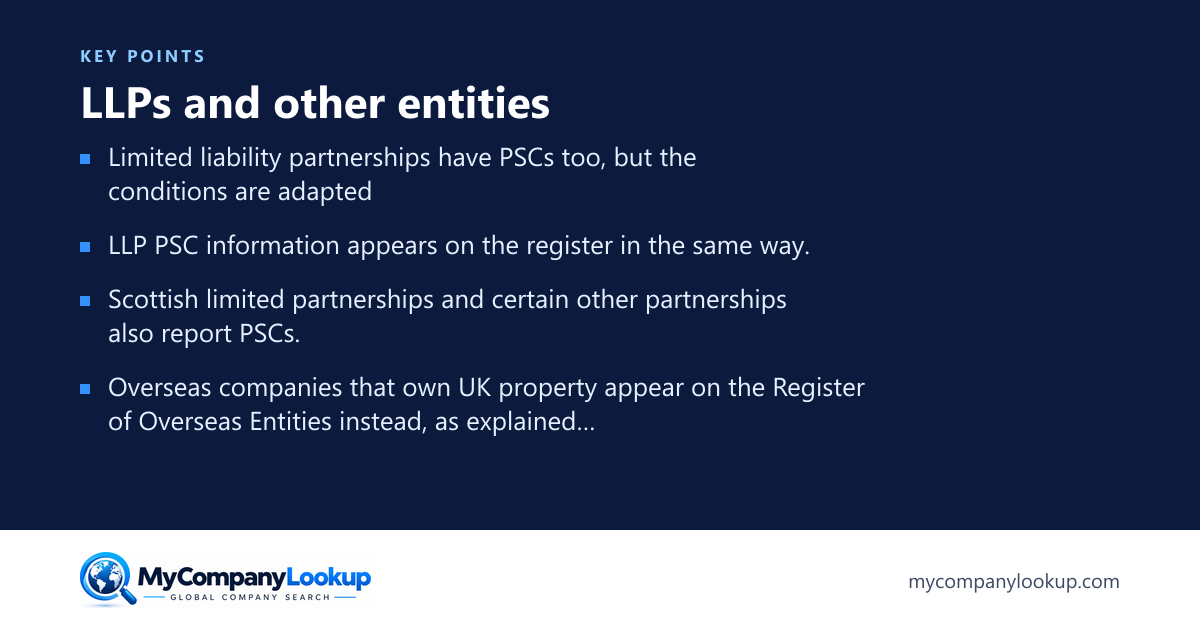
Limited liability partnerships have PSCs too, but the conditions are adapted: rights to more than 25% of surplus assets on a winding up, more than 25% of voting rights, the right to appoint or remove a majority of the management, or significant influence or control. LLP PSC information appears on the register in the same way.
Scottish limited partnerships and certain other partnerships also report PSCs. Overseas companies that own UK property appear on the Register of Overseas Entities instead, as explained above.
A ten-minute ownership check
When you need to know who is behind a UK company, work through these steps:
- Search the company by name or number in our company search and confirm it is the right one.
- Open the PSC section and note each PSC, the nature of their control and the date they became a PSC.
- Follow any corporate PSC (RLE) to its own record until you reach individuals.
- Check for statements instead of PSCs and how long they have been there.
- Open the latest confirmation statement in the filing history for the full shareholder list.
- Compare directors with owners. If neither group includes the people you are dealing with, ask why.
- Click the PSCs' names to see other companies they control. A pattern of short-lived companies can be telling.
- Note the date of your check and keep a copy for your records.
Using the PSC register for KYC and anti-money laundering
Businesses regulated under the Money Laundering Regulations, including accountants, lawyers, estate agents and financial firms, must identify and verify the beneficial owners of corporate customers. The PSC register is the natural starting point, and since the reforms it is more reliable, but it is not enough on its own:
- Collect proof of registration from the register for the customer and any RLEs.
- Ask the customer to confirm its ownership structure, ideally with a structure chart.
- Verify the identity of beneficial owners to your own standard.
- Investigate differences between what the customer tells you and what the register says, and report discrepancies to Companies House where the rules require it.
- Keep records of each step.
For businesses with many customers, a B2B plan makes regular ownership checks practical.
Official sources
The legal framework is set out in GOV.UK's guidance on people with significant control. You can view any company's PSCs on the government's Find and update company information service or on our company profiles. For property owned by overseas entities, see registering an overseas entity, and for land ownership in England and Wales, HM Land Registry.
Historic ownership: who owned the company before?
The PSC section shows ceased PSCs as well as current ones, with the date they stopped being a PSC. Together with old confirmation statements, this lets you build a timeline of ownership. That can be important when:
- A business claims a long history under the same owners.
- You are investigating whether a new company is a continuation of a failed one.
- You are buying a company and need to understand past transfers.
Download confirmation statements from several years to compare shareholder lists over time.
When the owner is a trust
If shares are held by trustees, the PSC entries may show the trustees, and individuals with significant influence or control over the trust may also be registered under the fifth condition. Trust arrangements can be complex, and the register will not show the terms of the trust. For regulated due diligence, ask for details of the trust and verify them directly.
Common misunderstandings about UK company ownership
"The director owns the company." Not necessarily. Directors are appointed to manage; ownership is about shares. Always check both lists.
"No PSC means nobody owns it." No. A company always has shareholders. A missing PSC simply means nobody crosses the 25% threshold or otherwise controls it, or that the company has not yet identified one.
"The PSC register shows everyone with an interest." It shows only people above the threshold or with control. A 20% investor will not appear on the PSC register, though they will appear in the shareholder list on the confirmation statement.
"Information on the register has been checked." Historically it was largely self-reported. Identity verification now confirms that PSCs are real people, but the accuracy of what companies report about control still depends on the company. If you find an error, it can be reported.
"Ownership information is the same in every country." It is not. The UK is unusually open, as the next section shows.
Ownership in other countries
Ownership transparency varies widely:
- United States: most states do not publish owners of LLCs. The federal beneficial ownership reporting regime under the Corporate Transparency Act was narrowed in 2025 so that US-formed companies are exempt. See our US LLC guide for non-residents.
- UAE: companies must keep and file ultimate beneficial owner information with their licensing authority, but it is not generally public. See our UAE company lookup guide.
- Singapore: companies keep a register of registrable controllers, which is filed with ACRA but not public.
- Hong Kong: companies keep a significant controllers register available to law enforcement, not the general public. See our Singapore and Hong Kong guide.
Summary
- Directors manage a company; shareholders own it.
- The PSC register shows anyone with more than 25% of shares or votes, board control, or significant influence or control.
- Ownership is shown in bands, not exact percentages.
- Follow corporate PSCs (RLEs) up the chain to find individuals.
- Check confirmation statements for the full shareholder list.
- Treat long-running "not yet completed reasonable steps" statements as a red flag.
Setting up a new company, verifying a director's identity or opening a business bank account? Biz E-Formations Inc. handles company formation, Companies House identity verification and business bank account setup in the UK, USA, Canada and the UAE.
Find the owners of any UK company now with our free company search.
Frequently asked questions
+How can I find out who owns a UK company?
Search the company on the Companies House register or MyCompanyLookup and open the people with significant control section. For a full list of shareholders, check the latest confirmation statement and incorporation documents in the filing history.
+What is a person with significant control?
Someone who holds more than 25% of the shares or voting rights, can appoint or remove a majority of the board, or has significant influence or control over the company or over a trust or firm that does.
+Does the PSC register show exact shareholdings?
No. It shows bands: more than 25% up to 50%, more than 50% to less than 75%, and 75% or more.
+Why does a company have no PSC?
Ownership may be spread so that nobody holds more than 25% or has control, in which case the company files a statement saying it has no registrable person.
+Can I see a PSC's home address?
No. The public register shows a service address and the month and year of birth. Residential addresses and full dates of birth are kept private.
+What if the PSC is another company?
That company is a relevant legal entity. Search it and look at its own PSC register, repeating until you reach individuals.