How to Search Companies in Singapore and Hong Kong in 2027 and 2028
Singapore and Hong Kong both have official company registers, but they work differently from the UK. Learn how to search them, which reports to buy and what to check.
MyCompanyLookup Editorial TeamUpdated 5 Oct 2026 13 min read
In this article
- Part 1: How to search Singapore companies
- Part 2: Hong Kong
- Searching by person rather than company
- Groups spanning Singapore, Hong Kong and the UK
- Singapore and Hong Kong for your own company
- When to use a professional
- Language and names
- How long do searches take and what do they cost?
- Singapore and Hong Kong compared
- Common status descriptions and what they mean
- Unincorporated businesses: not every business is a company
- Worked example: verifying a Singapore supplier
- Worked example: verifying a Hong Kong trading company
- Cross-checking with other sources
- Red flags for Singapore and Hong Kong companies
- Step-by-step: a 15-minute check for either country
- Checking companies in other countries
- Summary
Singapore and Hong Kong are Asia's two leading business hubs, and both have official, government-run company registers. If you are about to sign a contract with, invoice, or invest in a company from either place, a quick check on the official register is the fastest way to confirm it exists and is in good standing. This guide explains how to carry out a Singapore company search through ACRA and a Hong Kong company search through the Companies Registry, what is free, what you have to pay for and what the results tell you. This guide explains how to search Singapore and Hong Kong companies on their official registers.
You can reach both registries directly from our Singapore Company Finder and Hong Kong Company Finder. Type the company name once and we copy it so you can paste it into the official search.
Part 1: How to search Singapore companies
Who keeps the register?
Singapore companies, limited liability partnerships and business names are registered with the Accounting and Corporate Regulatory Authority (ACRA). ACRA's online service is Bizfile, available at bizfile.gov.sg. Every registered entity has a Unique Entity Number (UEN), Singapore's equivalent of a company number. Government agencies use the UEN to identify businesses, and it should appear on invoices and official documents.
Common Singapore entity types
| Entity | Suffix | Notes |
|---|---|---|
| Private limited company | Pte. Ltd. | Most common for businesses; up to 50 shareholders |
| Public company | Ltd. | Can have more shareholders; may be listed |
| Limited liability partnership | LLP | Partners have limited liability |
| Sole proprietorship | None | Business name registered to an individual |
| Partnership | None | Two or more partners, unlimited liability |
| Foreign company branch | Varies | Registered branch of an overseas company |
Free searches
There are two quick free checks:
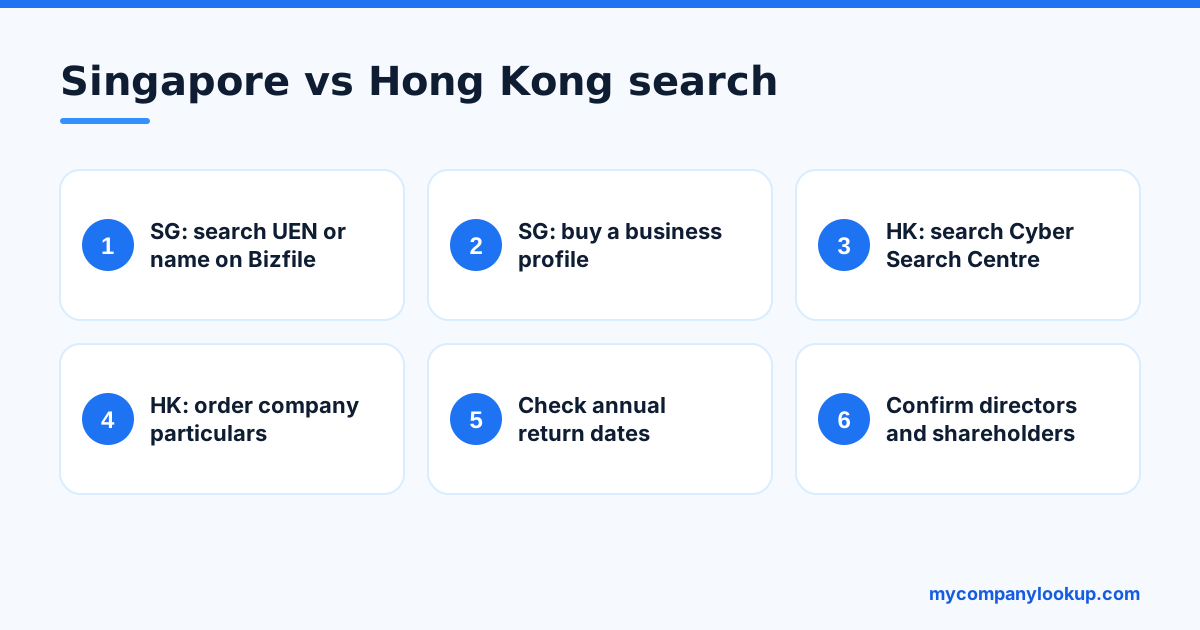
- Bizfile search: search by entity name or UEN to see basic information such as the registered name, UEN and entity status.
- UEN search: the government's UEN portal at uen.gov.sg lets you confirm that a UEN is valid and see the entity's name and status.
These checks confirm that a business exists. They do not show directors, shareholders or financial details.
Paid reports: the business profile
For more detail you can buy a business profile (also called a company information report) through Bizfile for a small fee. A business profile for a company typically includes:
- Registered name, UEN and former names.
- Incorporation date and entity status.
- Registered office address.
- Principal activities (SSIC codes).
- Share capital.
- Officers, including directors and company secretary.
- Shareholders and their shareholdings for private companies.
- Dates of the last annual general meeting and annual return, where applicable.
ACRA also sells copies of specific documents and, for some companies, financial statements filed with the annual return. Fees are shown on Bizfile at the point of purchase.
What to check in a Singapore business profile
- Status: "Live" means the company is registered and active. Statuses such as "Struck Off", "Dissolved", "In Liquidation" or "Gazetted to be Struck Off" are warnings.
- Age: compare the incorporation date with what the company told you about its history.
- Directors: every Singapore company must have at least one director who is ordinarily resident in Singapore. If the only local director is a nominee provided by a corporate service firm, that is legal and common, but it means the real decision-makers are elsewhere.
- Shareholders: confirm who owns the company. Ultimate beneficial owners are recorded in a register of registrable controllers, which companies must maintain and lodge with ACRA, but it is not public.
- Annual return: most non-listed companies must file an annual return with ACRA within seven months after the end of their financial year. Overdue annual returns can indicate poor compliance.
- Activities: the SSIC codes should broadly match the business you are dealing with.
Singapore compliance at a glance
| Requirement | Detail |
|---|---|
| Local director | At least one ordinarily resident director |
| Company secretary | Appointed within six months of incorporation |
| Annual return | Filed with ACRA within seven months after financial year end (non-listed companies) |
| Annual general meeting | Within six months after financial year end, unless the private company dispenses with it |
| Corporate income tax | Headline rate 17%, with partial exemptions; administered by IRAS |
| Registers | Members, directors, controllers and nominee directors maintained by the company |
For tax matters, the Inland Revenue Authority of Singapore at iras.gov.sg is the authority. GST-registered businesses can be checked using IRAS's GST registration search.
Setting up in Singapore
Singapore private limited companies are popular for regional headquarters and holding companies. You can see indicative setup costs on our Singapore fees page, including nominee director and accounting services through Biz E-Formations Inc. for founders who do not live in Singapore.
Part 2: Hong Kong
Who keeps the register?
Hong Kong companies are registered with the Companies Registry (cr.gov.hk). Searches are carried out through the Registry's e-Services Portal, which includes the Cyber Search Centre at e-services.cr.gov.hk. Each company has a Company Registration (CR) number. Businesses also register with the Inland Revenue Department's Business Registration Office and receive a Business Registration number; the first eight digits form the company's Unique Business Identifier.
Free search: the company name index
The Cyber Search Centre offers a free search of the company name index. It lets you confirm the company's registered English and Chinese names, CR number, company type, date of incorporation and current status (for example "Live", "Dissolved" or "Deregistered").
Paid searches: company particulars and documents
For more detail you can purchase:
- Company Particulars Report (sometimes called the Cyber Search Centre company particulars): current registered office, directors, company secretary, share capital and recent filings.
- Images of documents filed with the Registry, such as the annual return (form NAR1), which lists shareholders for private companies, and incorporation forms.
- Directors index searches, to find the companies a director is associated with.
Fees are charged per item and displayed before you pay.
Privacy changes you should know about
Hong Kong introduced a new inspection regime in phases from 2022 to 2023. Under it, the usual residential addresses of directors and the full identification numbers of directors and company secretaries are protected from general public inspection. Searchers see a correspondence address and a partial identification number instead. Specified persons, such as certain professionals and authorities, can apply for access to protected information. This means a Hong Kong search will confirm who the directors are, but not where they live.
What to check in a Hong Kong company search
- Status: "Live" is what you want. "Dissolved" or "Deregistered" means the company no longer exists.
- Annual return: private companies must deliver an annual return within 42 days after the anniversary of incorporation. A long gap since the last return is a warning sign.
- Directors and secretary: every private company must have at least one director who is a natural person and a company secretary who is either a Hong Kong resident individual or a Hong Kong company.
- Shareholders: shown in the annual return for private companies.
- Business Registration: the company should hold a valid Business Registration Certificate, renewed annually or every three years. Ask to see it.
- Significant controllers: Hong Kong companies keep a significant controllers register at their registered office. It is available to law enforcement officers on demand but is not public.
Hong Kong compliance at a glance
| Requirement | Detail |
|---|---|
| Directors | At least one natural person director |
| Company secretary | Hong Kong resident individual or Hong Kong company |
| Registered office | Physical address in Hong Kong |
| Annual return | NAR1 within 42 days after the incorporation anniversary (private companies) |
| Business Registration | Renewed every one or three years with the IRD |
| Profits tax | Two-tier rates: 8.25% on the first HK$2 million of assessable profits and 16.5% on the remainder for corporations |
| Significant controllers register | Kept at the registered office, not public |
Tax is administered by the Inland Revenue Department.
Setting up in Hong Kong
Biz E-Formations Inc. offers an all-in-one Hong Kong company formation package of HKD 8,840 including HKD 3,790 government fees, shown on our Hong Kong fees page.
Searching by person rather than company
Sometimes you know a person's name and want to know which companies they are involved with.
- Singapore: ACRA offers people-related searches through Bizfile for a fee, showing the entities a person is associated with as an officer or shareholder, subject to the information ACRA makes available.
- Hong Kong: the Companies Registry offers a directors index search, which lists the companies where a person is recorded as a director. Because of the new inspection regime, identification numbers are partly masked, so be careful with common names.
These searches are useful for due diligence on business partners, but always confirm you have the right person by matching other details.
Groups spanning Singapore, Hong Kong and the UK
Many Asian groups use a Singapore or Hong Kong holding company with subsidiaries in other countries, including the UK. If you are checking a UK company whose person with significant control is a Singapore or Hong Kong company, follow the chain:
- Note the corporate PSC's name and registration details on the UK register.
- Search the Singapore or Hong Kong register for that company and confirm it is live.
- Buy the business profile or company particulars to see its directors and shareholders.
- If the shareholders are themselves companies, continue up the chain.
The UK register is free and detailed; the Asian registers charge for detail and do not publish beneficial owners. Budget a little for reports when you investigate cross-border structures.
Singapore and Hong Kong for your own company
Both jurisdictions are popular for international founders:
- Singapore suits businesses targeting Southeast Asia, with a strong treaty network and a stable regulatory environment. A local resident director is required, which non-resident founders usually meet through a nominee director service.
- Hong Kong suits businesses trading with mainland China and wider Asia, with a territorial tax system and simple company administration. A local company secretary and registered office are required.
Both require annual filings and proper bookkeeping, and both expect real substance for tax purposes. Formation packages for each are listed on our News and Fees page, and Biz E-Formations Inc. can advise on which suits your plans.
When to use a professional
For routine supplier checks, the official searches in this guide are enough. For acquisitions, large investments, regulated onboarding or disputes, use a local corporate service provider or law firm. They can obtain certified documents, check court records and interpret local filings far more reliably than an overseas buyer working alone.
Language and names
Hong Kong companies can register an English name, a Chinese name or both, and searches can be made in either. If you only know the Chinese name, search the name index in Chinese characters. Singapore names are registered in English, though a business may use translated names in marketing. Always rely on the exact registered name and number, not a brand name, when you pay or sign.
How long do searches take and what do they cost?
Free searches on Bizfile, the UEN portal and the Hong Kong company name index return results immediately. Paid Singapore business profiles and Hong Kong company particulars are usually available instantly online after payment, by card. Document images in Hong Kong are typically available for download straight away for electronically held records. Fees are modest per item and are shown before you pay, so a thorough check of one company rarely costs more than a few report fees.
Keep the downloaded reports with the date of purchase. Registers change, and a report proves what the record showed when you relied on it.
Singapore and Hong Kong compared
| Singapore | Hong Kong | |
|---|---|---|
| Registry | ACRA (Bizfile) | Companies Registry (e-Services Portal) |
| Company identifier | UEN | CR number (plus BR number and UBI) |
| Free search | Name or UEN, basic status | Company name index, basic status |
| Directors visible | Yes, in paid business profile | Yes, in paid particulars (addresses and ID numbers partly protected) |
| Shareholders visible | Yes, for private companies in business profile | Yes, in annual return images |
| Beneficial owners | Register of registrable controllers, lodged with ACRA, not public | Significant controllers register, not public |
| Annual filing | Annual return within 7 months after year end | Annual return within 42 days after anniversary |
| Local presence | At least one resident director | Company secretary resident in Hong Kong; local registered office |
| Corporate tax | 17% headline | 8.25% / 16.5% two-tier |
Common status descriptions and what they mean
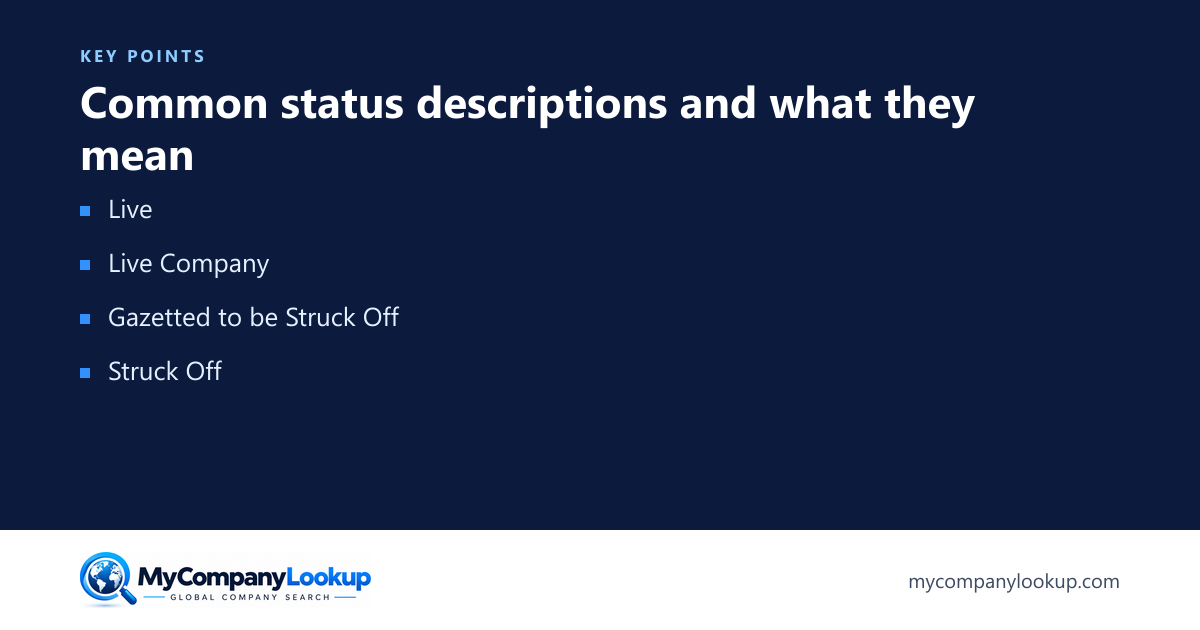
| Status you might see | Country | Meaning |
|---|---|---|
| Live | Singapore | Registered and active |
| Live Company | Singapore | Registered and active (wording varies by report) |
| Gazetted to be Struck Off | Singapore | ACRA has published a notice and intends to strike the company off |
| Struck Off | Singapore | Removed from the register; no longer exists |
| In Liquidation / Dissolved | Singapore | Being or has been wound up |
| Live | Hong Kong | Registered and active |
| Dissolved | Hong Kong | Wound up or struck off and no longer exists |
| Deregistered | Hong Kong | Removed from the register on the company's own application |
| Amalgamated | Hong Kong | Merged into another company |
If the status is anything other than live, do not proceed until you understand why.
Unincorporated businesses: not every business is a company
In both places, a trading name is not necessarily a company:
- In Singapore, sole proprietorships and partnerships are registered with ACRA and have a UEN, but they are not companies and the owners are personally liable. A business profile shows the owner or partners.
- In Hong Kong, sole proprietorships and partnerships register with the Inland Revenue Department's Business Registration Office rather than the Companies Registry, so they will not appear in a Companies Registry search. Ask for the Business Registration Certificate instead.
If a business without "Pte. Ltd." or "Limited" in its name asks you to pay a large deposit, check what kind of entity it is and who stands behind it.
Worked example: verifying a Singapore supplier
A buyer in the UK is about to pay a 30% deposit to "Example Components Pte. Ltd." in Singapore.
- The buyer asks for the UEN, which is printed on the invoice, and checks it on the UEN portal. The name matches and the entity is live.
- A business profile from Bizfile shows the company was incorporated nine years ago, has two directors (one resident in Singapore), and its shareholders are two individuals.
- The latest annual return was filed four months ago, within the deadline.
- The principal activity code relates to wholesale of electronic components, matching the goods.
- The bank details on the invoice show an account in the company's exact name at a Singapore bank.
Everything is consistent, so the buyer proceeds, keeping the business profile on file.
Worked example: verifying a Hong Kong trading company
A UK online seller is approached by "Example Trading Limited", which claims to be a Hong Kong supplier with ten years of history.
- A free search of the company name index shows the company exists, but its date of incorporation was only eight months ago.
- The company particulars show a single director and a corporate company secretary at a business centre address.
- No annual return has yet been filed, which is consistent with a company less than a year old.
- The bank details provided are for a personal account in a different name.
The age mismatch and personal bank account are both red flags. The seller asks for an explanation and, when none is given, declines the deal.
Cross-checking with other sources
The official registers are the primary source, but for a broader view you can also:
- Use the cross-check option on our Company Finder, which searches OpenCorporates for the same name in the relevant jurisdiction.
- Search trade references and customer reviews for the exact registered name.
- For Singapore GST-registered businesses, confirm GST registration through IRAS.
- For larger deals, order a credit report from a commercial provider covering the jurisdiction.
Red flags for Singapore and Hong Kong companies
- The UEN or CR number on the invoice does not match the registered name.
- The company is recently incorporated but claims many years of history.
- Status is anything other than live, or there is a pending strike-off.
- Annual returns are overdue by many months.
- The registered office is a mass-registration address and nobody can explain where the business actually operates. Corporate service addresses are normal in both places, but the business should still be able to show real operations.
- The bank account name differs from the registered company name.
- Directors are nominees only, and the person you are dealing with does not appear anywhere on the record and cannot explain their role.
Step-by-step: a 15-minute check for either country
- Ask for the company's full registered name and registration number (UEN or CR number).
- Run the free search to confirm the name, number and live status.
- Buy the business profile (Singapore) or company particulars (Hong Kong) if the deal is significant.
- Compare directors and shareholders with the people you are dealing with.
- Check the date of the last annual return.
- Confirm the bank account is in the company's name.
- For tax invoices, verify GST registration (Singapore) where GST is charged.
- Keep a copy of what you found with the date of your search.
Checking companies in other countries
If the company you are checking is part of a group with entities elsewhere, follow the chain on each register. Our Global Company Finder links to the official registries for the UK (with live Companies House data), every US state, all Canadian provinces and the UAE mainland and free zones. For UK companies, our guide to checking a UK company explains how to read directors, owners and filings, and our PSC register guide explains UK ownership disclosure, which is far more open than in Asia.
Summary
- Singapore companies are registered with ACRA; search by name or UEN on Bizfile or the UEN portal, and buy a business profile for directors and shareholders.
- Hong Kong companies are registered with the Companies Registry; search the free name index and buy company particulars and annual return images for detail.
- Neither country publishes beneficial owners publicly.
- Check status, annual return dates, directors, shareholders and bank account names.
- Use our Company Finder to reach both official registries in one click.
Frequently asked questions
+How do I search for a company in Singapore?
Use ACRA's Bizfile service to search by company name or UEN. Basic details are free, and a paid business profile shows directors, shareholders, share capital and filing dates.
+What is a UEN in Singapore?
The Unique Entity Number is the standard identification number for entities registered in Singapore. You can check it on the UEN portal or Bizfile.
+How do I search for a company in Hong Kong?
Use the Companies Registry's e-Services Portal (Cyber Search Centre). The company name index search is free; company particulars and document images are paid.
+Can I see directors' home addresses in Hong Kong?
No. Under the new inspection regime, directors' usual residential addresses and full identification numbers are protected from general public inspection.
+Are beneficial owners public in Singapore or Hong Kong?
No. Singapore companies lodge their register of registrable controllers with ACRA and Hong Kong companies keep a significant controllers register, but neither is open to the general public.
+When must a Hong Kong company file its annual return?
A private company must deliver its annual return within 42 days after the anniversary of its incorporation.