How to Look Up a UAE Company in 2027 and 2028: Mainland vs Free Zone
The UAE has no single public company register. Learn how to verify a mainland or free zone company by its trade licence, the right licensing authority and official portals.
MyCompanyLookup Editorial TeamUpdated 26 Sept 2026 13 min read
In this article
- Mainland, free zone and offshore: the three types of UAE company
- Step 1: Ask for the trade licence
- Step 2: Identify the licensing authority
- Step 3: Look up a UAE company on the official portal
- Step 4: Check the licence details match
- Step 5: Check tax registration
- Free zones by emirate
- What you cannot usually see
- Red flags for UAE companies
- Understanding UAE legal forms on a licence
- Licence renewals and why expiry dates matter
- Due diligence for larger transactions
- Comparing mainland and free zone for your own company
- Worked example: checking a Dubai supplier
- Worked example: a free zone consultant
- Keeping evidence of your checks
- Questions to ask a UAE company
- How other countries compare
- A UAE company verification checklist
- Summary
Checking a company in the United Arab Emirates works very differently from checking one in the UK. There is no single public register where you type a name and see directors, shareholders and accounts. Instead, every UAE business is licensed by one of many authorities: the economic department of the emirate for mainland companies, or the authority of one of more than forty free zones. A reliable UAE company lookup therefore starts with one question: who issued this company's licence? This guide explains how to look up a UAE company step by step, whether it is licensed on the mainland, in a free zone or offshore.
This guide explains the difference between mainland and free zone companies, how to find the right licensing authority, which official portals you can search, what information you can expect to see and how to spot a fake trade licence. Our UAE Company Finder links to the National Economic Register, all seven emirates' economic departments and every major free zone in one place.
Mainland, free zone and offshore: the three types of UAE company
| Type | Licensed by | Can trade in the UAE market? | Public information |
|---|---|---|---|
| Mainland (onshore) | Emirate economic department, for example Dubai's Department of Economy and Tourism | Yes, across the UAE | Licence details through emirate portals and the National Economic Register |
| Free zone | The free zone authority, for example DMCC, JAFZA, IFZA, RAKEZ | Mainly within the free zone and internationally; mainland trade usually through a distributor or permit | Varies by zone; DIFC and ADGM have searchable public registers |
| Offshore | Offshore registries such as RAK ICC or JAFZA Offshore | No local trading or office | Very limited |
Mainland companies
Mainland companies are licensed by the economic department of the emirate where they operate: the Department of Economy and Tourism (DET) in Dubai, the Abu Dhabi Department of Economic Development (ADDED), the Sharjah Economic Development Department (SEDD) and the equivalent departments in Ajman, Umm Al Quwain, Ras Al Khaimah and Fujairah. Since 2021, most mainland activities can be 100% foreign-owned, which has made mainland setup much more popular with international founders.
Free zone companies
Free zones are economic zones with their own authority, rules and registry. Each one licenses companies for specific activities. Free zone companies typically offer full foreign ownership, simple setup and, if they meet the conditions, a 0% corporate tax rate on qualifying income. The best-known include DMCC, JAFZA and DAFZ in Dubai, IFZA, Meydan, the TECOM business parks (such as Dubai Internet City and Dubai Media City), ADGM and KEZAD in Abu Dhabi, SHAMS and SAIF Zone in Sharjah, Ajman Free Zone, UAQ Free Trade Zone, RAKEZ and the Fujairah free zones.
Financial free zones: DIFC and ADGM
The Dubai International Financial Centre (DIFC) and Abu Dhabi Global Market (ADGM) are special. They have their own common-law-based legal systems, courts and companies registries, and both publish searchable public registers. If a company claims to be in DIFC or ADGM, you can verify it directly on the DIFC public register or ADGM public registers.
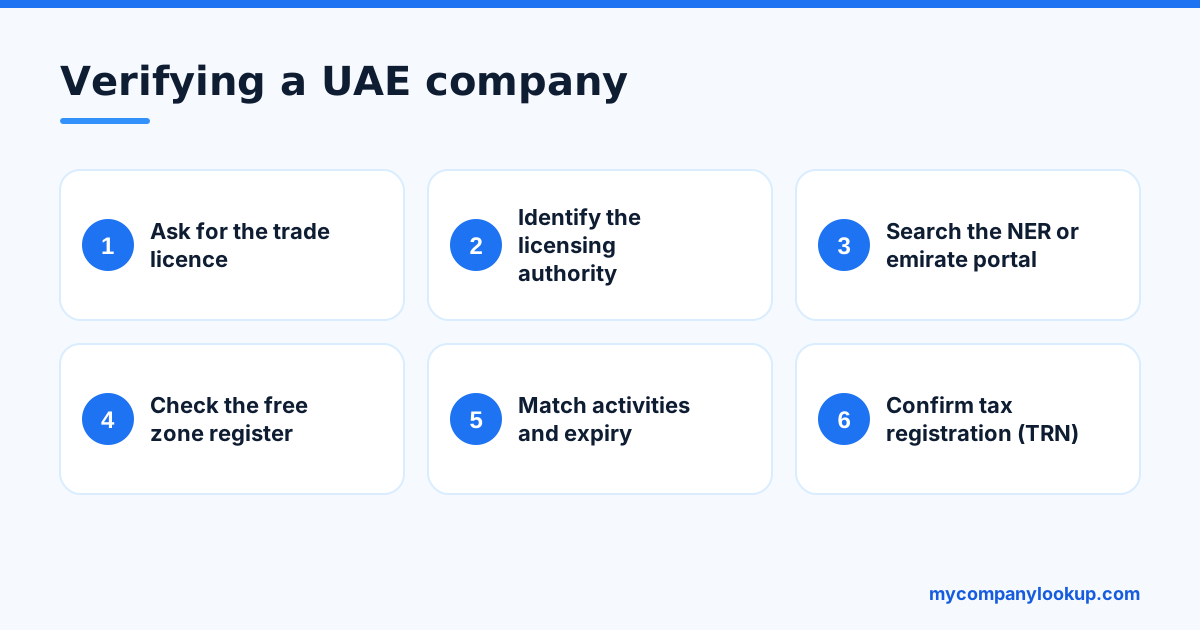
Step 1: Ask for the trade licence
Every legitimate UAE business has a trade licence (also called a commercial licence or business licence). It is the starting point for any check. Ask for a copy and note:
- Licence number.
- Licensing authority: the logo and name at the top tell you whether it is DET, ADDED, a free zone and so on.
- Legal name in English and Arabic.
- Legal form: for example LLC, sole establishment, FZE, FZ-LLC or branch.
- Licensed activities: the business is only allowed to carry out the activities listed.
- Issue and expiry dates: licences are renewed every year.
- Manager and partners or shareholders, shown on many licences.
A business that will not share its licence, or shares one with a name that does not match its invoices and bank account, should not be trusted.
Step 2: Identify the licensing authority
The licence tells you which authority to check. Common abbreviations:
- FZE / FZCO / FZ-LLC: a free zone entity. The specific zone is shown on the licence.
- LLC (without FZ): usually a mainland limited liability company.
- Establishment or sole proprietorship: a mainland or free zone single-owner business.
- Branch: a branch of a UAE or foreign company.
If the licence comes from a free zone you do not recognise, our UAE Company Finder lists the official website of each free zone authority by emirate.
Step 3: Look up a UAE company on the official portal
The National Economic Register (NER)
The UAE Ministry of Economy and Tourism runs the National Economic Register, a federal platform that brings together licence data from the economic departments of all seven emirates. It is the best single place to start for a mainland company. Search by name or licence number to confirm that the licence exists and is active. Access it through growth.gov.ae or via the official UAE government portal u.ae.
Emirate economic departments
Each emirate offers its own licence and trade-name enquiry services:
- Dubai: the Department of Economy and Tourism provides trade name and licence search services through its website and the Invest in Dubai platform.
- Abu Dhabi: ADDED and the TAMM government services platform provide licence searches.
- Sharjah, Ajman, Umm Al Quwain, Ras Al Khaimah and Fujairah: each economic department offers trade name and licence enquiries, some through apps.
Free zone verification
Free zones vary. DIFC and ADGM publish full public registers. Many other zones provide a licence verification service on request, a QR code on the licence that links to a verification page, or a company directory. If you cannot verify online, email the free zone authority with the licence number and ask them to confirm it.
Step 4: Check the licence details match
When you find the record, compare it with what you were given:
| Check | What to compare |
|---|---|
| Name | Exact legal name, including legal form |
| Licence number | Matches the document |
| Status | Active, not expired, suspended or cancelled |
| Activities | Includes the service or goods you are buying |
| Expiry date | Licence is current |
| Location | Address within the authority's jurisdiction |
A frequent issue is activity mismatch. A consultancy licence does not permit general trading, and an e-commerce licence does not cover construction. Dealing with a company outside its licensed activities creates risk for you too, for example if goods cannot be imported in its name.
Step 5: Check tax registration
The UAE introduced federal corporate tax for financial years starting on or after 1 June 2023. The standard rate is 9% on taxable income above AED 375,000, with 0% below that threshold, and qualifying free zone persons can benefit from 0% on qualifying income. Businesses must register with the Federal Tax Authority, regardless of whether tax is payable.
VAT at 5% applies to most supplies. Businesses with taxable supplies above AED 375,000 a year must register, and those above AED 187,500 may register voluntarily. A VAT-registered business has a Tax Registration Number (TRN) shown on its tax invoices. You can verify a TRN on the Federal Tax Authority website. An invoice charging 5% VAT without a valid TRN is a warning sign.
Free zones by emirate
There are more than forty free zones across the UAE. The ones you are most likely to meet on a licence are:
| Emirate | Major free zones |
|---|---|
| Dubai | DIFC, DMCC, JAFZA, Dubai Airport Free Zone (DAFZ), Dubai Silicon Oasis, IFZA, Meydan Free Zone, DWTC Free Zone, Dubai South, Dubai Healthcare City, Dubai CommerCity, International Humanitarian City and the TECOM business parks (Dubai Internet City, Dubai Media City, Dubai Knowledge Park, Dubai Studio City, Dubai Production City, Dubai Science Park, Dubai Design District, Dubai Outsource City, Dubai Industrial City) |
| Abu Dhabi | ADGM, KEZAD (Khalifa Economic Zones), Masdar City Free Zone, twofour54, Abu Dhabi Airports Free Zone |
| Sharjah | SAIF Zone, Hamriyah Free Zone, SHAMS (Sharjah Media City), SPC Free Zone (Sharjah Publishing City), Sharjah Research, Technology and Innovation Park |
| Ajman | Ajman Free Zone, Ajman Media City Free Zone |
| Umm Al Quwain | UAQ Free Trade Zone |
| Ras Al Khaimah | RAKEZ, RAK ICC (offshore and international companies) |
| Fujairah | Fujairah Free Zone, Fujairah Creative City |
Each free zone authority keeps its own register and has its own process for verifying licences. Our UAE Company Finder groups them by emirate and links to each authority's official website, so you can go straight to the right place once you know which zone issued the licence.
Note that a company's licence may come from a free zone in one emirate while its staff work from a business centre in another. That is common and legal for many activities, but the address on invoices should still be consistent with the licence.
What you cannot usually see
UAE public information is more limited than in the UK:
- Accounts: UAE companies do not generally publish financial statements on a public register. Some free zones require audited accounts to be filed with the authority, but they are not public.
- Beneficial owners: UAE companies must keep and file ultimate beneficial owner information with their licensing authority, but it is not open to the public.
- Court cases: there is no single public search for litigation.
For deeper due diligence, businesses use credit reports from licensed agencies, bank references and, for larger transactions, professional investigators.
Red flags for UAE companies
- The licence is expired, or the business says renewal is "in progress" for months.
- The name on the bank account differs from the licensed name.
- The licensing authority shown is not a real UAE authority or the zone's website cannot confirm it.
- Activities on the licence do not match the business you are dealing with.
- Personal bank accounts are given for business payments.
- An invoice charges VAT but the TRN cannot be verified.
- The business claims to be "Dubai-based" but the licence is from a free zone in a different emirate. This is not necessarily wrong, since many free zone companies operate across the UAE through flexi-desks and business centres, but it should match the story you were told.
Understanding UAE legal forms on a licence
The legal form printed on a licence tells you a lot about who stands behind the business and how liability works.
| Legal form | Where it is used | What it means |
|---|---|---|
| Limited Liability Company (LLC) | Mainland | Company with one or more shareholders whose liability is limited to their capital |
| Sole Establishment | Mainland | Business owned by one individual, with no separate legal personality; the owner is personally liable |
| Civil Company | Mainland | Partnership of professionals, such as consultants, with personal liability |
| Branch of a foreign company | Mainland or free zone | Not a separate company; the foreign parent is fully liable |
| Free Zone Establishment (FZE) | Free zone | Single-shareholder free zone company |
| Free Zone Company (FZCO / FZC) | Free zone | Multi-shareholder free zone company |
| FZ-LLC | Free zone (for example TECOM zones) | Free zone limited liability company |
| Offshore company | Offshore registries | Holding or asset vehicle that cannot trade in the UAE |
A sole establishment is not a company in the UK sense. If you are owed money by one, you are effectively dealing with the individual owner. A branch is backed by its parent, so check the parent company in its home country too, for example on our UK company search or the Global Company Finder.
Licence renewals and why expiry dates matter
UAE trade licences are normally issued for one year and must be renewed annually. Renewal usually requires an up-to-date lease or flexi-desk agreement, payment of fees, and in some cases updated documents for shareholders and managers. A business that does not renew:
- Becomes unable to issue valid invoices in many cases.
- May face fines from its licensing authority.
- Can have staff visas affected, because visas are tied to the licence.
- Eventually risks cancellation of the licence.
For this reason, always check the expiry date on the licence and on the official record, not just whether the business exists. If you are entering a contract that runs beyond the expiry date, ask for confirmation once the licence is renewed.
Due diligence for larger transactions
For significant deals, such as appointing a distributor, buying a business or extending large credit, go beyond licence verification:
- Request the memorandum of association (mainland) or articles and share certificates (free zone) to confirm ownership and signing authority.
- Ask for a power of attorney or board resolution if the person signing is not the licensed manager.
- Obtain a bank reference from the company's UAE bank.
- Commission a credit report from a licensed credit bureau or agency.
- Check sanctions lists for the company and its owners, as required for regulated businesses.
- Confirm corporate tax registration and request evidence where relevant.
- Visit the premises or arrange a video call at the registered location for high-value relationships.
These steps mirror the checks we recommend for UK companies in our company check guide, adapted to the UAE's licensing system.
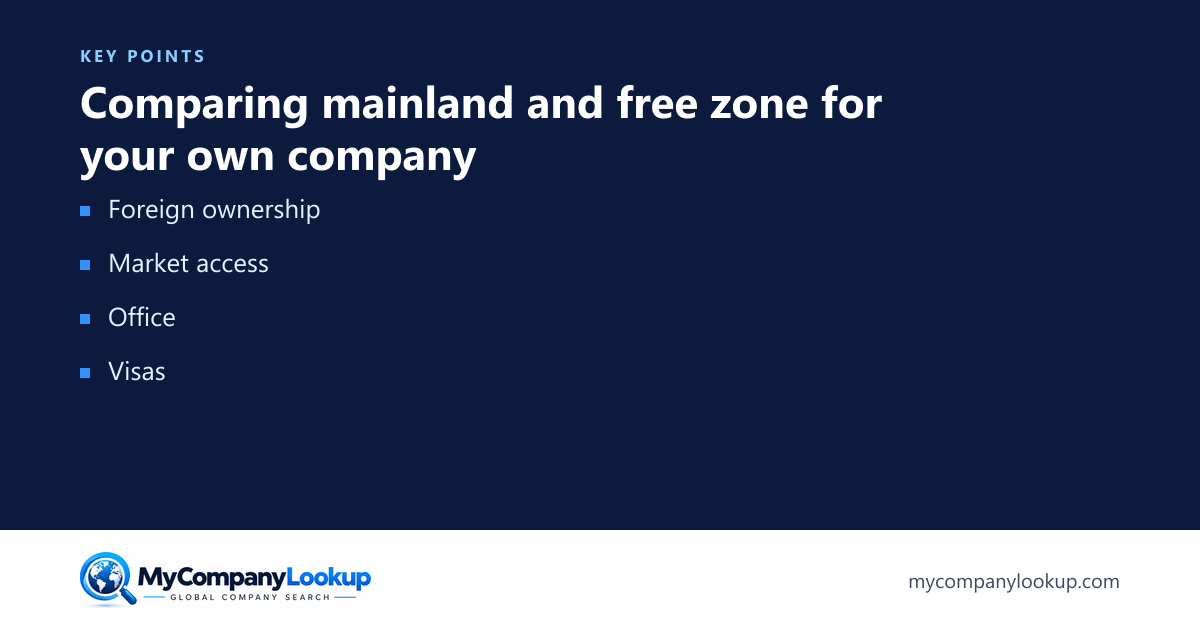
Comparing mainland and free zone for your own company
If you are thinking of setting up in the UAE rather than checking someone else, the same mainland-versus-free-zone choice applies.
| Factor | Mainland | Free zone |
|---|---|---|
| Foreign ownership | 100% for most activities | 100% |
| Market access | Whole UAE, including government contracts | Free zone and international; mainland via distributors or permits |
| Office | Physical office often required | Flexi-desk options in many zones |
| Visas | Linked to office size | Packages with set visa quotas |
| Corporate tax | 9% above AED 375,000 | 0% on qualifying income for qualifying free zone persons, otherwise 9% |
| Typical setup budget | Varies by activity and emirate | From around AED 7,950 in budget zones |
You can see indicative free zone prices on our UAE fees page. Biz E-Formations Inc. sets up companies in 17 free zones and on the mainland; see bizeformations.com/company-formation/uae.
Worked example: checking a Dubai supplier
A UK retailer is about to order stock from "Example General Trading LLC", which says it is based in Dubai.
- Licence requested. The supplier sends a PDF licence issued by Dubai's Department of Economy and Tourism, showing the legal form "LLC", a licence number, the activity "General Trading" and an expiry date eight months away.
- Authority identified. Because the licence is from DET and not a free zone, the retailer searches the licence number on the National Economic Register and DET's services.
- Record matched. The official record shows the same name, licence number, active status and expiry date.
- Activities checked. General trading covers the goods being ordered.
- Tax checked. The proforma invoice charges 5% VAT and shows a TRN, which the retailer verifies on the Federal Tax Authority website.
- Bank details checked. The bank account is in the exact licensed name at a UAE bank.
Everything matches, so the retailer proceeds and keeps a copy of the licence and screenshots of the checks with the purchase order.
Worked example: a free zone consultant
A UK company wants to hire "Example Consulting FZ-LLC" for a marketing project.
- The licence shows it was issued by a TECOM free zone authority, with the activity "Marketing Management".
- The free zone's verification service confirms the licence is active.
- The consultant invoices from the UAE to the UK client. Because the client is outside the UAE, VAT treatment differs from a local supply, and the client relies on the consultant's TRN and its own adviser for the correct treatment.
- The contract is signed by the manager named on the licence.
The checks show that the free zone company is legitimate and licensed for the work, even though it is not on a mainland register.
Keeping evidence of your checks
Whatever you find, keep a record: a copy of the licence, screenshots of the official search result with the date, the TRN check and any correspondence. For regulated businesses this is part of your due diligence file. For everyone else it is useful evidence if a dispute arises or if you need to show your bank or insurer that you acted carefully.
Questions to ask a UAE company
If anything on the licence or record is unclear, these questions usually resolve it quickly:
- Which authority issued your licence, and can you share the current licence and certificate of incorporation or registration?
- Who is authorised to sign contracts on behalf of the company?
- Are you registered for corporate tax and VAT, and what is your TRN?
- Where do your staff work, and is that location covered by your licence?
- When does your licence next renew?
A legitimate business answers these without difficulty.
How other countries compare
If you regularly check companies in several countries, it helps to know where each register sits on the transparency scale:
- United Kingdom: the most open, with free access to directors, owners and accounts. See our UK company check guide.
- Singapore and Hong Kong: official registers with paid reports for detailed information. See our Singapore and Hong Kong guide.
- United States: state-by-state registers; ownership is rarely public. See our US LLC fees guide.
- UAE: licence verification through many authorities; limited public detail.
Our Global Company Finder gives you the official link for each.
A UAE company verification checklist
- Get a copy of the trade licence.
- Identify the licensing authority from the licence.
- Verify the licence on the NER, the emirate portal or the free zone register.
- Confirm the name, licence number, status, activities and expiry date match.
- Verify the TRN if VAT is charged.
- Confirm the bank account is in the company's licensed name.
- For larger deals, request a credit report or bank reference.
- Re-check before each annual renewal date.
Summary
- The UAE has no single public company register; verification starts with the trade licence.
- Mainland companies are licensed by emirate economic departments and appear on the National Economic Register.
- Free zone companies are licensed by their zone; DIFC and ADGM have full public registers.
- Check that activities, status and expiry match what you are buying.
- Verify the TRN on VAT invoices.
- Financial statements and beneficial owners are generally not public.
Start your search on our UAE Company Finder.
Frequently asked questions
+Is there a public company register in the UAE?
There is no single public register like Companies House. Mainland licences can be checked through the National Economic Register and emirate economic departments, and free zone companies through their free zone authority. DIFC and ADGM have searchable public registers.
+How do I verify a Dubai trade licence?
Identify the issuing authority on the licence. For mainland Dubai licences, use the Department of Economy and Tourism services or the National Economic Register. For free zone licences, use the free zone's verification service or contact the authority.
+What is the difference between a mainland and a free zone company?
A mainland company is licensed by an emirate's economic department and can trade across the UAE. A free zone company is licensed by a free zone authority and mainly trades within the zone and internationally.
+Can I see who owns a UAE company?
Ownership is often shown on the trade licence, but ultimate beneficial owner registers are filed with licensing authorities and are not public.
+How do I check a UAE VAT number?
Verify the Tax Registration Number on the Federal Tax Authority website. A VAT invoice should always show a valid TRN.
+What is the UAE corporate tax rate?
Corporate tax is 9% on taxable income above AED 375,000, 0% below it, and qualifying free zone persons can pay 0% on qualifying income.