How to Choose the Cheapest US State to Form an LLC in 2027 and 2028
The cheapest filing fee is not always the cheapest LLC. Compare state filing fees, annual costs and registered agent fees to find the real first-year and ongoing cost in every state.
MyCompanyLookup Editorial TeamUpdated 22 Sept 2026 13 min read
In this article
- The four costs that make up an LLC
- The cheapest state for an LLC in 2027 and 2028
- Wyoming: the favourite for non-residents
- New Mexico: lowest ongoing cost
- Delaware: for investors, not for saving money
- Florida and Texas: good if you are there
- The home-state rule: why the cheapest state is not always right
- Hidden and one-off costs to watch
- Notes on other popular states
- How state fees change over time
- Single-member versus multi-member LLC costs
- Quick answer
- Mistakes that make an LLC more expensive
- Federal costs and filings (all states)
- How to choose the right state in 2027
- Step-by-step: forming an LLC
- Annual report deadlines in popular states
- Privacy: which states publish owners?
- What a $120 registered agent and address service should include
- LLC name rules
- LLC or corporation?
- Worked example: Wyoming LLC for an online store
- Let us handle it
- Summary
If you are planning to form a US limited liability company, the first number you will see is the state filing fee. It ranges from about $35 to $500 depending on the state. But LLC state fees are only part of the picture. Every LLC also needs a registered agent, most states charge an annual report fee or franchise tax, and some states add costs that do not appear until year two. A state with a cheap filing fee can turn out to be the most expensive to keep. This guide shows how to pick the cheapest state for an LLC once every fee is counted.
This guide compares the real first-year and ongoing cost of forming an LLC in the states people most often choose in 2027, explains each type of fee, and helps you decide which state actually makes sense for your business. You can see every state in one table on our US fees page, which shows the filing fee, the registered agent cost, the first-year total and the annual renewal fee side by side.
The four costs that make up an LLC
Every US LLC has the same building blocks:
- State filing fee: paid once to the Secretary of State (or equivalent) when you file the Articles of Organization (some states call it a Certificate of Formation).
- Registered agent: every LLC must have a registered agent with a physical address in the state of formation to receive legal documents. You can act as your own agent if you live in that state, but non-residents and most owners use a professional service. On our fees table we use $120 per year for a registered agent with a full US business address.
- Annual report or franchise tax: most states require an annual or biennial report with a fee, and some charge a minimum tax regardless of income.
- Federal and setup items: an Employer Identification Number (EIN) from the IRS is free, and an operating agreement is a document you prepare rather than a state fee.
So the simplest way to compare states is:
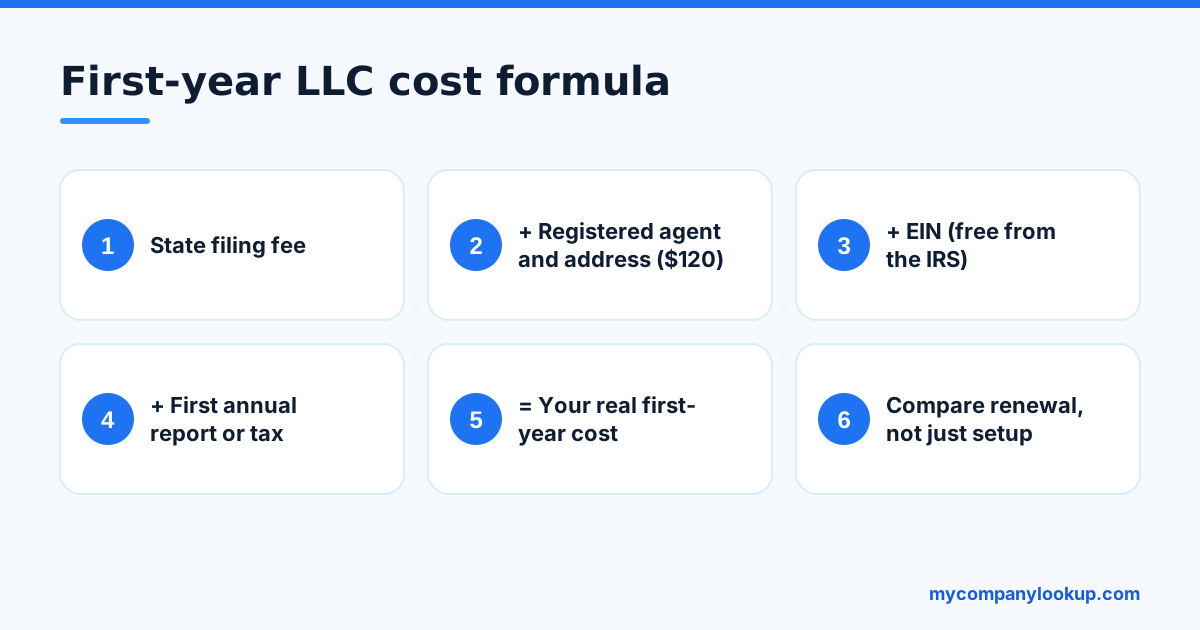
First-year cost = state filing fee + registered agent and business address ($120)
Ongoing yearly cost = annual report or franchise tax + registered agent ($120)
Some states add one-off items such as name reservation or newspaper publication, covered below.
The cheapest state for an LLC in 2027 and 2028
The table below uses the state fees shown on our fees page. Fees change, so always confirm on the state's official website before filing; our Global Company Finder links to every Secretary of State.
| State | Filing fee | Registered agent + address (1 yr) | First-year total | Annual / renewal state fee |
|---|---|---|---|---|
| Montana | $35 | $120 | $155 | $20 annual report |
| Kentucky | $40 | $120 | $160 | $15 |
| Arkansas | $45 | $120 | $165 | $150 franchise tax |
| Arizona | $50 | $120 | $170 | $0 |
| Colorado | $50 | $120 | $170 | $25 |
| Missouri | $50 | $120 | $170 | $0 |
| New Mexico | $50 | $120 | $170 | $0 |
| Michigan | $50 | $120 | $170 | $25 |
| Wyoming | $100 | $120 | $220 | $60 minimum |
| Delaware | $110 | $120 | $230 | $300 annual tax |
| Florida | $125 | $120 | $245 | $138.75 |
| Texas | $300 | $120 | $420 | $0 for most small LLCs (report still required) |
| Nevada | $425 | $120 | $545 | $350 (annual list + business licence) |
| California | $70 | $120 | $190 | $800 minimum franchise tax |
| Massachusetts | $500 | $120 | $620 | $500 |
Two lessons jump out. First, California looks cheap to form but costs at least $800 a year in franchise tax. Second, Massachusetts and Nevada are expensive both to start and to keep.
Wyoming: the favourite for non-residents
Wyoming is one of the most popular states for small LLCs and for owners who live outside the US. The reasons:
- Low costs: $100 to file and a $60 minimum annual license tax (calculated on assets located in Wyoming, so most small LLCs pay the minimum).
- No state income tax on LLC profits.
- Privacy: members' names are not required in the public formation filing.
- Strong LLC law, including charging-order protection for single-member LLCs.
The annual report is due on the first day of the anniversary month of formation. Miss it and the LLC can be administratively dissolved.
New Mexico: lowest ongoing cost
New Mexico is often the cheapest state to keep an LLC, because it has no annual report requirement for LLCs and a low $50 filing fee. Member names are not published in the formation filing. The trade-off is that New Mexico is less familiar to banks and investors than Wyoming or Delaware, and some payment providers ask more questions about LLCs from less common states.
Delaware: for investors, not for saving money
Delaware is the default choice for venture-backed corporations because of its specialised business courts and well-known corporate law. For a small LLC, though, it is not cheap: the $300 annual LLC tax is due every year by 1 June, regardless of income. If you plan to raise investment as a C corporation, Delaware is worth considering. For a one-person trading LLC, Wyoming or New Mexico usually cost less.
Florida and Texas: good if you are there
Florida has a $125 filing fee and a $138.75 annual report due between 1 January and 1 May. Florida's late fee for the annual report is steep, so diary it. Florida is a sensible choice if you live there or run a physical business there.
Texas charges $300 to form an LLC, but most small LLCs owe no franchise tax because their revenue is below the no-tax-due threshold. Texas still requires annual franchise tax filings such as the Public Information Report or Ownership Information Report, due 15 May. Check the Texas Comptroller's current rules each year.
The home-state rule: why the cheapest state is not always right
The most expensive mistake is forming in a "cheap" state when your business actually operates somewhere else. If your LLC is doing business in another state (for example it has an office, employees or a shop there), that state will usually require the LLC to register as a foreign LLC. You then pay:
- The home state's fees, plus
- The second state's foreign registration fee and annual fees, plus
- A second registered agent.
For a business with a physical presence in one state, forming directly in that state is usually cheaper and simpler. The low-cost states are most useful for online businesses, holding companies and owners who live outside the US.
Hidden and one-off costs to watch
| Cost | Where it applies | Notes |
|---|---|---|
| Newspaper publication | New York (and some others) | New York requires publication in two newspapers within 120 days; costs vary widely by county |
| Minimum franchise tax | California, Delaware, Arkansas, Tennessee and others | Payable even with no profit |
| Business licence | Nevada and some cities | Nevada state business licence is part of the annual list cost |
| Name reservation | Optional in most states | Only needed if you want to hold a name before filing |
| Expedited filing | Most states | Extra fee for faster processing |
| Certified copies and good standing | All states | Banks sometimes request these |
| Late fees | All states | Can exceed the original fee |
Notes on other popular states
Nevada is often marketed as a tax-friendly state, and it has no state corporate or personal income tax. But it is one of the most expensive states for a small LLC: $425 to form (including the initial list and state business licence) and $350 a year to maintain. Nevada also has a Commerce Tax for businesses with high Nevada gross revenue. It suits businesses with a real Nevada presence more than small online companies.
Colorado has a low $50 filing fee and a modest periodic report, which makes it one of the cheapest states for residents. Like most states, it taxes LLC owners who live in Colorado on their share of profits.
Arizona has a $50 filing fee and no annual report for LLCs, which keeps ongoing costs low. Check whether any publication requirement applies to your LLC based on the county of its statutory agent before filing.
Kentucky and Montana have some of the lowest filing fees in the country ($40 and $35) and low annual reports ($15 and $20). They are sensible choices for residents of those states but are rarely chosen by out-of-state owners.
New York charges $200 to form an LLC, but within 120 days the LLC must publish notices in two newspapers designated by the county clerk and file a certificate of publication. In some counties, publication alone can cost far more than the filing fee. Failure to publish can suspend the LLC's authority to do business.
Massachusetts has some of the highest LLC fees in the country, with $500 both to form and for each annual report.
How state fees change over time
States revise their fees from time to time, usually through legislation that takes effect at the start of a fiscal or calendar year. Changes in recent years have included increases to annual report fees, new or adjusted franchise tax thresholds and new online filing systems. Practical advice:
- Check the official fee schedule on the Secretary of State's website immediately before filing. Our US Company Finder links to each state.
- Watch for announcements about thresholds, such as the Texas no-tax-due threshold, which is reviewed periodically.
- Budget for renewal increases, not just today's figures.
- Follow our News and Fees page, where we post fee changes we track and update the state table.
Single-member versus multi-member LLC costs
State filing fees are the same whether an LLC has one member or several, but ongoing costs differ. A single-member LLC owned by a US person is usually reported on the owner's personal return, while one owned by a foreign person files Form 5472 with a pro forma 1120. A multi-member LLC files a partnership return (Form 1065) and issues K-1s to members, which usually means higher accounting fees. When budgeting, add a realistic figure for tax preparation to the state fees in this guide, and remember that some states also charge separate fees for amendments when members change.
Quick answer
If you want the lowest ongoing cost and run an online business from outside the US, compare New Mexico and Wyoming first. If you need investor familiarity, look at Delaware. If you have a physical presence in a state, form there.
Mistakes that make an LLC more expensive
- Choosing by filing fee alone and then paying a large annual tax.
- Forgetting foreign qualification when the business operates in another state.
- Letting the registered agent lapse, which can lead to missed lawsuits and administrative dissolution.
- Missing the annual report, followed by late fees and reinstatement costs.
- Paying for an EIN on an unofficial website when it is free from the IRS.
- Skipping federal filings such as Form 5472 for foreign-owned LLCs, which carries a $25,000 penalty.
Federal costs and filings (all states)
Wherever you form your LLC, some federal steps apply:
- EIN: free from the IRS. US persons can apply online. Non-residents without a Social Security Number use Form SS-4. See the IRS page on applying for an EIN.
- Federal tax returns: depend on how the LLC is taxed. A single-member LLC owned by a foreign person must file Form 5472 with a pro forma Form 1120 each year, even with no income. The penalty for not filing is $25,000. Our guide to US LLCs for non-residents covers this in detail.
- Beneficial ownership reporting: in March 2025, FinCEN issued an interim final rule exempting companies created in the US from beneficial ownership information reporting under the Corporate Transparency Act. Foreign companies registered to do business in the US remain in scope. Check FinCEN's BOI page for the current position.
How to choose the right state in 2027
Ask four questions:
- Where will the business physically operate? If it has an office, staff or stock in one state, form there.
- Where do you live? US residents may be taxed by their home state anyway, so a "no tax" state does not avoid state income tax on their share of profits.
- Will you raise investment? Investors often prefer Delaware corporations.
- What will it cost over three years? Multiply the annual cost by three and add the filing fee. That number, not the filing fee, is what you should compare.
Three-year cost comparison
| State | Year 1 | Years 2 and 3 (state fee + $120 agent each year) | Three-year total |
|---|---|---|---|
| New Mexico | $170 | $240 | $410 |
| Wyoming | $220 | $360 | $580 |
| Florida | $245 | $517.50 | $762.50 |
| Delaware | $230 | $840 | $1,070 |
| California | $190 plus $800 tax | $1,840 | $2,830 or more |
The figures exclude accounting and tax preparation, which depend on your business.
Step-by-step: forming an LLC
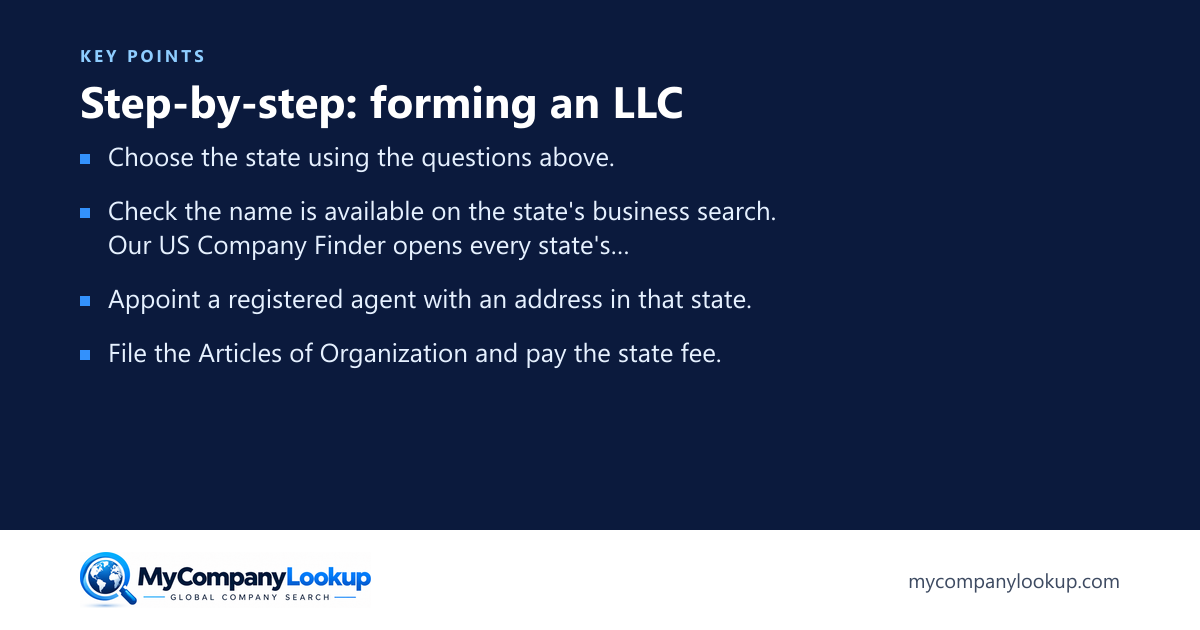
- Choose the state using the questions above.
- Check the name is available on the state's business search. Our US Company Finder opens every state's official search.
- Appoint a registered agent with an address in that state.
- File the Articles of Organization and pay the state fee.
- Prepare an operating agreement, especially important for multi-member LLCs and for opening bank accounts.
- Get an EIN from the IRS.
- Open a US business bank account or a fintech account that accepts your LLC.
- Diary the annual report and tax deadlines.
Annual report deadlines in popular states
Missing an annual report is the most common way small LLCs get into trouble. Most states eventually administratively dissolve an LLC that does not file, and reinstatement usually costs more than the original fee. Here are typical deadlines for popular states (always confirm on the state website):
| State | Annual filing | Typical deadline |
|---|---|---|
| Wyoming | Annual report and license tax | First day of the anniversary month |
| Delaware | Annual LLC tax ($300) | 1 June each year |
| Florida | Annual report ($138.75) | Between 1 January and 1 May |
| Texas | Franchise tax reports | 15 May |
| Nevada | Annual list and state business licence | Last day of the anniversary month |
| California | Franchise tax and biennial statement of information | Tax by the 15th day of the 4th month of the tax year; statement every two years |
| New Mexico | None for LLCs | Not applicable |
| Colorado | Periodic report | Around the anniversary month |
| New York | Biennial statement | Every two years in the anniversary month |
Put every deadline in your calendar the day the LLC is approved, and keep your registered agent active so that state reminders reach you.
Privacy: which states publish owners?
Many people choose a state partly for privacy. In general:
- Wyoming, New Mexico and Delaware do not require members' names in the public formation documents.
- Florida and several other states list managers or authorized persons in public annual reports.
- Some states require the names of managers or members in the formation document itself.
Privacy has limits. Banks, payment providers and the IRS all know who owns your LLC, and courts can order disclosure. US company registers rarely show owners, which is very different from the UK, where the PSC register publishes them. When you need to check a US company, our US Company Finder opens the official search for every state.
What a $120 registered agent and address service should include
On our fee tables, the registered agent with a full US business address is priced at $120 for one year. Whoever you use, make sure the service includes:
- A physical street address in the state of formation, available during business hours.
- Same-day scanning of legal documents (service of process) with email alerts.
- State compliance reminders for annual reports and taxes.
- A business mailing address you can use for correspondence, banks and platforms.
- Mail handling for official letters from the IRS and state agencies.
Cheap registered agent services that do not forward mail promptly can cost far more in missed deadlines than they save.
LLC name rules
Every state requires an LLC's name to include a designator such as "Limited Liability Company", "LLC" or "L.L.C." The name must be distinguishable from existing entities in that state, and certain words such as "Bank", "Insurance" or "Trust" are restricted. Check availability on the state's business search before filing. If the name you want is taken in one state, it may still be available in another, but think about trademarks too: a state filing does not give you trademark rights.
LLC or corporation?
This guide focuses on LLCs because they are the most common choice for small businesses and non-resident owners. Corporations have similar filing fees in most states but different annual obligations, such as franchise tax calculations in Delaware and requirements for directors, officers and shareholder meetings. If you plan to raise venture capital or issue stock options, a Delaware C corporation is usually expected. For trading businesses, freelancers and online sellers, an LLC is simpler.
Worked example: Wyoming LLC for an online store
Maria lives outside the US and sells digital products online. She forms a Wyoming LLC.
| Item | Cost |
|---|---|
| Wyoming filing fee | $100 |
| Registered agent with business address (year 1) | $120 |
| EIN from the IRS | Free |
| First-year total | $220 |
| Year 2 annual report (minimum license tax) | $60 |
| Year 2 registered agent | $120 |
| Ongoing yearly cost | $180 |
Maria must also file Form 5472 with a pro forma Form 1120 each year because her single-member LLC is foreign-owned. She uses a tax preparer for this. Our non-resident LLC guide explains the filing.
Let us handle it
Biz E-Formations Inc., our formation partner, forms LLCs in every US state, with registered agent and full US business address for one year, EIN application, operating agreement and support with payment platforms. Packages start from $199 plus the state fee. See the details on bizeformations.com/company-formation/usa, or browse the full state fee table first.
Summary
- Compare total cost over several years, not just the filing fee.
- First-year cost = state filing fee + registered agent and address ($120 in our table).
- New Mexico and Wyoming are usually the cheapest to keep; Delaware suits investor-backed companies.
- California's $800 minimum franchise tax and New York's publication requirement surprise many owners.
- If you operate physically in a state, forming there usually avoids paying twice.
- Non-resident owners must file Form 5472 every year.
Frequently asked questions
+What is the cheapest state to form an LLC in 2027?
By filing fee, Montana, Kentucky and Arkansas are among the cheapest. By total ongoing cost, New Mexico is usually cheapest because it has a $50 filing fee and no annual report for LLCs, followed by Wyoming.
+How much does an LLC cost in the first year?
Add the state filing fee to the cost of a registered agent with business address. Using $120 for the agent, a Wyoming LLC costs about $220 in the first year and a Florida LLC about $245, before any optional services.
+Is Delaware a good state for a small LLC?
Delaware is well known but charges a $300 annual LLC tax. It suits companies planning to raise investment; for a small online business, Wyoming or New Mexico usually cost less.
+Do I need a registered agent for my LLC?
Yes. Every state requires an LLC to have a registered agent with a physical address in the state to receive legal documents.
+Why does California cost so much?
California charges a minimum $800 annual franchise tax for LLCs, even if they make no profit, on top of the filing fee and statement of information.
+Can I form an LLC in Wyoming if I live in another state?
Yes, but if your LLC does business in your home state, you may need to register it there as a foreign LLC and pay that state's fees as well.