How to Set Up a US LLC as a Non-Resident in 2027 and 2028
You do not need to live in the United States or have a Social Security Number to own a US LLC. Here is the complete process and the annual filings that catch non-resident owners out.
MyCompanyLookup Editorial TeamUpdated 2 Oct 2026 13 min read
In this article
- Can you set up a US LLC as a non-resident?
- Step 1: Choose the right state
- Step 2: Appoint a registered agent and business address
- Step 3: File the Articles of Organization
- Step 4: Prepare an operating agreement
- Step 5: Get an EIN without a Social Security Number
- Step 6: Banking and payments
- Step 7: Understand how the LLC is taxed
- Step 8: Annual compliance calendar
- Worked example: a year in the life of a non-resident LLC
- Registered agent address versus business address
- What banks and payment platforms ask for
- Bookkeeping for a non-resident LLC
- Common mistakes and how to avoid them
- Selling on Amazon and other marketplaces
- Fees at a glance
- Is a US LLC right for you?
- Do you need a US phone number?
- Closing a non-resident LLC
- Verifying US companies you deal with
- Let us set it up for you
- Summary
Partner links: some links in this guide are partner (referral) links. If you sign up through them we may earn a commission or referral reward, at no extra cost to you. It doesn't change what we recommend.
A US LLC for non-residents is one of the most popular structures for international founders, e-commerce sellers, freelancers and software businesses. It gives you a US legal entity that customers, marketplaces and payment platforms recognise, and in many cases it can be formed entirely online without visiting the United States. This guide explains how to set up a US LLC as a non-resident, step by step.
But forming the LLC is the easy part. The parts that go wrong are the EIN, banking and, above all, the annual federal filing that foreign-owned LLCs must make even when they have no US income. This guide walks through the whole lifecycle for 2027 and 2028: choosing a state, the registered agent, the formation filing, getting an EIN without a Social Security Number, opening accounts, and staying compliant every year.
This article is general information, not tax or legal advice. US tax treatment depends on your facts and your home country's rules, so speak to a qualified adviser before making decisions.
Can you set up a US LLC as a non-resident?
Yes. There is no citizenship or residency requirement to form or own an LLC in any US state. You do not need a US visa, a US address of your own or a Social Security Number. What you do need is:
- A registered agent with a physical address in the state of formation.
- A way to obtain an Employer Identification Number (EIN) from the IRS.
- A business address for correspondence, banking and marketplaces (often provided with the registered agent service).
- An understanding of your annual filing obligations.
Owning a US LLC does not give you the right to live or work in the United States. Immigration is a completely separate matter.
Step 1: Choose the right state
Most non-residents choose a state with low fees, no state income tax on the LLC and simple annual requirements. The usual shortlist:
| State | Filing fee | Annual state cost | Why people choose it |
|---|---|---|---|
| Wyoming | $100 | $60 minimum annual report | Low cost, privacy, strong LLC law, well known to banks |
| New Mexico | $50 | No annual report for LLCs | Lowest ongoing cost |
| Delaware | $110 | $300 annual LLC tax | Prestige and investor familiarity |
| Florida | $125 | $138.75 annual report | Good if you have a Florida connection |
| Texas | $300 | Franchise tax reports, usually no tax for small LLCs | Large market, no state income tax |
For a detailed comparison including three-year costs, read our guide to US LLC state fees and the cheapest states, or see every state on our US fees table.
A key point: if your LLC will have a physical presence in a particular state (an office, staff or a warehouse), it may have to register in that state anyway. For purely online businesses run from abroad, Wyoming and New Mexico are the common choices.
Step 2: Appoint a registered agent and business address
Every LLC must name a registered agent: a person or company with a physical address in the state, available during business hours to accept legal documents such as lawsuits and official notices. As a non-resident you cannot act as your own registered agent, so you use a professional service.
Many owners also need a US business address for their bank, payment providers and marketplaces, separate from the registered agent address. On our fee tables we price a registered agent with a full US business address at $120 for the first year.
Check that the address service:
- Scans and emails mail promptly.
- Allows the address to be used on bank and platform applications.
- Will not let your LLC miss an official notice.
Step 3: File the Articles of Organization
The formation document is usually called the Articles of Organization (Certificate of Formation in some states). It typically includes the LLC name, the registered agent, the principal address, whether it is member-managed or manager-managed, and an organiser's signature.
Before filing, check the name is available on the state's business search. Our US Company Finder links directly to the official search for all 50 states and DC.
Filing is online in most states, and approval takes from a few minutes to a few weeks depending on the state and whether you pay for expedited processing.
Step 4: Prepare an operating agreement
An operating agreement sets out who owns the LLC, how it is managed, how profits are shared and what happens if a member leaves. Most states do not require you to file it, but banks and payment providers often ask for it, and for multi-member LLCs it is essential. Keep a signed copy with your company records.
Step 5: Get an EIN without a Social Security Number
The EIN is the LLC's federal tax ID number. You need it to open bank accounts, work with payment platforms, hire staff and file tax returns. It is free from the IRS. Beware of websites that charge large fees and imply they are official.
US persons can apply online, but the online application requires the responsible party to have an SSN or ITIN. Non-residents without either use Form SS-4:
- Complete Form SS-4 with the LLC's details. The "responsible party" is the owner. Where the form asks for an SSN or ITIN, non-residents without one follow the IRS instructions for foreign applicants.
- Submit by fax or mail as the IRS instructions describe. International applicants can also apply by phone.
- The IRS issues the EIN and a confirmation letter (CP 575). Keep it safe; banks often ask for it.
See the IRS pages on Form SS-4 and applying for an EIN for current methods and processing times.
Do you need an ITIN?
An Individual Taxpayer Identification Number (ITIN) is a personal tax number for people who are not eligible for an SSN but have a US tax filing requirement. Not every non-resident LLC owner needs one. You may need one if you personally have to file a US tax return, for example because the LLC has income effectively connected with a US trade or business, or to claim certain treaty benefits. ITINs are applied for using Form W-7. See the IRS page on ITINs.
Step 6: Banking and payments
A US bank account is usually the hardest part for non-residents. Traditional banks often require an in-person visit. Fintech business accounts are more accessible and many accept non-resident-owned LLCs with an EIN, formation documents, operating agreement, passport and proof of address.
Payment platforms such as Stripe and PayPal, and multi-currency providers such as Wise and Payoneer, are commonly used by non-resident LLCs. Each has its own requirements and supported countries, and they change, so check current eligibility.
Tips for a smooth application:
- Use a real business address, not just the registered agent address, if the provider asks for one.
- Make sure the name on every document matches the state filing exactly.
- Have a simple website and a clear description of what the business sells.
- Answer questions about where customers are and how money flows honestly and consistently.
Step 7: Understand how the LLC is taxed
US tax treatment depends on how many members the LLC has and what election it makes.
Single-member LLC owned by a non-resident
By default, a single-member LLC is a disregarded entity for income tax: the IRS looks through it to the owner. If the owner is a non-resident individual and the LLC's income is not effectively connected with a US trade or business, there may be no US federal income tax on that income. Whether income is effectively connected depends on facts such as US offices, employees, dependent agents and inventory in the US, so take advice.
However, a foreign-owned single-member LLC is treated as a corporation for reporting purposes. It must file:
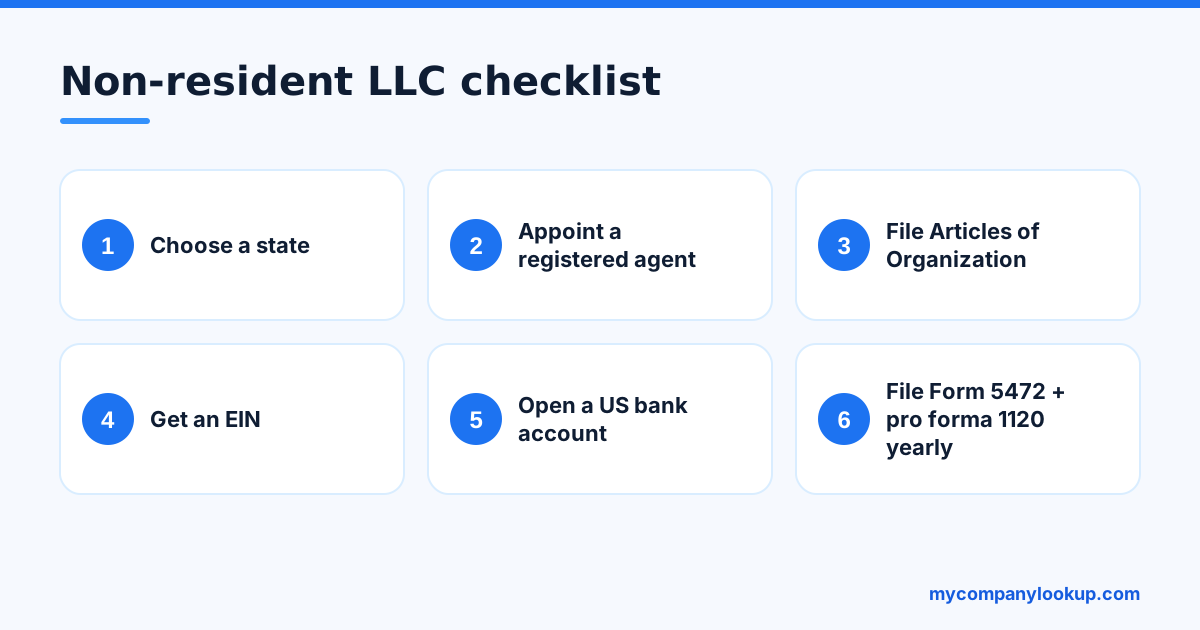
- Form 5472 (Information Return of a 25% Foreign-Owned U.S. Corporation or a Foreign Corporation Engaged in a U.S. Trade or Business), reporting transactions between the LLC and its foreign owner, such as money put in or taken out.
- A pro forma Form 1120, with only basic identifying information, as the cover document for Form 5472.
These are due by the corporate deadline, normally 15 April for calendar-year LLCs, with an extension available using Form 7004. The penalty for failing to file Form 5472 is $25,000 per form, per year. This is the single most expensive mistake non-resident LLC owners make. Read the IRS page About Form 5472.
Multi-member LLC
An LLC with two or more members is taxed as a partnership by default. It files Form 1065 and gives each member a Schedule K-1. If the partnership has effectively connected income allocable to foreign partners, withholding rules can apply. Multi-member LLCs with foreign owners should always use a US tax professional.
Electing corporate tax treatment
Any LLC can elect to be taxed as a corporation (Form 8832) or, if eligible, an S corporation. Non-residents cannot be S corporation shareholders. Corporate treatment changes the tax picture significantly and is a decision for an adviser.
State and sales taxes
Wyoming, New Mexico and several other states do not tax LLC income at the state level in the way described above, but states can tax businesses that have activity there. Sales tax is collected based on where customers are, and many states have "economic nexus" thresholds for online sellers. Marketplaces often collect sales tax on your behalf, but not in every case.
Step 8: Annual compliance calendar
| Obligation | Who | When |
|---|---|---|
| State annual report or tax | All LLCs (state-dependent) | Varies: Wyoming on the anniversary month, Delaware 1 June, Florida 1 January to 1 May |
| Registered agent renewal | All LLCs | Annually |
| Form 5472 + pro forma 1120 | Foreign-owned single-member LLCs | 15 April (calendar year), extension to 15 October with Form 7004 |
| Form 1065 + K-1s | Multi-member LLCs | 15 March (calendar year) |
| Sales tax returns | Where registered | Monthly, quarterly or annually |
| Beneficial ownership (BOI) | Foreign companies registered in the US | Check FinCEN rules |
On beneficial ownership: in March 2025, FinCEN issued an interim final rule exempting companies created in the United States from BOI reporting under the Corporate Transparency Act, while foreign entities registered to do business in a US state remain in scope. Check FinCEN's BOI page for the latest position before relying on this.
Worked example: a year in the life of a non-resident LLC
Imran lives in Pakistan and runs a software consultancy. In January 2027 he forms a single-member Wyoming LLC.
| When | What happens |
|---|---|
| January 2027 | Wyoming LLC approved ($100 filing fee); registered agent and US business address arranged ($120 for the year) |
| January 2027 | Operating agreement signed; Form SS-4 submitted for the EIN |
| February 2027 | EIN confirmation letter received; fintech business account and Stripe account opened |
| Throughout 2027 | Imran transfers $5,000 into the LLC to cover tools and later withdraws profits; every transfer is recorded in the books |
| 1 January 2028 | Wyoming annual report and $60 minimum license tax due (first day of the anniversary month) |
| 15 April 2028 | Form 5472 and pro forma Form 1120 for 2027 due (or extension filed with Form 7004) |
| April 2028 | Imran reports the LLC's profit in Pakistan as required by Pakistani tax rules |
| January 2028 | Registered agent renewal |
Because Imran's LLC has no US office, employees or dependent agents and he performs all services from Pakistan, his adviser concludes that the income is not effectively connected with a US trade or business. The LLC still files Form 5472 because the transfers between Imran and the LLC are reportable transactions.
Registered agent address versus business address
These are often confused:
- The registered agent address is the official address on the state record where legal documents are served. It must be in the state of formation.
- A business address is where the company receives everyday mail and the address you put on bank applications, invoices and marketplace profiles. It can be in any state.
Some providers bundle both, which is what our $120 figure covers. Do not use a registered agent address as your business address unless the provider expressly allows it, because some banks and platforms reject well-known registered agent addresses as business addresses.
What banks and payment platforms ask for
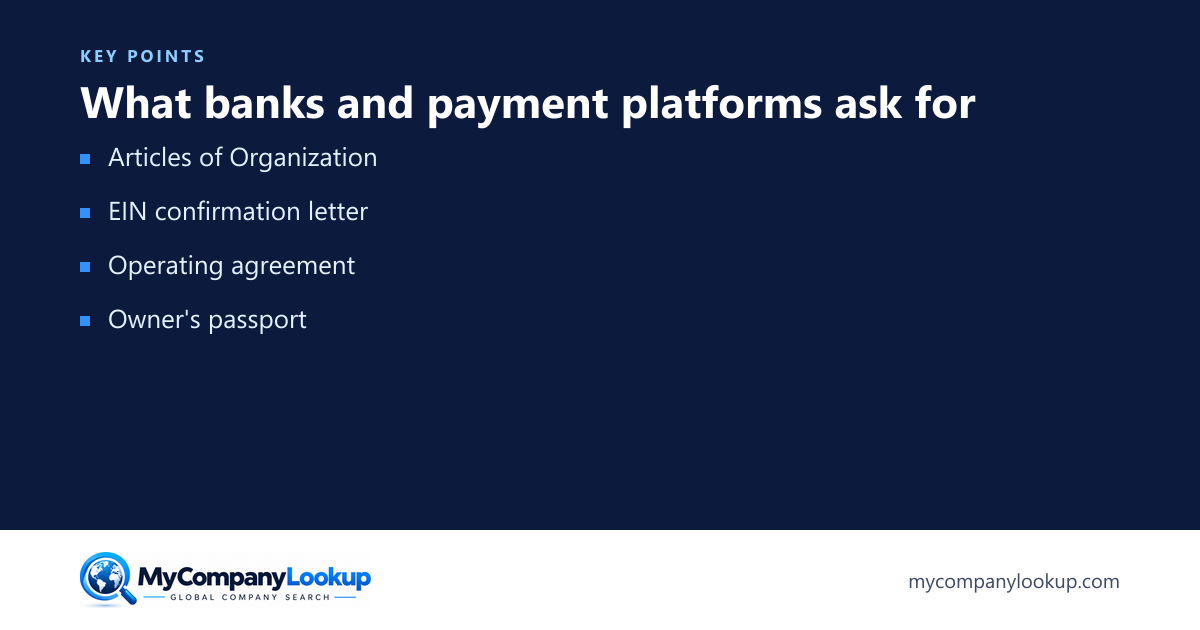
Expect to provide most of the following when opening accounts for a non-resident LLC:
| Document | Notes |
|---|---|
| Articles of Organization | Stamped or approved copy from the state |
| EIN confirmation letter | The IRS CP 575 or equivalent |
| Operating agreement | Shows ownership and who can sign |
| Owner's passport | Must match the name on the LLC documents |
| Proof of personal address | Recent utility bill or bank statement |
| US business address | Not a PO box |
| Website or business description | What you sell, to whom and how |
| Expected transaction volumes | Monthly incoming and outgoing amounts and countries |
Consistency is everything. The LLC name must be identical on every document, and your answers about the business must match across applications.
Bookkeeping for a non-resident LLC
Good books make the annual filings straightforward:
- Keep business and personal money separate. Pay business expenses only from the LLC account.
- Record every owner transfer into or out of the LLC with the date and amount. These are the reportable transactions on Form 5472.
- Keep invoices and receipts for all income and expenses.
- Reconcile monthly against bank and payment platform statements.
- Keep records for at least seven years, in line with typical IRS and state record-keeping expectations.
Simple cloud accounting software is enough for most single-member LLCs.
Common mistakes and how to avoid them
- Not filing Form 5472 because the LLC "had no income". Filing is required for reportable transactions, including the owner funding the LLC or taking money out.
- Paying for an EIN on an unofficial website. The EIN is free from the IRS.
- Choosing a state because of a cheap filing fee without checking annual costs. California's $800 minimum franchise tax is a classic surprise.
- Letting the registered agent lapse, which can lead to missed lawsuits and administrative dissolution.
- Mixing personal and business money, which weakens the LLC's liability protection and makes bookkeeping and reporting harder.
- Ignoring home-country tax. Your country of residence may tax the LLC's profits, treat it differently from the US, or have controlled foreign company rules.
Selling on Amazon and other marketplaces
Many non-resident LLC owners sell on Amazon, eBay, Walmart or Etsy. Marketplaces usually require:
- Business verification documents matching the LLC exactly (Articles, EIN letter).
- Identity verification of the owner, often including a video call.
- A bank or payment account in the LLC's name that can receive payouts.
- Tax interview information (Form W-9 for a US LLC, completed with the LLC's EIN), which also determines the tax forms the marketplace issues.
Marketplaces often collect and remit sales tax on your behalf in states with marketplace facilitator laws, but you remain responsible for sales made through your own website. Biz E-Formations Inc. offers Amazon seller packages that combine LLC formation with account setup; see the USA formation page.
Fees at a glance
Use our US fees table to see every state's filing fee, the first-year total including a registered agent with business address, and the annual renewal fee. For a deeper comparison of the most popular states over three years, read US LLC state fees and the cheapest states. If you have questions about which state fits your situation, contact our team.
Is a US LLC right for you?
A US LLC makes most sense when your customers, payment providers or marketplaces are US-based, or when you need a US entity to sign contracts. If most of your customers are in the UK or Europe, a UK limited company may suit better. Many founders end up with both, each serving its own market.
Do you need a US phone number?
You do not legally need one, but a US phone number helps with bank applications, two-factor authentication for US services and customer trust. Virtual US numbers are widely available. Make sure the number can receive SMS codes, since some banks and platforms send verification codes by text.
Closing a non-resident LLC
If you no longer need the LLC, close it properly rather than abandoning it. File articles of dissolution (or the state's equivalent), make the final annual report or tax payment if required, file a final Form 5472 and pro forma 1120 for the last year, close bank and payment accounts and cancel the registered agent once the state confirms dissolution. An abandoned LLC can continue to accrue state fees and penalties, and missing federal filings carry the same $25,000 exposure.
Verifying US companies you deal with
If you sell to or buy from other US businesses, check them on the official state register of the state where they were formed. US registers show whether an LLC exists and is in good standing, the registered agent and filing history, but usually not the owners. Our US Company Finder opens the right Secretary of State search for each state, and for listed companies the SEC's EDGAR database.
Let us set it up for you
Biz E-Formations Inc., our formation partner, forms LLCs in every state for non-residents, including registered agent and US business address for a year, EIN application, operating agreement, and help setting up Stripe, PayPal, Wise and Payoneer. Packages start from $199 plus the state fee, with Amazon seller and premium packages available. See bizeformations.com/company-formation/usa for current packages.
Summary
- Non-residents can own a US LLC in any state without an SSN or visa.
- You need a registered agent; budget $120 a year with a business address.
- Get your EIN free from the IRS using Form SS-4 if you have no SSN or ITIN.
- Foreign-owned single-member LLCs must file Form 5472 with a pro forma 1120 every year; the penalty for missing it is $25,000.
- Choose your state on total cost and where you actually operate.
- Take professional tax advice in both the US and your home country.
Frequently asked questions
+Can a non-resident form an LLC in the United States?
Yes. Anyone can form a US LLC regardless of nationality or residence. You need a registered agent in the state of formation and an EIN for tax and banking.
+How do I get an EIN without a Social Security Number?
Non-residents without an SSN or ITIN apply using IRS Form SS-4, submitted by fax or mail, or by phone for international applicants. The EIN is free.
+What is Form 5472 and who must file it?
Form 5472 reports transactions between a US entity and its foreign owners. A single-member LLC owned by a foreign person must file it every year with a pro forma Form 1120, even with no income. The penalty for not filing is $25,000.
+Which state is best for a non-resident LLC?
Wyoming and New Mexico are the most common choices for online businesses because of low fees and simple annual requirements. Delaware suits companies planning to raise investment.
+Does a non-resident LLC pay US tax?
It depends on whether the LLC's income is effectively connected with a US trade or business. Many single-member LLCs owned by non-residents with no US operations have no US federal income tax, but they still have filing obligations. Take professional advice.
+Do US LLCs still need to file beneficial ownership (BOI) reports?
In March 2025 FinCEN exempted companies created in the United States from BOI reporting. Foreign companies registered to do business in the US remain in scope. Check FinCEN's website for the current rules.