How to Get an ITIN in 2027 and 2028: Form W-7 for Non-Residents and LLC Owners
An ITIN lets people who can't get a Social Security number meet their US tax obligations. Here is who needs one, how to apply with Form W-7, and how to avoid delays.
MyCompanyLookup Editorial TeamUpdated 11 Oct 2026 13 min read
In this article
- What an ITIN is, and what it isn't
- Who needs an ITIN
- Who doesn't need an ITIN
- ITINs and US LLC owners
- Form W-7 explained
- Documents you need
- Three ways to apply
- Step-by-step: how to get an ITIN
- How long it takes
- Common reasons ITIN applications are rejected
- Keeping your ITIN active
- ITIN, SSN and EIN compared
- Banking, payment processors and the ITIN
- Practical scenarios
- Checklist before you send Form W-7
- Where to get help
- Common mistakes to avoid
- Spouses and dependents
- Sending the application safely
- After you receive your ITIN
- If the IRS writes back
- Privacy and security
- Key takeaways
- Related guides
- The bottom line
If you live outside the United States and have a US tax filing requirement, or you own a US LLC and want to deal with the IRS in your own name, you will probably come across the ITIN: the Individual Taxpayer Identification Number. It's a nine-digit number issued by the IRS to people who need a US taxpayer identification number but aren't eligible for a Social Security number (SSN). This guide explains how to get an ITIN from start to finish.
This guide explains how to get an ITIN in 2027: who needs one, who doesn't, how to complete Form W-7, which documents to send, the three ways to apply, how long it takes, and how to keep the number active. It also covers the questions we hear most from non-resident owners of US LLCs.
This guide is general information about IRS procedures, not tax advice. IRS rules and forms change, so always check the current Form W-7 instructions before you apply.
What an ITIN is, and what it isn't
An ITIN is a tax processing number. It allows the IRS to process tax returns and payments for people who don't have, and aren't eligible for, an SSN.
An ITIN is:
- a nine-digit number that starts with a 9 and is formatted like an SSN (9XX-XX-XXXX);
- used on federal tax returns and other tax documents; and
- issued to individuals, not companies.
An ITIN is not:
- permission to work in the United States;
- proof of immigration status;
- a way to qualify for Social Security benefits; or
- a substitute for an EIN, which identifies a business entity such as an LLC.
Who needs an ITIN
You generally need an ITIN if you must provide a US taxpayer identification number on a tax document and you are not eligible for an SSN. Common situations include:
| Situation | Why an ITIN is needed |
|---|---|
| Non-resident who must file a US federal tax return | To file Form 1040-NR, for example on US-source income |
| Non-resident claiming a tax treaty benefit | To claim reduced withholding under a treaty |
| Spouse or dependent of a US citizen or resident | To be included on a joint return or claimed as a dependent |
| Spouse or dependent of a visa holder | Same as above |
| Non-resident partner or member receiving US income | To report their share of income from a partnership or multi-member LLC |
| Foreign student, researcher or professor with a filing requirement | To file a return or claim treaty benefits |
Who doesn't need an ITIN
Many people assume they need an ITIN when they don't.
- To form a US LLC: you don't need an ITIN or SSN to form an LLC. State registration doesn't require either.
- To get an EIN for your LLC: a foreign owner without an SSN or ITIN can still get an EIN by applying with Form SS-4 by fax, mail or the IRS international phone line. Our guide on how to get an EIN as a non-resident explains the steps.
- If you are eligible for an SSN: you must apply for an SSN instead. The IRS won't issue an ITIN to someone who is eligible for an SSN.
So for many non-resident LLC owners, the ITIN is optional at the start. It becomes important if you have a personal US filing requirement, for example because you are a member of a multi-member LLC that is taxed as a partnership, or because you have other US-source income.
ITINs and US LLC owners
How your LLC is taxed decides whether you personally need an ITIN.
| LLC type | Typical owner filing | ITIN needed? |
|---|---|---|
| Single-member LLC owned by a non-resident, with no US trade or business income | The LLC files Form 5472 with a pro forma Form 1120 | Usually not for the 5472 itself; the LLC uses its EIN |
| Single-member LLC with effectively connected income | The owner may need to file a personal return (Form 1040-NR) | Usually yes |
| Multi-member LLC taxed as a partnership | The LLC files Form 1065; members receive K-1s and may need to file | Often yes, for each non-resident member with a filing requirement |
| LLC that elects to be taxed as a corporation | The LLC files Form 1120 | Not for the corporate return |
Whether a foreign owner's income is effectively connected with a US trade or business is a technical question. Take advice from a US tax professional. Our guide on how to set up a US LLC as a non-resident explains the filing obligations, including Form 5472.
Form W-7 explained
To apply for an ITIN you file Form W-7, Application for IRS Individual Taxpayer Identification Number. The main parts are:
- Reason for applying. You tick the box that matches your situation, such as "non-resident alien required to get an ITIN to claim tax treaty benefit" or "non-resident alien filing a US federal tax return".
- Your details. Full name, name at birth if different, mailing address, foreign address, date and place of birth, and nationality.
- Identification documents. Details of the documents you are submitting, such as your passport.
- Visa and entry details, where relevant.
- Signature. You, or an authorised representative where allowed, sign the form.
Most applicants must attach the federal tax return the ITIN is needed for. The ITIN is issued as part of processing that return. There are exceptions to this rule, such as certain treaty claims and third-party withholding situations, which are listed in the W-7 instructions. If you claim an exception, you send the documents that support it instead of a return.
Documents you need
The IRS needs proof of your identity and your foreign status.
- A valid passport is the only document that proves both on its own. If you send a passport, you usually don't need anything else for identity and foreign status.
- Without a passport, you need a combination of at least two other current documents from the IRS list, such as a national identity card with a photo, a foreign driver's licence or a birth certificate, together proving both identity and foreign status.
Documents must be originals or certified copies from the issuing agency. Ordinary notarised photocopies are not accepted. This is the biggest practical problem with ITIN applications: posting your original passport to the IRS means being without it for weeks. The solutions are below.

Three ways to apply
1. By mail to the IRS
You post Form W-7, your tax return (or exception documents) and your original or certified identity documents to the IRS ITIN Operation in Austin, Texas. The IRS returns original documents after processing.
- Pros: no cost beyond postage.
- Cons: you are without your passport for several weeks, and international post adds time and risk.
2. Through a Certifying Acceptance Agent (CAA)
A Certifying Acceptance Agent is a person or firm authorised by the IRS to help with ITIN applications. A CAA can review your documents and certify that they are genuine, so you keep your original passport. The CAA then sends the application to the IRS with a certificate of accuracy.
- Pros: you keep your passport; the CAA checks the application before it's sent, which reduces rejections.
- Cons: CAAs charge a fee; certain documents for dependents may still need to be sent to the IRS.
The IRS publishes a directory of acceptance agents, including agents outside the US. Biz E-Formations Inc. helps non-residents prepare ITIN applications as part of its US company services.
3. In person at an IRS Taxpayer Assistance Center
Some IRS Taxpayer Assistance Centers in the US verify identity documents in person, by appointment. This suits people who are in the US temporarily.
Step-by-step: how to get an ITIN
- Confirm you need one. Check you aren't eligible for an SSN and that you have a filing requirement or a valid exception.
- Prepare the tax return the ITIN is for, leaving the taxpayer identification number box blank, or gather the documents for your exception.
- Complete Form W-7, ticking the correct reason. Make sure names and dates match your passport exactly.
- Choose how to verify documents: post originals, use a CAA, or visit a Taxpayer Assistance Center.
- Send the application to the IRS ITIN Operation, or via your CAA.
- Wait for the IRS notice (CP565) confirming your ITIN, or a letter asking for more information.
- Keep the notice safe. You'll need the number for future returns.
How long it takes
The IRS generally says to allow about seven weeks for an ITIN application to be processed, and longer, often nine to eleven weeks, if you apply during the peak tax season (January to April) or from abroad. Applications with errors take longer because the IRS writes asking for corrections.
To avoid delays:
- apply outside peak season where possible;
- double-check names and dates against your passport;
- tick only one reason box, and the right one; and
- use a CAA so your documents are checked before they're sent.
Common reasons ITIN applications are rejected
| Problem | How to avoid it |
|---|---|
| No tax return attached, and no valid exception | Attach the return, or the documents that prove your exception |
| Documents are photocopies, or notarised copies | Send originals or certified copies from the issuing agency, or use a CAA |
| Expired documents | Use current documents |
| Name mismatch between W-7 and passport | Copy the name exactly as on the passport |
| Wrong reason box ticked | Read the W-7 instructions for each reason carefully |
| Applicant eligible for an SSN | Apply for an SSN instead |
Keeping your ITIN active
ITINs don't last forever.
- An ITIN expires if it isn't used on a federal tax return at least once in three consecutive tax years.
- The IRS also expired older ITINs on a set schedule in past years, based on the middle digits of the number.
If your ITIN has expired and you need to file, you renew it with a new Form W-7, ticking the renewal box and providing current documents. File the renewal before you file the return, to avoid processing delays and lost refunds. Check the IRS ITIN pages for current renewal rules.
ITIN, SSN and EIN compared
| ITIN | SSN | EIN | |
|---|---|---|---|
| Issued by | IRS | Social Security Administration | IRS |
| Issued to | Individuals not eligible for an SSN | Citizens and eligible residents | Businesses and other entities |
| Used for | Federal tax filing | Tax, employment, benefits | Business tax, banking, payroll |
| Work authorisation | No | Depends on status | Not applicable |
| Needed to form a US LLC | No | No | Not to form; yes for banking and tax |
Banking, payment processors and the ITIN
Some banks, payment processors and marketplaces ask for an SSN or ITIN for the business owner during onboarding, especially for US-based accounts. Others accept an EIN for the company and a passport for the owner. Policies differ and change often, so check what each provider asks for before you apply. If you're setting up banking for a US LLC, our guide on how to open a business bank account in the US, UK and Canada compares the options, and Biz E-Formations Inc. can help non-residents open a business bank account.
Practical scenarios
A UK resident with a single-member Wyoming LLC
The owner formed the LLC, got an EIN by fax, and files Form 5472 with a pro forma 1120 each year. The LLC sells digital services to customers worldwide and the owner's advisor concludes it has no effectively connected income. The owner doesn't need an ITIN for these filings, but decides to get one later when a payment processor asks for it.
Two non-resident partners in a multi-member LLC
The LLC is taxed as a partnership and has US-source income. It files Form 1065 and issues K-1s. Each partner has a US filing requirement, so each applies for an ITIN with Form W-7 attached to their Form 1040-NR, using a Certifying Acceptance Agent to keep their passports.
A non-resident spouse of a US citizen
A US citizen living abroad wants to file jointly with their non-resident spouse. The spouse applies for an ITIN with Form W-7 attached to the joint return.
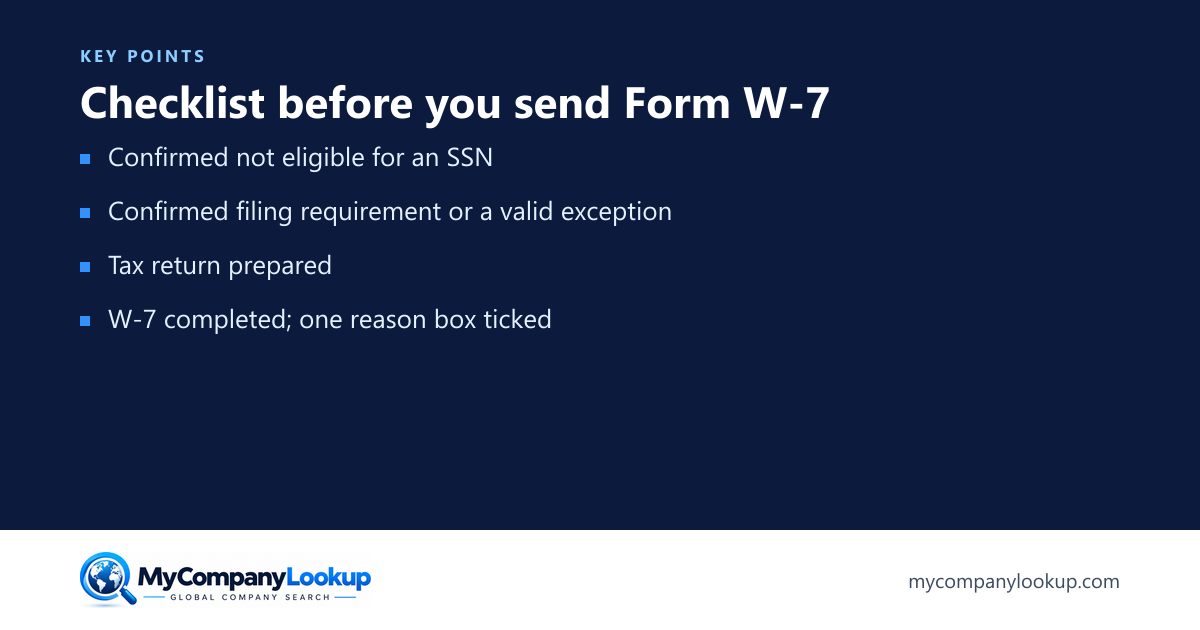
Checklist before you send Form W-7
| Item | Done? |
|---|---|
| Confirmed not eligible for an SSN | |
| Confirmed filing requirement or a valid exception | |
| Tax return prepared (or exception documents gathered) | |
| W-7 completed; one reason box ticked | |
| Name and date of birth match the passport exactly | |
| Passport (original or certified) or two acceptable documents | |
| Decided: mail, CAA or Taxpayer Assistance Center | |
| Copies of everything kept |
Where to get help
- The IRS ITIN pages and Form W-7 instructions are the official sources.
- A Certifying Acceptance Agent can verify your documents so you keep your passport.
- A US tax professional can tell you whether you have a filing requirement at all.
- Biz E-Formations Inc. offers US LLC formation, EIN applications, ITIN support and help opening a business bank account for non-residents.
Common mistakes to avoid
- Applying for an ITIN just to get an EIN. You don't need one; foreign owners can get an EIN without an ITIN.
- Sending notarised photocopies. They're rejected. Send originals, certified copies from the issuing agency, or use a CAA.
- Leaving the ITIN unused. It expires after three consecutive years without being used on a federal return.
- Using the ITIN as an ID for work. It doesn't authorise employment.
- Waiting until April. Peak-season applications take longest.
Spouses and dependents
Many ITIN applications are for family members of US taxpayers rather than for business owners. The rules have a few specifics:
- A non-resident spouse can get an ITIN to be included on a joint return (after an election to be treated as a US resident) or to be claimed for certain tax purposes.
- Dependents must meet the residency and relationship tests to be claimed, and the IRS asks for extra proof of US residency for many dependents, such as school or medical records, unless an exception applies.
- Each person needs their own Form W-7, attached to the same return.
- Certifying Acceptance Agents can authenticate passports and birth certificates for dependents, but in some cases the IRS still requires originals or certified copies to be sent.
Check the dependent rules in the current W-7 instructions carefully, because they're the most common reason family applications are rejected.
Sending the application safely
If you post your application yourself:
- Use a tracked international courier, not ordinary post.
- Put the W-7 on top, then the tax return (or exception documents), then the identity documents.
- Keep copies of everything you send, including the passport pages.
- Don't staple identity documents; use a clip.
- Write your full name on any loose pages, in case they're separated.
The IRS returns original documents to the mailing address on the W-7, usually within about 60 days. Make sure that address is reliable.
After you receive your ITIN
- Use it on your return each year you have a filing requirement, so it doesn't expire.
- Give it to US payers who need it for withholding forms, such as Form W-8BEN for individuals.
- Keep the CP565 notice with your tax records.
- If you later become eligible for an SSN, apply for one and tell the IRS, so your records are combined under the SSN.
If the IRS writes back
If something is missing or unclear, the IRS sends a letter rather than issuing the ITIN. The most common are requests for more documents or corrected information. Reply by the deadline in the letter, send exactly what is asked for, and include a copy of the letter so your reply is matched to your file. If the application is rejected, you can usually apply again with a new W-7 once you've fixed the problem. Keep a note of the date you posted each document and the tracking numbers.
Privacy and security
Your ITIN is sensitive, just like an SSN. Share it only with people who genuinely need it for tax reporting, such as US payers completing withholding forms or your tax preparer. Be wary of emails or calls claiming to be from the IRS and asking for your ITIN or passport details: the IRS usually makes first contact by post. Store your CP565 notice and copies of your W-7 securely, and shred paper copies you no longer need.
Key takeaways
- An ITIN is a US tax processing number for people who can't get a Social Security number.
- You usually apply with Form W-7 attached to the tax return the ITIN is needed for, unless an exception applies.
- A Certifying Acceptance Agent can verify your passport so you don't have to post it to the IRS.
- Allow around seven weeks, longer in peak season or from abroad.
- Use the ITIN on a federal return at least once every three years so it doesn't expire.
- You don't need an ITIN to form a US LLC or to get its EIN.
Related guides
- How to get an EIN for a US LLC as a non-resident
- How to set up a US LLC as a non-resident
- How to choose the cheapest US state to form an LLC
- How to open a business bank account in the US, UK and Canada
The bottom line
An ITIN is the US tax number for people who can't get an SSN. You need one if you have a personal US tax filing requirement or want to claim a treaty benefit, and many non-resident LLC owners don't need one at the start. When you do apply, attach the right return or exception documents, prove your identity with a passport, and use a Certifying Acceptance Agent if you'd rather not post your passport to the IRS. Then use the ITIN at least once every three years so it stays active.
Frequently asked questions
+What is an ITIN?
An Individual Taxpayer Identification Number is a nine-digit number issued by the IRS to people who need a US tax identification number but aren't eligible for a Social Security number.
+Do I need an ITIN to form a US LLC?
No. You can form an LLC without an ITIN or SSN, and a foreign owner can get the LLC's EIN without one too.
+How long does it take to get an ITIN?
The IRS generally says about seven weeks, and nine to eleven weeks during peak season or when applying from abroad.
+Do I have to send my original passport?
Not if you use a Certifying Acceptance Agent, who can verify it and return it to you. Otherwise you must send the original or a certified copy from the issuing agency.
+Does an ITIN expire?
Yes, if it isn't used on a federal tax return at least once in three consecutive tax years. You can renew it with a new Form W-7.
+Does an ITIN let me work in the US?
No. An ITIN is only for tax purposes and doesn't authorise employment or prove immigration status.