How to Check a UK Company Before Doing Business in 2027 and 2028
A practical, step-by-step checklist for verifying any UK limited company before you sign a contract, pay a deposit or hire a supplier, using free official data.
MyCompanyLookup Editorial TeamUpdated 2 Sept 2026 14 min read
In this article
- Why you should check a UK company in 2027 and 2028
- What information is public on Companies House?
- Step 1: Find the exact company, not one with a similar name
- Step 2: Check the company status
- Step 3: Match the company to the people you are dealing with
- Step 4: Find out who really owns and controls the company
- Step 5: Read the accounts and filing deadlines
- Step 6: Scan the filing history for unusual activity
- Step 7: Check charges and insolvency history
- Checks beyond Companies House
- Red flags and green flags at a glance
- How businesses use company checks (B2B)
- How individuals use company checks (B2C)
- What to do if something looks wrong
- If you run a company: keep your own record clean
- How often should you re-check a company?
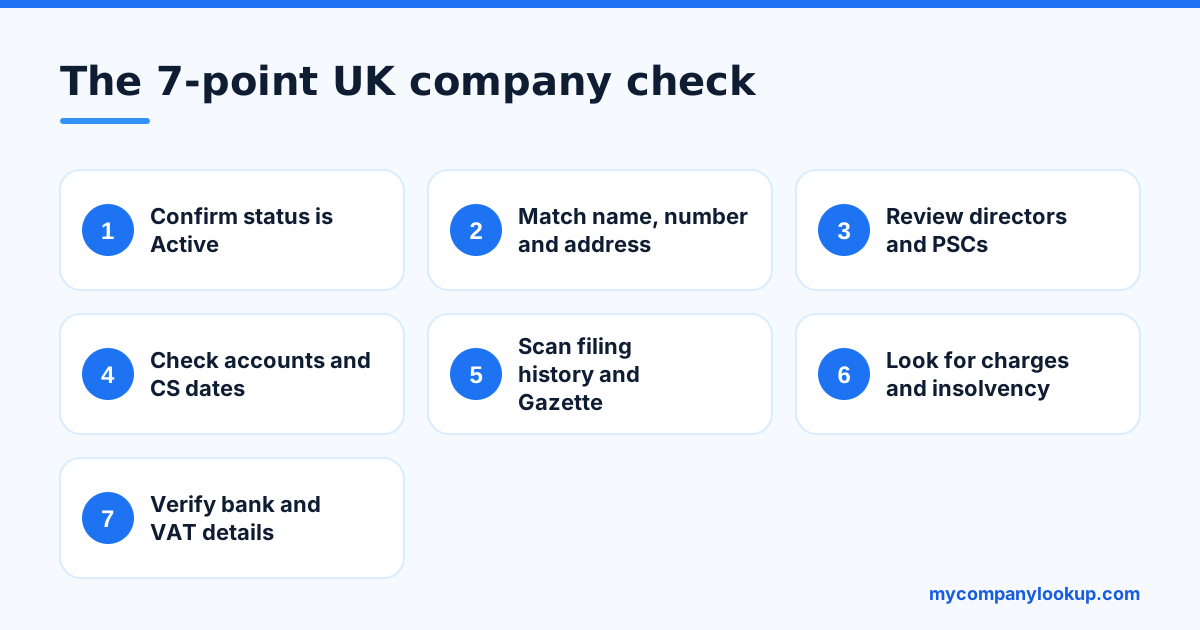
- Summary: the ten-minute UK company check
If you want to check a UK company before you sign a contract, pay a deposit, hire a builder or take on a new customer on credit, you can do almost all of it for free in under ten minutes. Every limited company and LLP in the United Kingdom is registered with Companies House, and the core facts about it are public: its legal name, number, status, registered office, directors, owners, accounts and filing history. This guide walks you through a complete check, step by step, and explains what each piece of information really tells you, which red flags matter and which do not.
You can follow along using our free UK company search, which pulls live data from the official Companies House register, or directly on the government's Find and update company information service. Both show the same official data; our version simply puts the most useful facts and deadlines on one page.
Why you should check a UK company in 2027 and 2028
UK company registration is quick and cheap, which is good for entrepreneurs but also means that anyone can create a company in an afternoon. A professional-looking website, a "Ltd" after the name and a London address do not prove that a business is established, solvent or even real. Most problems we see fall into a few patterns:
- Clone firms that copy the name of a genuine company, sometimes changing a single letter, to take payments from that company's customers.
- Phoenix companies, where directors let one company fail with debts and immediately carry on the same business through a new company.
- Dormant shells that have never traded but are presented as long-established businesses.
- Companies already being struck off, which may be dissolved before your contract even starts.
- Hidden ownership, where the people you are dealing with are not the people who control the company.
Companies House has been given much stronger powers under the Economic Crime and Corporate Transparency Act 2023, including identity verification for directors and people with significant control, the ability to query and remove false information, and new rules for registered office and email addresses. These changes make the register more reliable going into 2027, but they do not replace your own checks. Companies House is a registrar, not a regulator of whether a business is trustworthy.
What information is public on Companies House?
Before starting, it helps to know what you can and cannot see. For a private limited company the public register shows:
| Information | Where to find it | Why it matters |
|---|---|---|
| Company name and number | Company overview | Confirms you have the right legal entity |
| Status (active, dissolved, liquidation and so on) | Company overview | Tells you if the company legally exists and is solvent |
| Registered office address | Company overview | Official address for legal post |
| Incorporation date | Company overview | How long the company has existed |
| Nature of business (SIC codes) | Company overview | What the company says it does |
| Directors and secretaries | Officers tab | Who manages the company |
| People with significant control | PSC tab | Who owns or controls it |
| Accounts and confirmation statements | Filing history | Size, activity and compliance |
| Charges (mortgages) | Charges tab | Whether lenders have security over assets |
| Insolvency history | Insolvency tab | Administration, liquidation, CVA |
What you will not see: bank details, contracts, credit scores, court judgments (those are on the Register of Judgments), or unaudited figures for very small companies that file limited accounts. For those you need other sources, which we cover later.
Step 1: Find the exact company, not one with a similar name
Start with the company number if you have it. Every UK company has a unique registration number, usually eight characters. English and Welsh companies normally use eight digits (for example 01234567), Scottish companies start with SC, Northern Irish companies with NI, and LLPs with OC, SO or NC. The number should appear on the company's invoices, website footer, letterhead and emails, because the law requires it.
If you only have a name, search for it and compare carefully:
- Look for exact spelling, including "Limited" versus "Ltd" (both are allowed), and words like "Group", "Holdings", "UK" or "Services" that distinguish related companies.
- Check the registered office and incorporation date. A genuine company that has traded for twenty years will not have been incorporated last month.
- Compare the number shown on the register with the number on the paperwork you were given.
Run the search on our company search page by typing the name or the number. Opening a company from your own results does not use another free lookup, so you can compare several similarly named companies at no cost.
Tip: if a supplier's invoice shows no company number at all, ask for it. A real limited company has one and is required to display it.
Step 2: Check the company status
The status line is the single most important fact on the page. The common statuses mean:
- Active: the company exists and is not in a formal insolvency or strike-off process. This is what you want to see, but it says nothing about how healthy the company is.
- Active – Proposal to Strike off: a first notice has been published in The Gazette. Companies House or the directors are in the process of removing the company from the register. If the process completes, the company is dissolved and ceases to exist.
- Dissolved: the company no longer exists. It cannot enter contracts, own property or be sued in the normal way. Any assets pass to the Crown.
- Liquidation: the company is being wound up, usually because it is insolvent.
- Administration: an insolvency practitioner is running the company to rescue it or sell the business.
- Voluntary arrangement: the company has a formal agreement with its creditors.
- Receivership: a lender has appointed a receiver over some or all assets.
A proposal to strike off is not always sinister. Many are caused by late accounts and are withdrawn once the company files. But you should not sign a long contract or pay in advance until you understand why it is there. We explain the process in detail in our guide to closing a UK company and the DS01 strike off.
You can confirm Gazette notices yourself on The Gazette, the official public record.
Step 3: Match the company to the people you are dealing with
Open the officers list. It shows current and former directors (and company secretaries if appointed) with their name, month and year of birth, nationality, country of residence, occupation and a service address.
Ask yourself:
- Is the person you are talking to actually a director? If someone introduces themselves as "the owner" but is not listed as a director or PSC, ask what their role is. They might be a genuine employee or manager, or they might be using a company they have no authority over.
- How long have the current directors been in place? A long-established company where every director was appointed in the last few weeks has changed hands. That is not necessarily a problem, but it explains why the history you were told may not match.
- How many other companies do the directors run? Click a director's name to see all their appointments. Dozens of companies, many of them dissolved within a year or two, is a classic pattern of phoenixing or of nominee directors who lend their name to other people's businesses.
- Are any directors disqualified? Disqualified directors appear on a separate register. If a person you are dealing with is acting as a director while disqualified, that is a criminal offence.
From late 2025 onwards Companies House began requiring every director to verify their identity. Over the course of the transition period, a verified director will be linked to a personal code. As this rolls out fully in 2026 and 2027, an unverified director on an active company is a reason to ask questions. We explain the rules in our Companies House identity verification guide.
Step 4: Find out who really owns and controls the company
Directors run a company; shareholders own it. The register shows the owners in two places.
The people with significant control (PSC) register lists anyone who holds more than 25% of the shares or votes, can appoint or remove a majority of the board, or otherwise has significant influence or control. If the PSC is another company (a "relevant legal entity"), follow the chain to see who controls that company.
The confirmation statement and incorporation documents include the shareholder list for most private companies. These are in the filing history as PDFs.
Things to watch for:
- A PSC that is an overseas company in a secrecy jurisdiction, with no individual named behind it.
- A statement that the company "has not yet completed taking reasonable steps to find out" whether it has a PSC, years after incorporation.
- Ownership that does not match what you were told, such as a family business that is actually owned by an unrelated investor.
For a deeper explanation of the five PSC conditions and how to read the register, see our article Who owns a UK company? The PSC register explained.
Step 5: Read the accounts and filing deadlines
Every company must file annual accounts and a confirmation statement. Their dates tell you a lot about how well the business is run.
On our company profile the Deadlines panel shows the next accounts due date and the next confirmation statement due date, and flags anything overdue in red. Overdue filings are one of the most reliable early warning signs we know of: companies in financial trouble often stop filing on time, and Companies House eventually starts strike-off action against companies that do not file.
When you open the latest accounts, note the type:
- Dormant accounts mean the company had no significant transactions in that year. If someone claims a dormant company has been trading successfully, the two cannot both be true.
- Micro-entity accounts show a very short balance sheet. They are legitimate for small companies but reveal little.
- Small company or full accounts show more detail, sometimes including turnover and profit.
Look at net assets (total assets minus liabilities). Negative net assets, sometimes called net liabilities, mean the company owes more than it owns on paper. That is common in start-ups funded by director loans, but it matters if you are being asked to give credit.
Companies House has announced reforms that will require more small companies to file a profit and loss account and to file accounts using software. Check the latest Companies House guidance for the timetable, because these changes will make accounts more informative from 2027 onwards.
The government guide to filing company accounts and tax returns explains the deadlines in detail, and our article on late filing penalties explains what happens when a company misses them.
Step 6: Scan the filing history for unusual activity
The filing history is a timeline of everything the company has told Companies House. Read the last two years. Healthy companies have a dull filing history: one set of accounts and one confirmation statement each year, plus the occasional change of director or address.
Red flags include:
- Frequent changes of registered office in a short period, especially to and from addresses used by many unrelated companies.
- Many director appointments and resignations in quick succession.
- A change of name shortly before you were approached, particularly to a name similar to a well-known brand.
- Notices of a first Gazette notice for compulsory strike-off, even if later discontinued, which show a history of late filing.
- A registered office that Companies House has replaced with its default address, which happens when a company's address is found to be inappropriate.
None of these prove wrongdoing on their own, but a combination of them should make you slow down and ask more questions.
Step 7: Check charges and insolvency history
The charges tab shows whether a lender has registered security over the company's assets. A bank debenture or a mortgage over a property is normal for a trading company. What matters is the pattern: a recently registered charge in favour of an unusual lender, or many outstanding charges from finance providers, can indicate cash-flow stress.
The insolvency tab shows any formal insolvency procedures. Our company profile flags insolvency history at the top of the page so you do not miss it.
Checks beyond Companies House
Companies House tells you that a company exists and who runs it. It does not tell you whether the business does what it says. Depending on what you are buying, add these checks:
- VAT number: if the company charges VAT, verify the number with HMRC's VAT number checker. The name should match the company.
- FCA register: anyone offering financial services, loans or investments must usually be authorised. Search the FCA register and beware of clone firms that copy an authorised firm's details.
- Trade bodies and licences: gas engineers, electricians, letting agents, debt advisers and many other trades have their own registers.
- Bank details: ask for the payee name to match the company name. UK banks now run Confirmation of Payee checks; take a mismatch warning seriously.
- Reviews and footprint: look for an established online presence that matches the company's age and address.
- County court judgments: unpaid court judgments are on the Register of Judgments, Orders and Fines, a paid search.
If the company is based abroad, use our Global Company Finder to reach the official registry in the USA, Canada, the UAE, Singapore or Hong Kong.
Red flags and green flags at a glance
| Green flags | Red flags |
|---|---|
| Active for several years with on-time filings | Overdue accounts or confirmation statement |
| Directors stable and verified | Many recent director changes |
| PSCs are named individuals | Opaque offshore PSC with no individual named |
| Registered office matches trading address or a known agent | Frequent address changes or default Companies House address |
| Accounts type matches the story you were told | Dormant accounts for a "busy" business |
| No insolvency history | Liquidation, administration or strike-off notices |
| Bank payee name matches company name | Payment requested to a personal account |
How businesses use company checks (B2B)
For businesses, checking companies is part of routine risk management:
- Onboarding new customers on credit terms: check status, filing record and net assets before setting a credit limit.
- Supplier due diligence: confirm the supplier exists, has filed accounts and is not in an insolvency process before you place large orders.
- Know Your Customer (KYC): regulated firms must identify beneficial owners. The PSC register is a starting point, though it cannot be relied on alone.
- Sales prospecting: use incorporation dates and SIC codes to find businesses at the right stage.
- Monitoring: re-check key customers regularly. A status change to "proposal to strike off" or a new charge can be an early warning.
Our B2B plans give teams 100 to 500+ lookups per month, which suits accountants, agencies and credit control teams who check companies daily.
How individuals use company checks (B2C)
You do not need to be a business to benefit. Typical personal checks include:
- Builders and tradespeople before paying a deposit.
- Landlords and letting agents, especially when the landlord is a company.
- Online shops you have never heard of before.
- A new employer before you resign from your current job.
- Investment or crypto schemes, which very often use newly registered companies.
Visitors get free lookups every day without an account, and a free account adds monthly lookups.
What to do if something looks wrong
- Pause any payment. It is far easier to stop a payment than to recover it.
- Ask direct questions about anything you found: overdue accounts, recent director changes, a mismatch in names.
- Verify contact details independently, using details from the official register rather than the email you received.
- Report suspected fraud to Action Fraud (or Police Scotland), and report false information on the register to Companies House.
- Get advice before signing anything significant.
If you run a company: keep your own record clean
Your customers are checking you too. A clean public record builds trust:
- File your confirmation statement and accounts on time.
- Make sure directors and PSCs complete identity verification.
- Keep your registered office address and registered email address current.
- File changes of directors and addresses promptly.
If you would rather not deal with it yourself, our Filing Centre handles confirmation statements, accounts, CT600 returns and company changes. Filings are prepared and submitted by Biz E-Formations Inc., our filing partner, and you get email updates at every stage.
How often should you re-check a company?
A company check is a snapshot. The register changes every day as companies file accounts, appoint directors, register charges or enter insolvency. How often you re-check depends on how much you have at stake:
- One-off purchases: check once, immediately before you pay.
- Ongoing suppliers: re-check before each large order or at least every six months.
- Customers on credit terms: re-check before increasing a credit limit and whenever a payment is late. A late payer whose accounts are also overdue is a much higher risk than one who simply forgot.
- Long contracts, leases or partnerships: re-check before signing, before renewal, and whenever you notice changes in the people you deal with.
Pay particular attention to the weeks after a company's accounts deadline. If the deadline passes and nothing is filed, that is new information. Likewise, watch for a change of registered office to an insolvency practitioner's address, which often comes shortly before a formal liquidation.
For teams that track many companies, keep a simple list of company numbers, the date you last checked each one and what you found. A spreadsheet is enough to start. As the list grows, a paid plan with a higher monthly allowance makes regular re-checks practical.
Summary: the ten-minute UK company check
- Search the company by number and confirm it is the right one.
- Check the status is Active and not in strike-off or insolvency.
- Confirm the person you deal with is a director or has authority.
- Identify the people with significant control.
- Check accounts and confirmation statement are up to date.
- Read two years of filing history for unusual activity.
- Look at charges and insolvency history.
- Add VAT, FCA and bank-detail checks where relevant.
Setting up a new company, verifying a director's identity or opening a business bank account? Biz E-Formations Inc. handles company formation, Companies House identity verification and business bank account setup in the UK, USA, Canada and the UAE.
Ready to try it? Search a UK company now using live Companies House data.
Frequently asked questions
+Is it free to check a UK company?
Yes. Basic company information from Companies House is free to view. MyCompanyLookup gives visitors free lookups every day without an account, and a free account adds monthly lookups.
+How can I tell if a UK company is legitimate?
Confirm the company number and name match the paperwork, the status is Active, the directors include the person you are dealing with, accounts and confirmation statements are filed on time, and the bank account name matches the company name.
+What does "proposal to strike off" mean?
It means a first Gazette notice has been published and the company may be removed from the register and dissolved, often because of late filings. It can be withdrawn if the company files what is missing.
+Can I see who owns a UK company?
Yes. The people with significant control (PSC) register lists anyone who owns more than 25% of shares or votes or otherwise controls the company, and confirmation statements usually list shareholders.
+Does Companies House check that information is true?
Companies House now has stronger powers to query and remove false information and requires identity verification for directors and PSCs, but it does not verify that a business is trustworthy. Always add your own checks.
+How do I check a company outside the UK?
Use our Global Company Finder, which links to the official registries for every US state, Canadian province, UAE mainland and free zone, Singapore and Hong Kong.