How to Avoid Companies House Late Filing Penalties in 2027 and 2028
Late accounts cost from £150 to £1,500, doubled if you are late twice. Add HMRC penalties for a late CT600 and strike-off risk. Here is how the penalties work and how to avoid them.
MyCompanyLookup Editorial TeamUpdated 30 Sept 2026 13 min read
In this article
- The three annual filings every UK company makes
- Companies House late filing penalties for accounts
- How the accounts deadline is calculated
- HMRC penalties for a late Company Tax Return (CT600)
- The confirmation statement: no fine, but serious consequences
- Strike-off: the cost beyond the penalty
- Can you appeal a late filing penalty?
- Practical example: what a missed year can cost
- Can you get more time to file accounts?
- Changing your accounting reference date
- Which accounts must small companies file?
- HMRC payment deadlines and interest
- Other penalties that often follow late accounts
- Consequences for directors
- How to make sure you never file late
- A deadline calendar for a typical small company
- Penalties for public companies and LLPs
- Myths about late filing penalties
- Paying a Companies House penalty
- Are late filing penalties tax deductible?
- A note for accountants and agents
- What to do if you are already late
- Upcoming changes to watch in 2027 and 2028
- Summary
Every year, hundreds of thousands of UK companies pay penalties simply for filing late. Most of these penalties are automatic, fixed and entirely avoidable. A small business that misses its accounts deadline by a few weeks pays the same penalty as a large one, and missing the deadline two years in a row doubles it. On top of that, HMRC charges its own penalties for a late Company Tax Return, and a company that keeps missing deadlines risks being struck off. This guide explains how late filing penalties are calculated at Companies House and HMRC, and how to avoid them.
This guide sets out exactly how late filing penalties work for Companies House and HMRC in 2027, how deadlines are calculated, when you can appeal and how to make sure it never happens to you. You can check any company's next deadlines in our UK company search. The Deadlines panel flags overdue filings in red.
The three annual filings every UK company makes
| Filing | Sent to | Deadline | Automatic penalty if late? |
|---|---|---|---|
| Annual accounts | Companies House | 9 months after the accounting reference date (private companies) | Yes, from £150 |
| Company Tax Return (CT600) | HMRC | 12 months after the end of the accounting period | Yes, from £100 |
| Confirmation statement | Companies House | 14 days after the end of the review period | No automatic penalty, but an offence and strike-off risk |
Corporation Tax payment has its own deadline, usually nine months and one day after the end of the accounting period for small and medium-sized companies, with interest charged on late payment.
Companies House late filing penalties for accounts
Companies House penalties for late accounts are set by law and depend on how late the accounts are and whether the company is private or public.
| How late the accounts are | Private company | Public company |
|---|---|---|
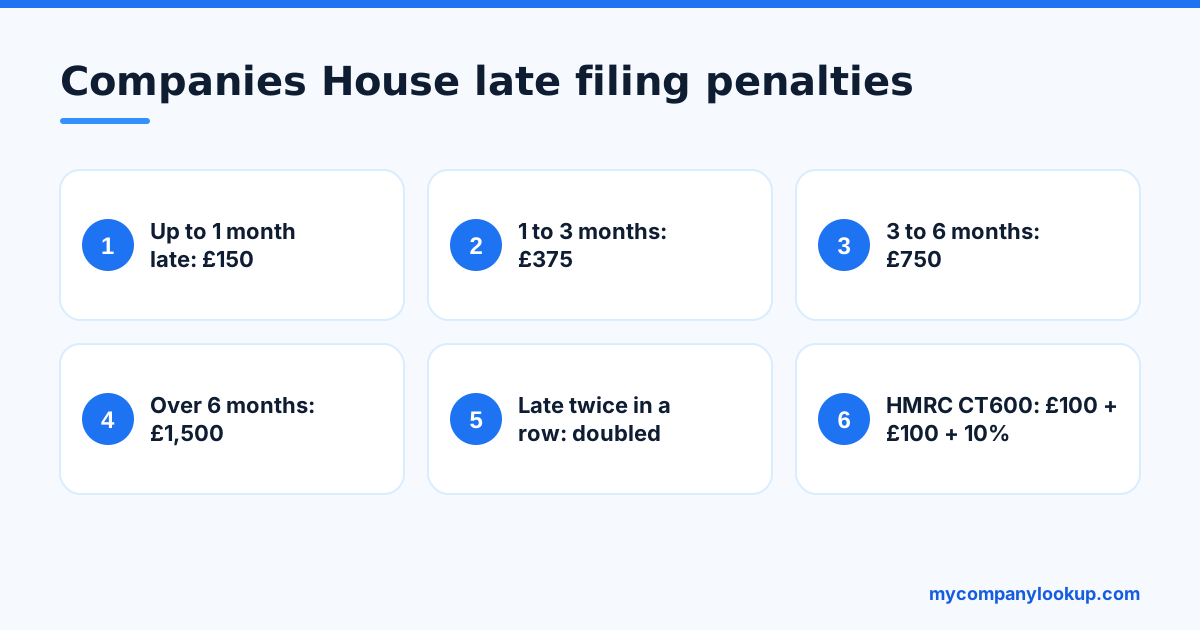
| Up to 1 month | £150 | £750 |
| More than 1 month and up to 3 months | £375 | £1,500 |
| More than 3 months and up to 6 months | £750 | £3,000 |
| More than 6 months | £1,500 | £7,500 |
Penalties double if the company's accounts were also late the previous financial year. So a private company that files more than six months late two years running pays £3,000.
The penalty applies to the company, not to the directors personally, but directors can also be prosecuted for failing to file, and they are responsible for making sure the company files on time. The official rules are on GOV.UK's page about penalties for late filing.
Penalties apply even to dormant companies
The size of the penalty has nothing to do with whether the company traded. A dormant company with £1 in share capital pays exactly the same £150 penalty as a trading company. Our guide to dormant company accounts and nil CT600 returns explains how to file the simplest accounts on time.
"Filed" means accepted, not posted
The accounts must be received and accepted by the deadline. If Companies House rejects your accounts because of an error, they are not filed. If you resubmit after the deadline, the penalty applies. File well before the deadline so there is time to fix any rejection.
How the accounts deadline is calculated
The accounts deadline depends on the accounting reference date (ARD), which is the company's financial year end.
- Normal deadline: 9 months after the ARD for private companies (6 months for public companies). A private company with a 31 March year end must file by 31 December.
- First accounts: 21 months after the date of incorporation for private companies. A company incorporated on 15 April 2026 with a first ARD of 30 April 2027 must file its first accounts by 15 January 2028.
- If you shorten the accounting period: the deadline is either the normal 9 months after the new ARD or 3 months from the date you filed the change, whichever is later.
- Month-end rule: if the ARD is the last day of a month, the deadline is the last day of the corresponding month.
Our company search shows the accounts due date calculated by Companies House for any company, so you do not have to work it out yourself.
HMRC penalties for a late Company Tax Return (CT600)
HMRC penalties are separate from Companies House penalties. You can be charged by both for the same year.
| How late the CT600 is | Penalty |
|---|---|
| 1 day late | £100 |
| 3 months late | Another £100 |
| 6 months late | HMRC estimates the tax due (a determination) and adds a penalty of 10% of the unpaid tax |
| 12 months late | Another 10% of any unpaid tax |
If the return is late three times in a row, the £100 penalties increase to £500 each. Interest is also charged on any Corporation Tax paid late. See GOV.UK's guide to Company Tax Return penalties.
Do you need to file a CT600 at all?
You must file a Company Tax Return if HMRC sends the company a notice to deliver one, which it does for most active companies. Dormant companies that have told HMRC they are dormant may not receive a notice. If you are not sure, read our dormant company guide.
The confirmation statement: no fine, but serious consequences
A late confirmation statement does not trigger an automatic penalty, but it is a criminal offence and it can lead Companies House to strike the company off. The usual sequence:
- The statement becomes overdue.
- Companies House writes to the registered office.
- A first notice for compulsory strike-off is published in The Gazette.
- If nothing is filed, the company is dissolved and any assets pass to the Crown.
Our step-by-step confirmation statement guide explains how to file and what you need, including the identity verification requirements for directors.
Strike-off: the cost beyond the penalty
For a company that ignores missing filings, strike-off is the biggest risk. When a company is struck off and dissolved:
- Its bank accounts are frozen and its assets, including cash, become the property of the Crown.
- Contracts in the company's name can be disrupted.
- Restoring the company requires an application and can be time-consuming and expensive.
Anyone checking your company, including banks, landlords and customers, will see the strike-off notice on the public record.
Can you appeal a late filing penalty?
Companies House appeals
Companies House will only cancel a penalty in exceptional circumstances that genuinely prevented the accounts from being filed on time. Examples that may be accepted include the serious illness or death of a director shortly before the deadline, or events such as a fire or flood that destroyed records. Reasons that are generally not accepted include:
- The accountant was late or let you down.
- You did not know about the deadline or thought the company was too small.
- The company was dormant or had no money.
- The accounts were rejected and you resubmitted late.
- Post was not received because the registered office was out of date.
Appeals must be made in writing with evidence. Companies House has an online appeals service. If the appeal fails you can ask for an independent review.
HMRC appeals
HMRC will consider a reasonable excuse, which is something outside your control that stopped you filing on time, such as serious illness, a failure of HMRC's own systems or a bereavement. You must also file as soon as possible after the excuse ended. HMRC's appeal process is separate from Companies House's.
Practical example: what a missed year can cost
Imagine a small, profitable company with a 31 March 2026 year end. The director forgets about both filings.
- Accounts were due on 31 December 2026. They are filed on 15 April 2027, more than three months late: £750 Companies House penalty.
- The CT600 was due on 31 March 2027. It is filed on 20 July 2027, more than three months late: £200 HMRC penalties (£100 plus £100).
- Corporation Tax was due on 1 January 2027 and paid in July: interest on the late payment.
- The following year the accounts are late again: the Companies House penalty is doubled.
None of this money buys anything. It is all avoidable with a calendar reminder or an agent.
Can you get more time to file accounts?
Companies House can grant an extension to the accounts deadline, but only if you apply before the deadline and only for events outside your control, such as a serious illness, a cyber attack that destroyed records or a natural disaster. An extension is not granted because the accountant is busy or the director forgot. Apply online, explain what happened and how much extra time you need. If refused, the normal deadline and penalties apply.
Changing your accounting reference date
Some companies change their year end to align with a group, a seasonal business cycle or tax planning. This can be done with form AA01, subject to rules:
- You can shorten an accounting period as often as you like.
- You can extend a period only once every five years (with some exceptions), and never to more than 18 months.
- You cannot change a period whose filing deadline has already passed.
Changing the date also changes the filing deadline. If you shorten a period, the new deadline is the later of nine months after the new year end or three months from the date you filed the AA01. Plan carefully: a change made too close to a deadline can create an immediate filing obligation.
Which accounts must small companies file?
The penalty regime is the same regardless of accounts type, but the work involved differs a lot:
| Accounts type | Typical company | What is filed |
|---|---|---|
| Dormant | No significant transactions | Balance sheet and notes |
| Micro-entity | Very small, under the micro thresholds | Short balance sheet; profit and loss prepared but not historically filed |
| Small company | Under the small company thresholds | Balance sheet and notes; profit and loss optional in the past |
| Medium or large | Above the small thresholds | Full accounts, often audited |
Companies House has announced that small and micro companies will have to file a profit and loss account and that filing will move to commercial software. The timing of these changes is set by Companies House, so confirm what applies to your year before you prepare accounts. Whatever the format, the deadline is the same.
HMRC payment deadlines and interest
Filing and paying are different obligations:
- Small and medium companies: Corporation Tax is due nine months and one day after the end of the accounting period, even though the CT600 is not due until twelve months after.
- Large companies (broadly, taxable profits above £1.5 million): tax is paid in quarterly instalments, starting during the accounting period.
- Interest runs on tax paid late from the due date until payment. HMRC also pays a lower rate of interest on overpaid tax.
Corporation Tax rates are 19% for small profits up to £50,000 and 25% above £250,000, with marginal relief between those limits. See GOV.UK's Corporation Tax rates.
Other penalties that often follow late accounts
Companies that miss Companies House deadlines often miss others too:
- VAT: HMRC uses a points-based system for late VAT returns, with a financial penalty once a points threshold is reached, plus separate penalties and interest for late payment.
- PAYE: late Full Payment Submissions can attract penalties based on the number of employees, and late payments attract interest and penalties.
- Confirmation statement: strike-off action, as described above.
If one deadline has slipped, review all of them.
Consequences for directors
Penalties are charged to the company, but directors carry responsibility:
- Failing to file accounts and confirmation statements is a criminal offence for which directors can be prosecuted and fined.
- Persistent default in filing can lead to a director being disqualified, which bars them from acting as a director of any UK company.
- A director's other appointments are visible on the register, so a record of late filings and struck-off companies follows them. Anyone checking a director can see it.
How to make sure you never file late
1. Know your dates
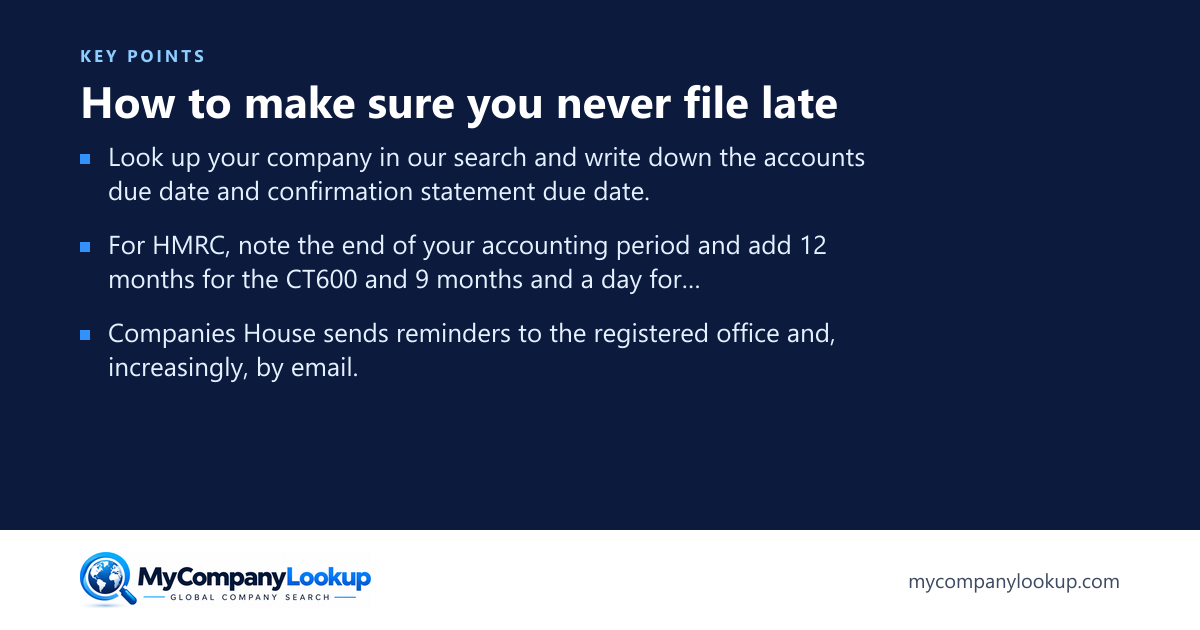
Look up your company in our search and write down the accounts due date and confirmation statement due date. For HMRC, note the end of your accounting period and add 12 months for the CT600 and 9 months and a day for payment.
2. Keep your registered office and email current
Companies House sends reminders to the registered office and, increasingly, by email. If your registered office address is out of date, you will miss them.
3. Sign up for email reminders
Companies House offers email reminders for filing deadlines. Turn them on.
4. Start early
Aim to have accounts ready at least a month before the deadline. That leaves time for rejections, questions from your accountant and director approval.
5. Get directors verified in good time
Since November 2025, directors must verify their identity. A director who has not verified can hold up a confirmation statement.
6. Use an agent if your year is busy
Through our Filing Centre you can order micro-entity accounts, Accounts + CT600, Accounts + nil CT600 for non-trading companies (£50) and confirmation statements (£70 + £50 gov fee). Filings are prepared and submitted by Biz E-Formations Inc., and the order page shows the statutory due date so nothing is missed.
A deadline calendar for a typical small company
Here is how one financial year plays out for a private company with a 31 December year end and a confirmation statement review period ending on 14 June.
| Date | Deadline |
|---|---|
| 31 December 2026 | Financial year ends |
| 28 June 2027 | Confirmation statement due (14 days after the review period ends on 14 June) |
| 30 September 2027 | Accounts due at Companies House (nine months after year end, month-end rule) |
| 1 October 2027 | Corporation Tax payment due (nine months and one day after year end) |
| 31 December 2027 | CT600 due at HMRC (twelve months after year end) |
Notice that Corporation Tax must be paid three months before the CT600 is due, and the accounts and payment deadlines fall within a day of each other. Many companies prepare accounts and the tax return together by early September to meet both comfortably.
Penalties for public companies and LLPs
Public companies have a shorter deadline (six months after the accounting reference date) and much higher penalties, from £750 up to £7,500, as shown in the table above.
LLPs must also file annual accounts with Companies House. They are subject to the same private company penalty scale for late accounts. LLPs do not file a CT600, because their members are taxed individually, but the LLP files a partnership return with HMRC.
Myths about late filing penalties
"If we file late, Companies House will just send a reminder." No. The penalty is automatic the day after the deadline.
"The penalty is per director." No. It is charged to the company, though directors can face separate prosecution.
"A small penalty means nothing else will happen." Repeated late filing leads to doubled penalties, strike-off action, prosecution and possible disqualification.
"Our accountant was late, so we can appeal." Accountant delays are usually not accepted as exceptional circumstances.
"We filed on paper on the deadline day." Paper filings must arrive and be accepted by the deadline. Posting on the deadline day is too late, and paper filing is slower to process.
Paying a Companies House penalty
When a penalty is issued, Companies House sends a notice to the registered office explaining the amount and how to pay. Pay promptly: unpaid penalties can be passed to debt collectors and enforced through the courts. If you intend to appeal, do so quickly and keep evidence of the circumstances. Paying the penalty does not prevent a later doubled penalty if the following year's accounts are also late, so use the experience to fix your process.
Are late filing penalties tax deductible?
No. Penalties charged by Companies House and HMRC are not allowable expenses for Corporation Tax, so a late filing penalty costs the company the full amount with no tax relief. That is one more reason to treat deadlines seriously.
A note for accountants and agents
If you file for clients, the same deadlines apply to every company you manage. Keep a deadline register, collect authentication codes securely, get client approval of accounts early and track identity verification for each director, since unverified directors can delay confirmation statements. Make sure each client's registered office and email are current so that penalty notices and reminders reach someone.
What to do if you are already late
- File immediately. Penalties increase with time, and filing stops strike-off action.
- Pay the penalty when the notice arrives, or appeal if you have exceptional circumstances or a reasonable excuse.
- Check whether the company has a strike-off notice. If so, filing quickly is essential.
- Fix the cause, whether that is an outdated address, a missing authentication code or a lack of records.
- Diary next year's deadlines so that the penalty does not double.
Upcoming changes to watch in 2027 and 2028
Companies House is implementing reforms under the Economic Crime and Corporate Transparency Act. These include changes to the accounts that small and micro companies must file (including a profit and loss account) and a move to filing accounts through software. Companies House has also raised its fees, with the confirmation statement now costing £50 online. Timetables can change, so follow the official Companies House guidance and our News and Fees page for updates.
Summary
- Late accounts: £150 to £1,500 for private companies, doubled if late two years running.
- Late CT600: £100, another £100 after three months, then 10% of unpaid tax at six and twelve months.
- Late confirmation statement: no automatic fine, but an offence and strike-off risk.
- First accounts are due 21 months after incorporation; later accounts 9 months after the year end.
- Appeals succeed only in exceptional circumstances (Companies House) or with a reasonable excuse (HMRC).
- File early, keep addresses current and use reminders or an agent.
Setting up a new company, verifying a director's identity or opening a business bank account? Biz E-Formations Inc. handles company formation, Companies House identity verification and business bank account setup in the UK, USA, Canada and the UAE.
Check your deadlines now with our free company search, or order your filings and let us track them for you.
Frequently asked questions
+How much is the Companies House late filing penalty?
For private companies: £150 up to one month late, £375 up to three months, £750 up to six months and £1,500 after six months. The penalty doubles if accounts were also late the previous year.
+Is there a penalty for a late confirmation statement?
There is no automatic financial penalty, but failing to file is a criminal offence and Companies House may start action to strike the company off.
+What is the HMRC penalty for a late CT600?
£100 if one day late, another £100 at three months, then 10% of unpaid tax at six months and another 10% at twelve months. Penalties rise to £500 if late three times in a row.
+Do dormant companies pay late filing penalties?
Yes. Penalties apply to all companies that file accounts late, whether or not they traded.
+Can I appeal a Companies House late filing penalty?
Only in exceptional circumstances, such as the serious illness of a director close to the deadline. Accountant delays, lack of knowledge or rejected accounts are usually not accepted.
+When are my first company accounts due?
For a private company, first accounts are due 21 months after the date of incorporation.