How to Meet the UK Registered Office Address Rules in 2027 and 2028
Since 2024 every UK company's registered office must be an "appropriate address" and every company needs a registered email. Learn what qualifies, what does not and how to change it.
MyCompanyLookup Editorial TeamUpdated 9 Oct 2026 13 min read
In this article
- What is a registered office address for?
- The jurisdiction rule
- The "appropriate address" test
- What happens if your address is not appropriate?
- The registered email address
- Using your home as the registered office
- Changing your registered office: form AD01
- Choosing a registered office service
- Worked example: moving from home to an accountant's address
- Where the company keeps its registers
- Overseas companies and LLPs
- What happens to post sent to the Companies House default address?
- Disclosure rules: where the address must appear
- Registered office versus other addresses
- Registered office versus trading address on your website
- Using a shared or co-working space
- Does the registered office affect tax or residence?
- Can two companies share a registered office?
- Moving a registered office between providers
- How often should you review your registered office?
- Registered office rules for new companies in 2027
- Common problems and how to fix them
- Official guidance
- How the address rules fit with other reforms
- Checklist: is your registered office compliant?
- Summary
Every UK company must have a registered office address. It is the company's official address on the public register, where Companies House, HMRC, courts and anyone else can send legal documents. For years almost any address would do. Since 4 March 2024, under the Economic Crime and Corporate Transparency Act 2023, the address must be an appropriate address, and Companies House has the power to remove addresses that are not.
This guide explains exactly what the rules require in 2027, whether you can use your home, an accountant's office or a virtual office, what happens if Companies House decides your address is not appropriate, how the registered email address works, and how to change your address correctly. If you need to move your registered office now, our Filing Centre can file the AD01 change for you.
What is a registered office address for?
The registered office is:
- The official address for service of legal documents. A claim form delivered there is validly served on the company.
- Where Companies House and HMRC send official letters, including the company's authentication code, reminders and penalty notices.
- The default place where the company's statutory registers (members, directors, PSCs and so on) are kept, unless they are kept at a single alternative inspection location (SAIL) or on the central register.
- Part of the company's public record, visible to anyone who looks up the company.
It does not have to be where the company trades. Many companies use their accountant's address or a formation agent's address instead.
The jurisdiction rule
A UK company is registered in one of three jurisdictions, and its registered office must be in the same one for its whole life:
| Registered in | Registered office must be in |
|---|---|
| England and Wales | England or Wales (companies registered as Welsh must use an address in Wales) |
| Scotland | Scotland |
| Northern Ireland | Northern Ireland |
You cannot move a company's registered office from England to Scotland, for example. The company number prefix gives a clue: Scottish companies start with SC and Northern Irish companies with NI.
The "appropriate address" test
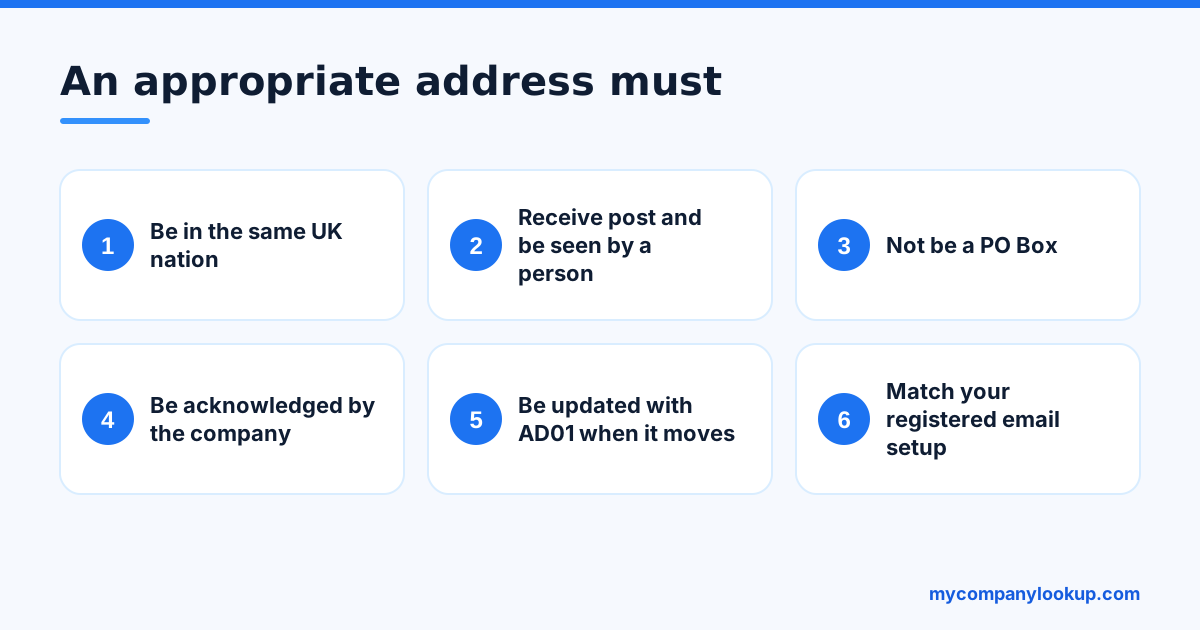
Since March 2024, a registered office address is appropriate only if, in the ordinary course of events:
- Documents addressed to the company and delivered there by hand or by post would be expected to come to the attention of a person acting on behalf of the company; and
- The delivery of documents can be recorded by obtaining an acknowledgement of delivery.
In plain terms, someone acting for the company must actually receive and deal with post sent there, and someone must be able to sign for recorded deliveries.
What does not qualify
- A PO box on its own. It cannot be used as a registered office.
- An address with nobody to receive post, such as an empty property or a building site.
- An address the company has no right to use, such as a random business centre or someone else's home without permission.
- An address used for mass registration without any service actually behind it.
What usually qualifies
- Your home, if you live there and receive the company's post.
- Your trading premises, if post is received and dealt with.
- Your accountant's or solicitor's office, under an agreement to receive and forward post.
- A registered office service from a company formation agent or business centre that receives, records and forwards post, and can sign for deliveries.
Virtual office services are allowed as long as they meet the test. Check that your provider signs for recorded post, scans or forwards everything promptly and has agreed to act for your company.
What happens if your address is not appropriate?
Companies House can act on its own information or on a report from someone else, for example a homeowner whose address has been used without permission. If Companies House is satisfied that the address is not appropriate, it can:
- Change the registered office to a Companies House default address.
- Notify the company, which then has 28 days to provide a new appropriate address.
- If the company does not provide one, Companies House can begin to strike the company off the register.
While the company is at the default address, the public record shows it. Anyone checking your company will see that something is wrong. Banks and payment providers often treat a default address as a red flag.
Post sent to the default address is not forwarded in the normal way, so the company can miss important notices, including late filing penalties and strike-off warnings.
The registered email address
Also since March 2024, every company must have a registered email address. It must be an address where emails sent by Companies House would be expected to come to the attention of a person acting on behalf of the company.
Key facts:
- New companies provide it at incorporation.
- Existing companies were required to provide it on their first confirmation statement after 5 March 2024.
- It is not shown on the public register.
- You can change it at any time, and you confirm it on every confirmation statement.
Use a mailbox that is checked regularly, ideally one that more than one person can access, such as a shared company inbox, rather than a personal email that may lapse when someone leaves.
Using your home as the registered office
Many small company directors use their home address. It is allowed, but think about privacy:
- The registered office is public, permanently visible on the register and in the filing history.
- Using your home links your home address to the company forever, even after you move.
- Since the reforms, people can apply to Companies House in certain circumstances to have their residential address suppressed from historic filings, but this is a separate process with conditions.
Many owners prefer to use an accountant's address or a registered office service to keep their home private. Directors can also use a separate service address for their own correspondence; a director's residential address is never shown on the public register, only the service address.
Changing your registered office: form AD01
To change the registered office, file form AD01 with Companies House. Online filing is free and fast.
Step-by-step
- Choose the new address and make sure it is appropriate and in the correct jurisdiction.
- Get agreement from the address owner or registered office service.
- File AD01 online with the company number and authentication code, or ask an agent to file it.
- Wait for acceptance. The change takes effect when Companies House registers it.
- Update your stationery, website and email signatures. Companies must show their registered office address on business letters, order forms and websites.
- Tell HMRC, your bank and other organisations that use the address.
- Move your statutory registers if they are kept at the registered office.
For 14 days after the change is registered, documents can still be validly served at the old address. Arrange for post to be forwarded during that period.
Through our Filing Centre, the AD01 change costs £30, prepared and submitted by our filing partner Biz E-Formations Inc.
Choosing a registered office service
If you decide not to use your home or trading premises, compare providers on more than price:
| What to check | Why it matters |
|---|---|
| Meets the appropriate address test | Post must reach a person acting for you and deliveries must be acknowledged |
| Signs for recorded and special delivery | Required by the test and essential for court documents |
| Same-day scanning and email alerts | Deadlines and court papers cannot wait for weekly forwarding |
| Forwarding options and costs | Original documents are sometimes needed |
| Written agreement naming your company | Proves you have permission to use the address |
| Anti-money laundering checks | Legitimate providers must verify who you are |
| Notice period if the service ends | Gives you time to file an AD01 before post stops |
| Directors' service address included | Keeps directors' home addresses private too |
Very cheap services that only redirect post occasionally, or that cannot sign for deliveries, are exactly the kind of arrangement the new rules target.
Worked example: moving from home to an accountant's address
Tom formed his company in 2024 using his home address as the registered office. In 2027 he wants more privacy and agrees with his accountant that their office will act as the registered office.
- Tom signs a registered office agreement with the accountant, confirming they will receive, sign for and forward post.
- The accountant files form AD01 online the same day with Tom's authentication code.
- Companies House registers the change the next day. For 14 days, documents can still be validly served at Tom's home.
- Tom updates his website footer, invoice template and email signature with the new registered office.
- He tells HMRC and his bank.
- At his next confirmation statement, he confirms the new address and checks that his registered email address is current.
Tom's home address remains in older filings in the public record. If he has privacy concerns, he can look into whether he qualifies to apply to Companies House to have his residential address suppressed from those historic documents.
Where the company keeps its registers
Companies must keep statutory registers (members, directors, directors' residential addresses, secretaries, PSCs and others). They can be kept:
- At the registered office, which is the default.
- At a single alternative inspection location (SAIL), an address notified to Companies House where the registers are available for inspection.
- On the central register at Companies House, for private companies that elect to do so for some registers, in which case the information is filed with Companies House instead of being kept locally.
If you move the registered office, remember to move the registers too, or notify Companies House of a SAIL.
Overseas companies and LLPs
LLPs follow the same registered office rules as companies, including the appropriate address test and the requirement for a registered email address.
Overseas companies with a UK establishment register the UK establishment with Companies House and provide an address for it, along with details of people authorised to accept service. Overseas entities that own UK land register on the Register of Overseas Entities, which has its own address and verification requirements.
What happens to post sent to the Companies House default address?
When Companies House moves a company to its default address, post sent there is generally not handed to the company in the way a normal registered office would forward it. Treat a default address as an emergency to fix within the 28-day window. Until you do:
- You may miss court documents served on the company.
- You may miss reminders about confirmation statements and accounts.
- Banks and suppliers checking your company will see the default address.
Filing a new appropriate address with AD01 resolves it.
Disclosure rules: where the address must appear
Under the trading disclosure rules, a company must show certain details on its business documents and website, including:
| Where | What to show |
|---|---|
| Business letters, order forms and websites | Registered name, registered number, part of the UK where registered, and registered office address |
| Registered office and other business premises | Company name displayed (a sign) |
| Emails used for business | Registered name and the same details as letters, in practice |
Customers increasingly check these details, so make sure they match the public register exactly.
Registered office versus other addresses
It is easy to mix up the different addresses a company deals with:
| Address | Purpose | Public? |
|---|---|---|
| Registered office | Official legal address of the company | Yes |
| Trading address | Where the company actually does business | Only if you publish it |
| Directors' service address | Where directors receive official post | Yes |
| Directors' residential address | Home address of each director | No (kept by Companies House only) |
| SAIL address | Alternative place to keep statutory registers | Yes, if used |
| Registered email address | Companies House email contact | No |
Registered office versus trading address on your website
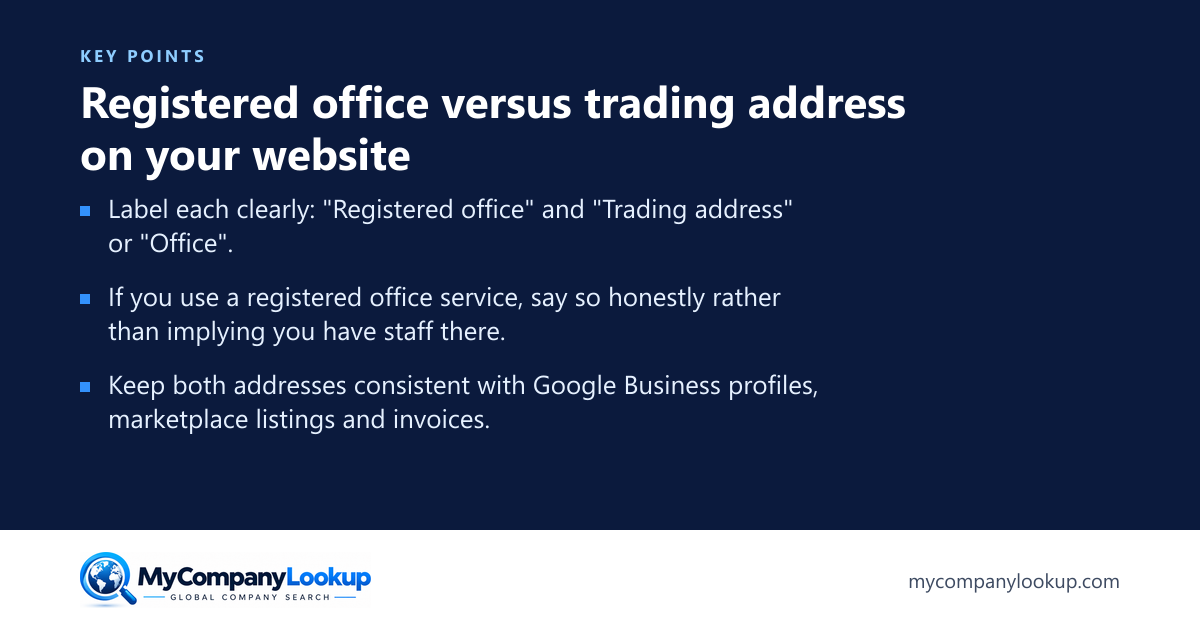
Customers often expect to see where a business actually operates. The law requires the registered office on your website and business documents, but you can also show a trading address. Practical tips:
- Label each clearly: "Registered office" and "Trading address" or "Office".
- If you use a registered office service, say so honestly rather than implying you have staff there.
- Keep both addresses consistent with Google Business profiles, marketplace listings and invoices.
- Include the company number and place of registration with the registered office, for example "Registered in England and Wales, company number 01234567".
People who check your company compare what your website says with the register. Consistency builds trust.
Using a shared or co-working space
Co-working spaces can be a valid registered office if the operator has agreed to act as your registered office and its staff receive and sign for post on your behalf. A hot-desk membership on its own may not include this. Ask the operator:
- Will you accept post and sign for recorded deliveries for my company?
- How quickly will you tell me about official letters?
- Can I use your address on the public register, and is that in writing?
- What happens to my post if I end my membership?
If the answers are unclear, use a dedicated registered office service instead.
Does the registered office affect tax or residence?
The registered office address itself does not decide where a company pays tax. A company incorporated in the UK is generally UK tax resident regardless of its address. Where the company is managed and controlled, and where it trades, matter more for tax questions, so take advice if directors live abroad.
Can two companies share a registered office?
Yes. Many companies can use the same registered office, which is how accountants and formation agents operate. What matters is that each company's post reaches a person acting for that company and deliveries can be acknowledged. Group companies commonly share one registered office at the head office. The concern under the new rules is with addresses used by large numbers of companies where nobody actually deals with the post.
Moving a registered office between providers
When you switch provider, avoid a gap. Sign up with the new provider first, file the AD01 with the new address, wait until Companies House shows the change, and only then end the old service. Ask the old provider to forward anything received during the following 14 days, because documents can still be validly served at the old address during that period. Finally, update every place where the old address appears: your website, invoices, HMRC, your bank, payment providers and any licences.
How often should you review your registered office?
Review it at least once a year, ideally when you file your confirmation statement, and whenever:
- Your provider changes ownership, moves or changes its terms.
- You move home, if you use your home address.
- Your accountant changes.
- You stop receiving post you expect, such as HMRC letters or Companies House reminders.
- Directors change, since new directors need to know where official post arrives.
Registered office rules for new companies in 2027
When forming a new company, you must provide:
- A registered office address that meets the appropriate address test, in the correct jurisdiction.
- A registered email address.
- A statement that the company's intended activities are lawful.
- Verified identities for directors and PSCs, as explained in our identity verification guide.
Formation agents usually offer a registered office service with the incorporation. Biz E-Formations Inc. provides UK formations with registered office options; see bizeformations.com/company-formation/uk.
Common problems and how to fix them
Post goes missing. If your registered office service closes or your accountant moves, letters stop reaching you. Review your registered office every year when you file the confirmation statement.
Someone used your address without permission. Report it to Companies House. Under the reforms, Companies House can investigate and change the company's address to the default address.
The company was moved to the default address. File AD01 with a new appropriate address within 28 days and confirm the company is still operating. If the company is no longer needed, consider closing it properly with a DS01 instead.
Your authentication code went to an old address. Request a new code; it will be posted to the current registered office, so update the address first if needed.
Official guidance
The legal requirements are explained on GOV.UK's pages about your registered office address and filing changes to a company with Companies House. Companies House also publishes guidance on the appropriate address requirement and registered email addresses on its GOV.UK organisation page.
How the address rules fit with other reforms
The appropriate-address rule is one of several changes introduced by the Economic Crime and Corporate Transparency Act. Others include identity verification for directors and PSCs, the lawful purpose statement on incorporation and each confirmation statement, stronger name checks and new powers for Companies House to query and remove information. Together they make the public register more reliable for everyone who relies on it. We post updates on these changes on our News and Fees page.
Checklist: is your registered office compliant?
- The address is in the correct UK jurisdiction.
- Someone acting for the company receives post there.
- Recorded deliveries can be signed for.
- It is not just a PO box.
- You have permission to use it.
- Your registered email address is monitored.
- Your website, letters and order forms show the address correctly.
- You review it every year with the confirmation statement.
Summary
- Every UK company needs a registered office address in its jurisdiction of registration.
- Since March 2024 it must be an appropriate address: post must reach a person acting for the company and deliveries must be acknowledged.
- PO boxes alone are not allowed; virtual office services are allowed if they meet the test.
- Companies House can move an inappropriate address to its default address and give the company 28 days to fix it.
- Every company must also have a registered email address, which is not public.
- Change the address with form AD01 and update your disclosures.
Need to change your address? Order an AD01 change, or check your company's current address.
Frequently asked questions
+Can I use a PO box as my company's registered office?
No. A PO box alone is not an appropriate address. The registered office must be a place where post reaches a person acting for the company and deliveries can be acknowledged.
+Can I use my home address as a registered office?
Yes, if you receive the company's post there. Remember that the registered office is permanently public, so many owners use an accountant or registered office service for privacy.
+What is an appropriate address for a registered office?
An address where documents delivered by hand or post would be expected to come to the attention of a person acting for the company, and where delivery can be acknowledged.
+What happens if Companies House says my address is not appropriate?
Companies House can change your registered office to its default address. You then have 28 days to provide an appropriate address, or the company may be struck off.
+How do I change my registered office address?
File form AD01 with Companies House online. The change takes effect when registered, and documents can still be served at the old address for 14 days.
+Is the registered email address public?
No. Every company must have a registered email address for Companies House, but it is not shown on the public register.