How to Close a UK Company in 2027 and 2028: DS01 Strike Off Step by Step
Closing a company you no longer need is simple if you do it in the right order. Here is how to strike off a solvent UK company with form DS01 and avoid the common traps.
MyCompanyLookup Editorial TeamUpdated 7 Oct 2026 13 min read

In this article
- Three ways to close a UK company
- Can you use a DS01? The eligibility rules
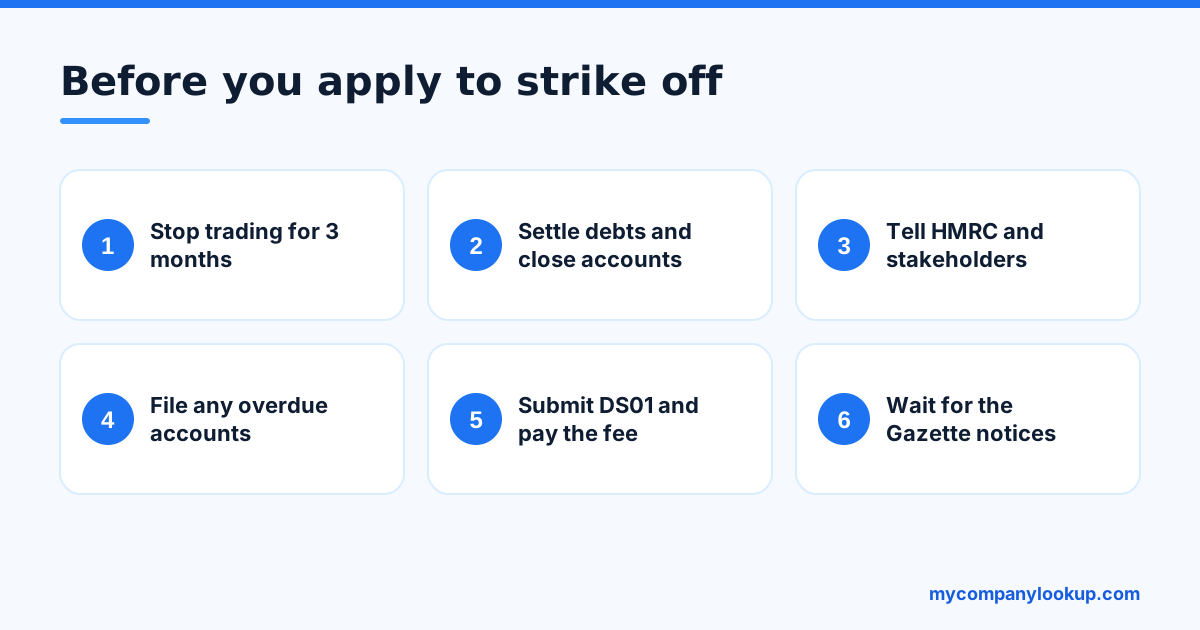
- Step 1: Stop trading and wait three months
- Step 2: Settle debts and deal with assets
- Step 3: Tell HMRC and close tax accounts
- Step 4: Bring filings up to date
- Step 5: Tell everyone with an interest
- Step 6: Submit the DS01 and pay the fee
- Step 7: The Gazette timeline
- What happens after dissolution
- Restoring a struck-off company
- Worked example: closing a consultancy company
- Director's loan accounts and closing a company
- Domain names, trademarks and other intangible assets
- LLPs and strike off
- When Companies House is striking off your company
- Can you reuse the company name?
- Official guidance
- DS01 versus members' voluntary liquidation
- Common reasons strike-off applications fail
- Should you use an accountant or agent?
- After the company is dissolved: what directors should keep
- Checking the result
- Dormant first, or close straight away?
- Telling customers, suppliers and banks
- Checklist before you submit a DS01
- Closing companies outside the UK
- Summary
Many companies outlive their purpose. A project ends, a director retires, a business is sold as assets, or a company set up "just in case" was never used. Keeping it costs money every year in filings and fees, and every deadline missed creates penalties. If the company is solvent and has no further use, the simplest way to close a UK company is to apply to have it struck off the register using form DS01.
This guide explains when you can use a DS01, what to do before you apply, the step-by-step process and Gazette timeline, what happens to money left in the company, when you need a liquidator instead, and how to avoid the mistakes that cause applications to fail or assets to be lost. If you would rather hand it over, our Filing Centre can file your DS01 for you.
Three ways to close a UK company
| Route | When it is used | Who runs it | Typical cost |
|---|---|---|---|
| Voluntary strike off (DS01) | Solvent company with no further use | Directors | Companies House fee plus any agent fee |
| Members' voluntary liquidation (MVL) | Solvent company with significant assets to distribute | Licensed insolvency practitioner | Professional fees |
| Creditors' voluntary or compulsory liquidation | Insolvent company that cannot pay its debts | Licensed insolvency practitioner or Official Receiver | Professional fees or court process |
Companies House can also strike off a company itself (compulsory strike off) when it believes the company is no longer operating, usually because it has stopped filing. That is not a way to close a company deliberately; it leaves directors exposed and the record damaged.
This guide focuses on voluntary strike off, which suits most small, solvent companies.
Can you use a DS01? The eligibility rules
You can apply to strike off a company only if, in the three months before applying, the company has not:
- Traded or otherwise carried on business, except for things needed to close it down, such as paying debts or settling its affairs.
- Changed its name.
- Been the subject of, or proposed to be the subject of, insolvency proceedings or a scheme of arrangement.
- Sold or disposed of property or rights that it would have sold in the normal course of business before it stopped trading.
The application must be signed by all of the directors, or a majority if there are more than two.
You should not use a DS01 if:
- The company owes money it cannot pay. Creditors can object, and directors who strike off an insolvent company to avoid debts risk personal liability and disqualification.
- The company is involved in legal proceedings.
- The company has assets you have not dealt with, such as property, investments or cash above what you can distribute (see the £25,000 rule below).
Step 1: Stop trading and wait three months
Stop all business activity and leave at least three months between the last trading activity and the DS01 application. Use this time to tidy up. Bear in mind that the DS01 asks you to confirm the three-month conditions, and making a false statement is an offence.
Step 2: Settle debts and deal with assets
Before applying:
- Pay all creditors, including suppliers, HMRC, landlords and director loan accounts where appropriate.
- Collect money owed to the company.
- Sell or transfer assets such as equipment, vehicles, domain names and intellectual property.
- Cancel contracts, insurance, subscriptions and direct debits.
- Distribute remaining funds to shareholders, observing the rules below.
- Close the company bank account.
Closing the bank account is essential. When a company is dissolved, any property it still owns, including cash in its bank account, passes to the Crown as bona vacantia. Getting it back requires the company to be restored, which is time-consuming and costly.
The £25,000 rule for distributions
When a solvent company is closed by strike off, distributions to shareholders of up to £25,000 in total can generally be treated as capital rather than income for tax purposes. If the amount to distribute is above £25,000, the whole distribution can be taxed as income dividends unless the company is wound up through a formal members' voluntary liquidation. For larger amounts, speak to an accountant about whether an MVL is more tax-efficient.
Step 3: Tell HMRC and close tax accounts
HMRC needs to know the company is closing:
- Corporation Tax: file the final Company Tax Return (CT600) for the period up to the date trading stopped, and pay any tax due. If the company then has no income, tell HMRC it is dormant. See our guide to dormant company accounts and nil CT600.
- VAT: cancel the VAT registration.
- PAYE: close the payroll scheme and send final submissions if the company had employees, including directors on payroll.
- Other registrations: close any other HMRC registrations such as Construction Industry Scheme.
HMRC can object to the strike off if it has unfinished business with the company, so dealing with it first prevents delays.
Step 4: Bring filings up to date
Companies House will not normally accept a strike-off application while the company has outstanding filings. Before applying:
- File any overdue accounts. Late accounts still attract late filing penalties.
- File any overdue confirmation statement. Our confirmation statement guide explains how.
- Make sure directors have verified their identity where required.
You do not usually need to file final accounts with Companies House for the period after trading stopped if you apply to strike off promptly, but you must still provide HMRC with what it requires.
Step 5: Tell everyone with an interest
Within seven days of submitting the DS01, you must send a copy of the application to everyone with an interest in the company, including:
- Shareholders (members).
- Creditors, including any contingent creditors.
- Employees.
- Managers or trustees of any employee pension fund.
- Any directors who did not sign the application.
Failing to notify interested parties is an offence and gives them grounds to apply for the company to be restored later.
Step 6: Submit the DS01 and pay the fee
The DS01 can be filed online or on paper. Online is faster. You will need:
- The company number and authentication code (for online filing).
- The details of all directors signing the application.
- Payment of the Companies House fee. Check the current fee when you file, as Companies House fees increased in 2024 and again in February 2026. Our Filing Centre shows the current fee at checkout.
Through our Filing Centre, Biz E-Formations Inc. prepares the application, checks the company is eligible, files it and emails you at each stage.
Step 7: The Gazette timeline
After Companies House accepts the application:
- Companies House publishes a first notice in The Gazette, the official public record, announcing that the company will be struck off unless there is cause to the contrary. The company's status changes to "Active – Proposal to Strike off".
- There is a period of at least two months for objections.
- If no valid objection is received, Companies House strikes the company off and publishes a second notice in The Gazette. The company is dissolved and ceases to exist.
The whole process typically takes around three months from application, assuming no objections. You can follow the status on our company search.
Objections
Creditors, HMRC and other interested parties can object. Common reasons include unpaid debts, outstanding tax returns or ongoing legal action. If an objection is upheld, the strike off is suspended until the issue is resolved.
Withdrawing the application
If the company starts trading again, changes its name, becomes subject to insolvency proceedings or otherwise stops meeting the conditions, the directors must withdraw the application using form DS02. Withdrawal is also used if you change your mind.
What happens after dissolution
Once dissolved:
- The company no longer exists and cannot trade, own property or enter contracts.
- Remaining assets belong to the Crown.
- The company's records remain on the public register.
- Directors must keep the company's books and papers for a period after dissolution (generally at least seven years is advised).
- Directors can still be held accountable for wrongdoing while the company existed.
Restoring a struck-off company
If you discover that the company still had assets, a contract to complete or a claim to make, it may be possible to restore it:
- Administrative restoration is available in some cases where Companies House struck off the company itself (not after a voluntary DS01), generally within six years.
- Restoration by court order is available more widely, including after a voluntary strike off, but involves court proceedings.
Restoration is far more expensive than getting the closure right first time.
Worked example: closing a consultancy company
Priya ran a one-person consultancy through a limited company with a 31 March year end. She takes a permanent job and stops trading on 31 January 2027.
| Date | Action |
|---|---|
| February 2027 | Last client invoices paid; supplier bills and the accountant paid |
| February 2027 | VAT registration cancelled; final PAYE submission made |
| March 2027 | Remaining cash of £18,000 distributed to Priya as the only shareholder; bank account closed |
| March 2027 | Accounts to 31 January 2027 and final CT600 prepared; Corporation Tax paid |
| 1 May 2027 | Three months have passed since trading stopped; DS01 filed online |
| Within 7 days | Copy of the DS01 sent to HMRC and anyone else with an interest |
| May 2027 | First Gazette notice published; status shows "proposal to strike off" |
| August 2027 | No objections; company struck off and dissolved; second Gazette notice published |
Because the distribution was below £25,000, it was treated as a capital distribution rather than a dividend, subject to the anti-avoidance rules, which do not apply because Priya is not carrying on a similar trade through another company.
Director's loan accounts and closing a company
Before closing, check the director's loan account:
- If the company owes the director money, the company can repay it before closing. That repayment is not taxable income for the director.
- If the director owes the company money (an overdrawn loan account), the loan must be repaid, written off or treated as part of the distribution. Writing off a director's loan usually has tax consequences for the director, and an overdrawn loan outstanding at the year end can trigger a temporary Corporation Tax charge for the company. Ask your accountant how to clear it.
Leaving an overdrawn loan account in place when the company is dissolved does not make the debt disappear in a way that helps the director. It is one of the issues that can lead to a dissolved company being restored.
Domain names, trademarks and other intangible assets
Intangible assets are easy to forget:
- Domain names registered to the company should be transferred to the director or a new owner before dissolution.
- Trademarks owned by the company should be assigned, or they pass to the Crown with everything else.
- Social media accounts, software licences and marketplace accounts registered in the company's name should be closed or transferred.
- Leases and guarantees: check that any lease is surrendered and any personal guarantee given by a director is released.
LLPs and strike off
Limited liability partnerships can also be struck off voluntarily using the LLP version of the form (LL DS01). The same broad conditions apply: no trading, no name change and no disposal of property in the previous three months, notifying interested parties and dealing with assets first. LLP members should also consider any obligations to each other under the LLP agreement.
When Companies House is striking off your company
If your company is showing "proposal to strike off" because Companies House believes it is no longer operating, usually because of late filings, you have two options:
- Keep the company: file the overdue accounts and confirmation statement immediately. In most cases this stops the strike-off action. You can also ask Companies House to suspend the action while you bring filings up to date.
- Close the company properly: if you no longer need it, follow the voluntary process in this guide. Letting a compulsory strike off complete leaves your record damaged and any assets passing to the Crown.
Anyone checking your company can see a strike-off notice, so act quickly either way.
Can you reuse the company name?
Once a company is dissolved, its name usually becomes available for a new company. There is an important exception: if a company went into insolvent liquidation, its directors are restricted from using the same or a similar name for another company for five years, except in permitted circumstances. This "prohibited name" rule does not apply to a solvent voluntary strike off, but you should still be careful not to give customers the impression that the new company is the old one.
Official guidance
GOV.UK explains the options on its pages about closing a limited company and striking off your company from the Companies Register. Gazette notices can be checked on The Gazette.
DS01 versus members' voluntary liquidation
| DS01 strike off | Members' voluntary liquidation | |
|---|---|---|
| Suitable for | Small solvent companies with little left to distribute | Solvent companies with significant reserves |
| Managed by | Directors | Licensed insolvency practitioner |
| Distribution treatment | Up to £25,000 generally treated as capital | Distributions generally treated as capital, subject to anti-avoidance rules |
| Protection from later claims | Limited; company can be restored | Formal process with advertisement for creditors |
| Cost | Low | Professional fees |
| Typical timescale | About 3 months | Several months |
Common reasons strike-off applications fail
| Problem | What happens | How to avoid it |
|---|---|---|
| Overdue accounts or confirmation statement | Companies House may reject or delay the application | Bring filings up to date first |
| HMRC objection | Strike off suspended | File final returns and pay tax before applying |
| Creditor objection | Strike off suspended | Pay all debts or agree settlements |
| Not all directors signed | Application invalid | Get every director's signature, or a majority if more than two |
| Company traded within three months | Application improper; possible offence | Wait three months after the last activity |
| Interested parties not notified | Offence; grounds for restoration | Send copies within seven days |
| Money left in the bank account | Funds pass to the Crown on dissolution | Close the account before applying |
Should you use an accountant or agent?
Many directors file a DS01 themselves, and for a simple dormant company it is straightforward. Professional help is worthwhile when:
- The company has traded and needs final accounts and a final CT600.
- There is cash to distribute and you want the £25,000 treatment handled correctly.
- There is a director's loan account to clear.
- There are employees, a pension scheme or VAT to close down.
- The company is behind on filings and you want the strike off to go through first time.
Through our Filing Centre, Biz E-Formations Inc. checks eligibility, files the DS01 and tracks the Gazette notices, and our team can arrange final accounts and the nil or final CT600 if needed.
After the company is dissolved: what directors should keep
Directors should keep:
- The company's accounting records and statutory registers.
- Copies of the DS01, the notices sent to interested parties and evidence of delivery.
- Final tax returns and HMRC correspondence.
- Bank statements showing the account was closed and funds distributed.
These records protect you if HMRC, a former creditor or a shareholder later raises questions, or if the company ever needs to be restored.
Checking the result
After the second Gazette notice, search the company on our UK company search. The status should show "Dissolved" with the dissolution date. Keep a screenshot with your records as proof that the closure completed, and tell anyone who still writes to the company.
Dormant first, or close straight away?
Some owners stop trading and leave the company dormant for a year before deciding. That keeps options open but costs a year of filings: dormant accounts, a confirmation statement and the £50 fee. If you are sure the company has no future, closing it as soon as the three-month condition is met is usually cheaper and simpler.
Telling customers, suppliers and banks
Closing the company formally is only part of the job. Before the strike off:
- Tell customers that the company is ceasing to trade and who, if anyone, will continue to serve them.
- Tell suppliers to close accounts and stop deliveries.
- Cancel insurance at the right time, keeping cover until the business has fully stopped.
- Update your website, or take it down, so that it does not invite new orders.
- Tell your bank you intend to close the account and confirm how remaining funds will be paid out.
A clean, well-communicated closure protects your reputation if you start another business later, and it means anyone who checks the company afterwards sees an orderly record.
Checklist before you submit a DS01
- No trading, name change or asset disposals in the last three months.
- All creditors paid and debts collected.
- Assets sold, transferred or distributed.
- Bank account closed.
- Final CT600 filed, VAT and PAYE closed.
- Accounts and confirmation statement up to date.
- All directors ready to sign.
- List of everyone who must receive a copy within seven days.
- Authentication code available.
Closing companies outside the UK
Every country has its own dissolution process. A US LLC is usually dissolved by filing articles of dissolution with the state and closing tax accounts, including any final Form 5472 for non-resident owners. In the UAE, licences must be cancelled with the licensing authority and visas cancelled, and companies must deregister for corporate tax and VAT. Singapore and Hong Kong have their own striking-off and deregistration procedures. Our Global Company Finder links to each official registry.
Summary
- A DS01 voluntary strike off is the simplest way to close a small solvent UK company.
- The company must not have traded, changed its name or disposed of assets in the three months before applying.
- Pay creditors, distribute assets, close the bank account and tell HMRC first.
- Send copies to shareholders, creditors and employees within seven days.
- The company is dissolved after a first Gazette notice and at least two months without objection.
- For distributions above £25,000, consider a members' voluntary liquidation.
Setting up a new company, verifying a director's identity or opening a business bank account? Biz E-Formations Inc. handles company formation, Companies House identity verification and business bank account setup in the UK, USA, Canada and the UAE.
Ready to close a company? Order a DS01 strike off or check the company's status first.
Frequently asked questions
+How long does it take to strike off a company with a DS01?
Usually about three months. Companies House publishes a first Gazette notice and, if there are no objections after at least two months, dissolves the company.
+Can I close a company that owes money?
You should not use a DS01 to avoid debts. Creditors can object, and an insolvent company should be closed through a formal insolvency process with a licensed insolvency practitioner.
+What happens to money left in the company bank account?
When a company is dissolved, its remaining assets, including bank balances, pass to the Crown. Close the bank account and distribute funds before applying.
+How much can I take out when closing a company?
Distributions of up to £25,000 in total on a strike off can generally be treated as capital. Above that, consider a members' voluntary liquidation and take advice.
+Do I need to tell HMRC before striking off my company?
Yes. File the final Company Tax Return, pay any tax and close VAT and PAYE registrations. HMRC can object if anything is outstanding.
+Can a struck-off company be restored?
Yes, in some cases by administrative restoration or by court order, but it is costly. It is better to deal with all assets and obligations before applying.