How to File Dormant Company Accounts and a Nil CT600 in 2027 and 2028
A non-trading company still has filing duties. Here is exactly what counts as dormant, which accounts to file, when HMRC needs a nil CT600 and how to avoid penalties.
MyCompanyLookup Editorial TeamUpdated 10 Sept 2026 14 min read
In this article
- What does "dormant" mean?
- Step 1: Confirm whether your company is really dormant
- What a dormant company must file each year
- Dormant accounts explained
- Accounts deadlines for a dormant company
- HMRC and the nil CT600
- Why non-trading companies get penalties
- Step-by-step: filing dormant accounts and a nil CT600
- Keeping a dormant company in good standing
- When a dormant company starts trading
- Should you keep a dormant company or close it?
- Frequently confused points
- How we can help
- What a dormant balance sheet looks like
- Worked example: a dormant company's first two years
- Dormant subsidiaries in a group
- VAT, payroll and other registrations while dormant
- Records to keep while a company is dormant
- Dormant companies and bank accounts: a quick decision guide
- Official guidance
- Summary
Many UK limited companies do nothing for long stretches. Some are set up to protect a name, some are waiting for a project to start, and some have simply stopped trading. A company that is not trading still exists in law, and it still has filing obligations. Getting dormant company accounts and the nil Corporation Tax return right is cheap and quick. Getting them wrong leads to automatic penalties, strike-off notices and HMRC letters. This guide explains how to file dormant accounts at Companies House and a nil CT600 with HMRC in 2027 and 2028.
This guide explains what "dormant" actually means (it means two slightly different things to Companies House and HMRC), what to file with each, the deadlines for 2027 and the mistakes we see most often. If you just want it done, our Filing Centre offers Accounts + CT600 for a non-trading company for £50.
What does "dormant" mean?
The word is used by two government bodies with different definitions.
For Companies House, a company is dormant if it has had no significant accounting transactions during the financial year. A significant accounting transaction is one the company must record in its accounting records. Some transactions are ignored for this test:
- Fees paid to Companies House (for example the confirmation statement fee or a change of name fee).
- Penalties for late filing of accounts.
- Money paid for shares when the company was formed (the initial subscription).
So a company whose only activity was paying its confirmation statement fee is still dormant for Companies House. A company that received even a small amount of bank interest, paid a bank charge, bought a domain name or issued an invoice is not dormant for Companies House, even if it did no real business.
For HMRC and Corporation Tax, a company is dormant if it is not carrying on any business activity (no trading, no investment income, no other income). HMRC may treat a company as dormant for Corporation Tax if it is a new company that has not started trading, or if it has stopped trading.
A company can therefore be dormant for one body and not the other. The most common example is a non-trading company with a bank account that earns a few pounds of interest. It has income, so it is not dormant for Companies House accounts purposes, and it may need to report that income to HMRC.
Step 1: Confirm whether your company is really dormant
Before choosing what to file, review the year:
- Look at the company bank statements for the whole financial year. Any money in or out, other than Companies House fees, is a transaction.
- Check whether any director paid expenses on the company's behalf. If they did and the company owes them the money, that is a transaction.
- Check for invoices, contracts, payroll, VAT returns or any other sign of activity.
If there were no transactions at all, the company is dormant for Companies House. If there were transactions, you need small or micro-entity accounts instead, even if the company made no profit. Our Filing Centre also offers micro-entity accounts for companies with a small amount of activity.
What a dormant company must file each year
| Filing | Who receives it | When | Fee |
|---|---|---|---|
| Annual accounts (dormant) | Companies House | 9 months after the accounting reference date | None |
| Confirmation statement | Companies House | Within 14 days after the end of each review period | £50 online |
| Company Tax Return (CT600) | HMRC | Only if HMRC has sent a notice to deliver a return, or the company is not dormant for tax | None |
Even if nothing happened during the year, the accounts and confirmation statement are always required while the company exists. The CT600 depends on HMRC's position, explained below.
Dormant accounts explained
Dormant company accounts are the simplest accounts a company can file. For a small dormant company they usually consist of:
- A balance sheet showing the company's assets and liabilities at the year end. For many dormant companies this is just the unpaid or paid share capital, for example £1 or £100 of share capital owed by the shareholder or held as cash.
- Notes required by law, including a statement that the company was dormant throughout the year.
- A directors' statement that the company was entitled to exemption from audit as a dormant company, that the members have not required an audit and that the directors acknowledge their responsibilities.
- The name and signature of a director and the date of approval.
Companies House has historically offered a dedicated online form for dormant company accounts (often referred to as AA02 for small dormant companies). Companies House has announced that accounts filing will move to commercial software, so the exact route may change during 2027. Check the current guidance on GOV.UK's page about dormant companies before you file, or use an agent who files through approved software.
Who cannot use dormant accounts?
You cannot file dormant accounts if the company:
- Had any significant accounting transactions during the year.
- Is a public company that is not small, or is in a regulated sector such as banking or insurance.
- Was not dormant for the whole financial year (for example it traded for the first three months and then stopped).
In those cases file small or micro-entity accounts for the year in which activity stopped. Next year, if there are no transactions at all, the company can return to dormant accounts.
Accounts deadlines for a dormant company
The deadline is the same as for any private company: nine months after the accounting reference date (the company's financial year end).
For the first accounts after incorporation, the deadline is 21 months after the date of incorporation. That catches many owners out: they assume they have nine months after the first anniversary, when the first period often runs for more than twelve months.
You can see the next accounts due date for any company in our UK company search. Late accounts attract automatic penalties from £150, doubled if you are late two years running, even if the company is dormant. The full table is in our guide to Companies House late filing penalties.
HMRC and the nil CT600
Corporation Tax works differently. HMRC does not automatically expect a Company Tax Return every year from every company. What matters is whether HMRC has sent the company a notice to deliver a Company Tax Return (often a letter called a "Notice to deliver a Company Tax Return", or the form CT603 in older correspondence), and whether the company is dormant for tax.
If the company has never traded
When a company is incorporated, HMRC writes to it with its Unique Taxpayer Reference (UTR). If the company is not going to trade straight away, the directors should tell HMRC the company is dormant. This can be done online through HMRC's services or by contacting HMRC. HMRC may then treat the company as dormant and stop issuing notices to file returns, typically reviewing the position every few years.
If HMRC has sent a notice to file
If HMRC has sent a notice to deliver a return, the company must file a CT600 for that period, even if it was dormant. In practice this is a "nil return": a CT600 showing no turnover, no profit and no tax due, supported by the dormant accounts. HMRC's online service requires the accounts and computations in a digital format, which is why most people use software or an agent.
If the company stopped trading
When a company stops trading it must tell HMRC within three months. HMRC needs a final Company Tax Return up to the date trading stopped. After that, if the company is dormant, HMRC can be asked to treat it as dormant.
What counts as non-dormant for tax?
Bank interest, rental income, investment income or the sale of an asset all mean the company is not dormant for Corporation Tax. Even small amounts of interest technically create taxable income and should be reported. This is why we recommend closing or emptying the company bank account if a company is going to be dormant for a long time.
Why non-trading companies get penalties
The usual story goes like this. A company is set up, never trades, and the owner assumes nothing needs to be done. Twenty-one months later the first accounts are due. Nobody files. Companies House issues a £150 penalty, which rises over the following months. Then the confirmation statement is missed. Companies House publishes a first Gazette notice for compulsory strike-off. Meanwhile HMRC, which was never told the company was dormant, issues a notice to file and then its own late filing penalties of £100 and more.
None of these penalties depend on whether the company made money. They are purely for not filing. Most of them are avoidable with three simple filings a year.
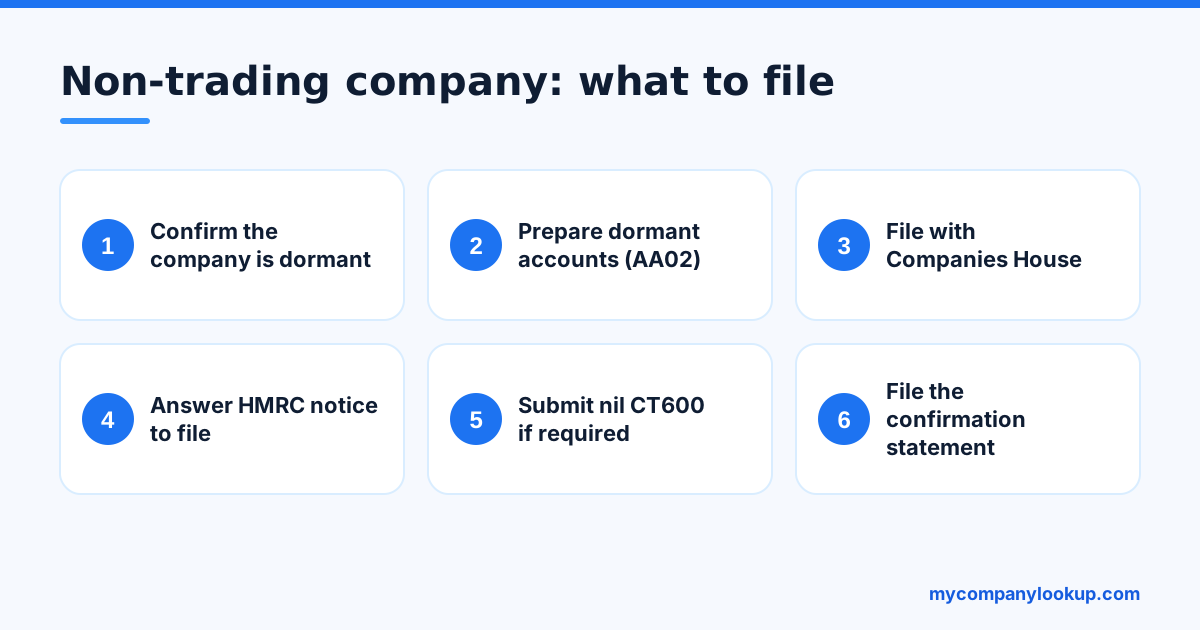
Step-by-step: filing dormant accounts and a nil CT600
- Confirm dormancy using the bank statements and records for the year.
- Check deadlines: accounts due date at Companies House and any HMRC filing deadline. Look up your company in our search to see the accounts due date.
- Prepare the dormant balance sheet with share capital and any amounts due from shareholders.
- Approve and sign the accounts as a director.
- File the accounts with Companies House through the current online service or approved software, using the company's authentication code.
- Check HMRC's position: has a notice to deliver a return been sent? Log in to the company's HMRC account or check post at the registered office.
- If required, file a nil CT600 with the dormant accounts attached in the required digital format, by the HMRC deadline (12 months after the end of the accounting period).
- If not required, tell HMRC the company is dormant if you have not already done so.
- File the confirmation statement within 14 days of the end of the review period. Use SIC code 99999 for a dormant company if appropriate. See our confirmation statement guide.
- Diary next year's deadlines.
Keeping a dormant company in good standing
| Task | Frequency | Notes |
|---|---|---|
| Dormant accounts | Annually | Even with no activity |
| Confirmation statement | Annually | £50 online fee |
| Identity verification | Once per director and PSC | Required since November 2025 rollout |
| Registered office | Ongoing | Must be an appropriate address where post is handled |
| Registered email | Ongoing | Must be monitored |
| HMRC dormant status | Review | Tell HMRC when the company starts trading |
| Bank account | Optional | Consider closing to avoid interest income |
Companies House now requires every director to verify their identity, and dormant companies are not exempt. The registered office must also be an appropriate address where post comes to the attention of someone acting for the company.
When a dormant company starts trading
When the company starts business:
- Tell HMRC within three months of starting to trade, so it can issue notices to file Company Tax Returns.
- Register for VAT if taxable turnover is expected to pass the VAT threshold, and for PAYE if you employ anyone (including directors on a salary).
- Keep full accounting records from day one.
- From the first year with transactions, file micro-entity or small company accounts instead of dormant accounts.
- Update the SIC codes on your next confirmation statement.
Should you keep a dormant company or close it?
A dormant company costs money and time each year: the confirmation statement fee, the accountant's or agent's fee, and the risk of penalties if a deadline is missed. Keep it if you plan to use it, or if the name has value. Close it if it has no future.
Closing a solvent, debt-free company is usually done by applying to strike it off using form DS01. The company must not have traded or changed its name in the previous three months, and you must notify shareholders, creditors, employees and HMRC. Our guide to closing a UK company with a DS01 walks through the process, and our Filing Centre can file the DS01 for you.
Frequently confused points
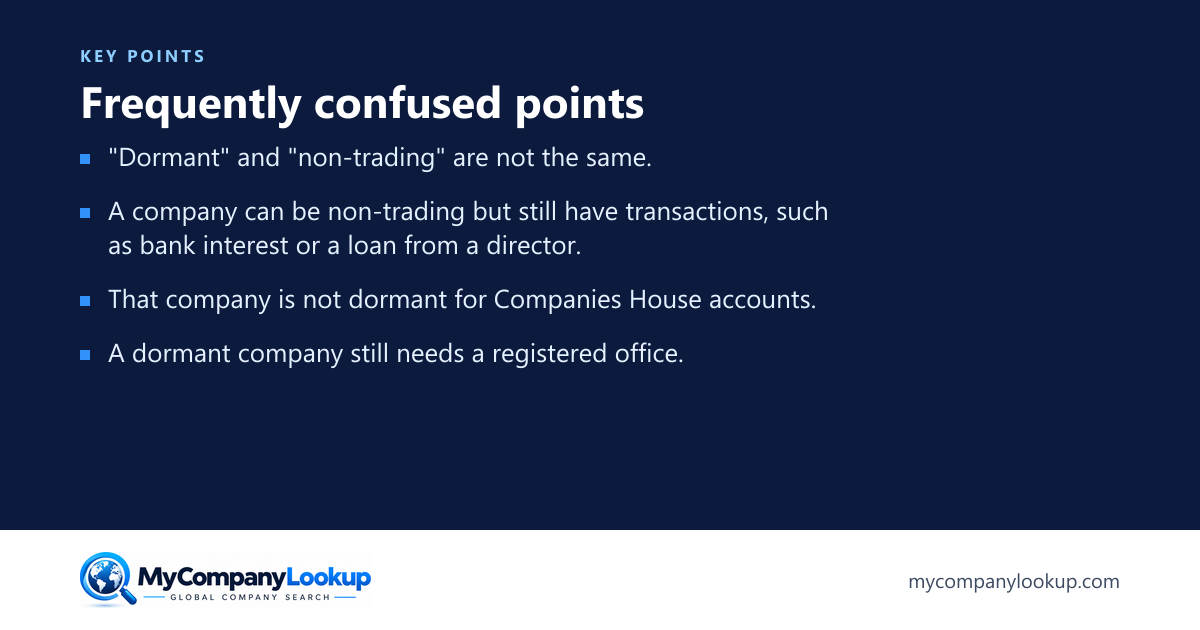
"Dormant" and "non-trading" are not the same. A company can be non-trading but still have transactions, such as bank interest or a loan from a director. That company is not dormant for Companies House accounts.
A dormant company still needs a registered office. Post from Companies House and HMRC goes there, including authentication codes and notices to file.
Dormant does not mean struck off. A dormant company is active on the register. If you stop filing, it may be struck off, and any assets it holds (including cash in its bank account) pass to the Crown.
An agent cannot make an active company dormant. Dormancy depends on facts: whether there were transactions. An agent can only file what the records show.
How we can help
Our Filing Centre offers a fixed-price Accounts + CT600 (No Trading) service for £50. You give us the company number, authentication code, period end date and UTR, upload bank statements if there is a bank account, and confirm the company did not trade. The filing is prepared and submitted by Biz E-Formations Inc., our filing partner, and you receive email updates at every stage with the official filing reference when it is done.
If the company did have some activity, choose micro-entity accounts or the Accounts + CT600 bundle. If you are unsure which applies, contact us before ordering.
What a dormant balance sheet looks like
Dormant accounts are short. For a company with 100 ordinary shares of £1 each, where the shareholder has paid for the shares and the money sits in the company's bank account, the balance sheet might look like this:
| Balance sheet at 31 March 2027 | £ |
|---|---|
| Current assets: cash at bank | 100 |
| Net assets | 100 |
| Capital and reserves: called up share capital | 100 |
| Shareholders' funds | 100 |
If the shareholder has never actually paid for the shares, the asset is shown as "called up share capital not paid" or as an amount owed by the shareholder, and there is no cash. Either way, nothing changes from one year to the next while the company remains dormant, apart from the dates.
The notes then state that the company was dormant throughout the year, that it is entitled to exemption from audit, that members have not required an audit and that the directors acknowledge their responsibilities for keeping accounting records and preparing accounts. A director signs and dates the balance sheet.
Worked example: a dormant company's first two years
A company is incorporated on 1 June 2026 to hold a brand name. It does not open a bank account and does not trade.
| Step | Date |
|---|---|
| Incorporation | 1 June 2026 |
| Directors tell HMRC the company is dormant | June 2026 |
| First accounting reference date | 30 June 2027 |
| First confirmation statement due | by 14 June 2027 |
| First accounts due (21 months after incorporation) | 1 March 2028 |
| HMRC return | Only if a notice to deliver a return is received |
| Second confirmation statement due | by 14 June 2028 |
| Second accounts (year to 30 June 2028) due | 31 March 2029 |
If, in the second year, the company receives £3 of bank interest after opening an account, it stops being dormant for that year. It would then need small or micro-entity accounts and would have taxable income to report to HMRC.
Dormant subsidiaries in a group
Groups often keep dormant subsidiaries to protect names or to hold old contracts. They follow the same rules: annual dormant accounts and a confirmation statement every year. Some subsidiaries may also qualify for exemptions from preparing or filing accounts where a parent company gives a guarantee, but the conditions are technical and the parent's group accounts must meet specific requirements. Speak to your accountant before relying on any group exemption.
VAT, payroll and other registrations while dormant
A dormant company should not have active tax registrations it no longer needs:
- VAT: if the company is VAT registered and stops making taxable supplies, it should usually cancel its registration. Nil VAT returns must otherwise continue to be filed, with penalties for missing them.
- PAYE: close the payroll scheme if there are no employees and no director salary.
- Corporation Tax: tell HMRC the company is dormant, as described above.
Leaving registrations open means HMRC keeps expecting returns, and missed returns lead to penalties even though no tax is due.
Records to keep while a company is dormant
Even with no activity, directors must keep the company's statutory books and records up to date:
- The register of members (shareholders), directors, secretaries and PSCs, or elect to keep some of them on the central register at Companies House.
- Minutes of any board or shareholder decisions, including approval of the annual accounts.
- Copies of filings and correspondence from Companies House and HMRC.
- Bank statements, if a bank account exists, to evidence that there were no transactions.
Good records make it simple to prove dormancy if HMRC or Companies House ever asks, and they make it much quicker to restart the company when you need it. They also help anyone who later checks the company, because the filings will be consistent year after year.
Dormant companies and bank accounts: a quick decision guide
Ask three questions. Does the company need a bank account in the next year? If not, close it. Does the account pay interest? If so, the company has income. Will anyone pay fees from it? If so, those are transactions. The simplest dormant company has no bank account at all.
Official guidance
The rules in this guide come from GOV.UK guidance on dormant companies, Company Tax Returns and filing your company accounts and tax return. Companies House and HMRC update their online services regularly, especially as accounts filing moves towards software, so always check the current position before you file.
Summary
- Dormant for Companies House means no significant accounting transactions in the year.
- Dormant companies still file accounts every year and a confirmation statement.
- A nil CT600 is required if HMRC has sent a notice to file, even for a dormant company.
- Tell HMRC when a company is dormant and when it starts or stops trading.
- Late filing penalties apply regardless of whether the company traded.
- Keep the bank account empty or closed to stay dormant for tax.
Setting up a new company, verifying a director's identity or opening a business bank account? Biz E-Formations Inc. handles company formation, Companies House identity verification and business bank account setup in the UK, USA, Canada and the UAE.
Check your deadlines now: search your company and look at the Deadlines panel.
Frequently asked questions
+Does a dormant company need to file accounts?
Yes. Every company on the register must file annual accounts with Companies House, even if it was dormant. A dormant company can usually file simplified dormant accounts.
+Does a dormant company need to file a CT600?
Only if HMRC has sent a notice to deliver a Company Tax Return, or if the company had taxable income. If a notice has been sent, a nil CT600 must be filed even for a dormant company.
+Is bank interest a transaction for a dormant company?
Yes. Bank interest is a significant accounting transaction and taxable income, so a company that receives interest is not dormant for Companies House accounts or for Corporation Tax.
+When are a dormant company's first accounts due?
First accounts are due 21 months after the date of incorporation. Later accounts are due 9 months after the accounting reference date.
+How much does it cost to file dormant accounts and a nil CT600?
There is no Companies House fee for filing accounts. Through our Filing Centre, Accounts plus a nil CT600 for a non-trading company costs £50.
+Do I still need a confirmation statement for a dormant company?
Yes. The confirmation statement is required at least once every 12 months for every company, dormant or not, and the online fee is £50.