How to Complete Companies House Identity Verification in 2027 and 2028
Every director and person with significant control of a UK company must now verify their identity with Companies House. Here is who, when, how and what happens if you do not.
MyCompanyLookup Editorial TeamUpdated 14 Sept 2026 13 min read
In this article
- Why Companies House introduced identity verification
- Who must verify their identity?
- Key dates and deadlines
- The two ways to verify your identity
- What is a personal code?
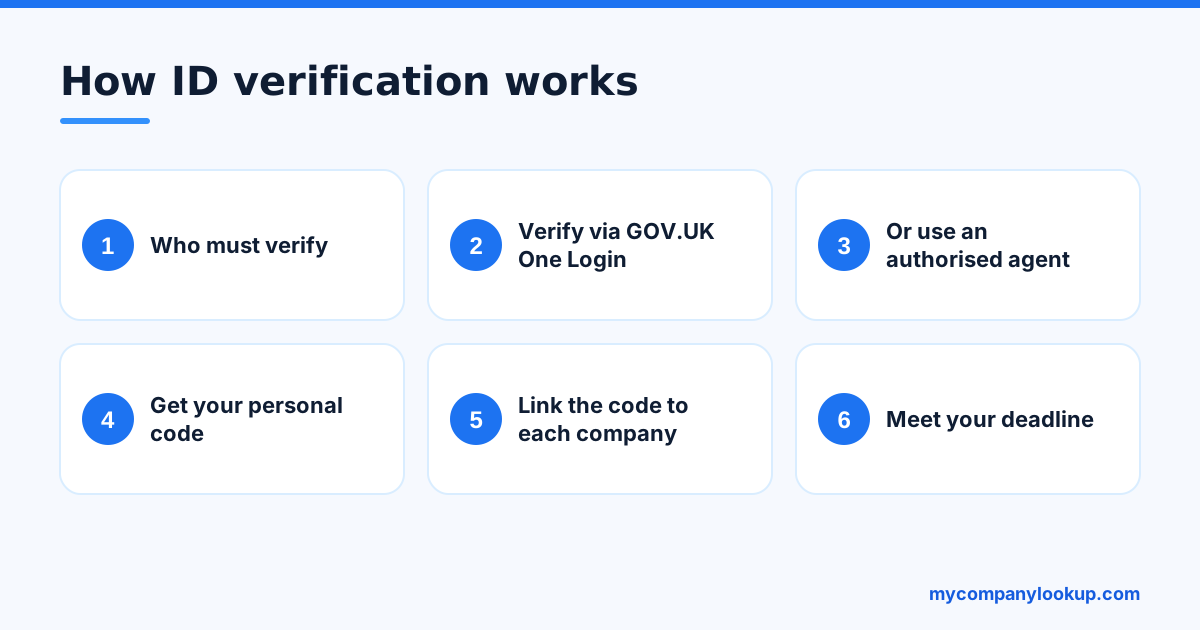
- Step-by-step: verifying and linking your identity
- What happens if someone does not verify?
- Special situations
- Identity verification checklist for company owners
- How identity verification changes company checks
- Protecting yourself from identity misuse
- What to do if verification fails
- Costs compared
- Other ECCTA changes to know about
- Who verifies what: common scenarios
- Forming a new company in 2027
- What changes on the public register
- How authorised agents are regulated
- A timeline to get your companies ready
- Questions overseas directors often ask
- Summary
Companies House identity verification is the biggest change to UK company law in a generation. Since 18 November 2025, directors and people with significant control (PSCs) of UK companies have been required to prove who they are to Companies House. For decades anyone could be listed as a director simply by typing in a name. That era is over. This guide explains who must verify, the deadlines, and how to verify your identity directly or through an authorised agent.
This guide explains in plain English who has to verify, the deadlines that apply during the transition into 2027, the two ways to verify, what a personal code is and how to use it, and what happens if someone does not verify. If you want it handled for you, our Filing Centre offers identity verification through an authorised agent for £30.
Why Companies House introduced identity verification
The UK register has long been criticised for allowing fake names, stolen identities and nominee directors who had no real involvement in the companies they "ran". Fraudsters used this to set up companies for scams, money laundering and phoenix trading, and genuine people sometimes found their names or addresses used without permission.
The Economic Crime and Corporate Transparency Act 2023 (ECCTA) changed the role of Companies House from a passive record-keeper to an active gatekeeper of the register. Identity verification is the centrepiece of that reform, alongside new powers to query and remove information, rules on registered office and email addresses, and stronger checks on company names.
For anyone who uses the register to check a UK company, this is good news: as verification completes, the people listed as directors and PSCs will be people whose identity has been confirmed.
Who must verify their identity?
Identity verification applies to individuals in these roles:
- Directors of UK companies, including directors of dormant companies.
- People with significant control (PSCs) who are individuals.
- Members of LLPs (designated members and members).
- Relevant officers of corporate PSCs: where a PSC is a company, a relevant officer of that company must verify.
- People who file information with Companies House on behalf of companies. Companies House has said that in a later phase, anyone filing must either be verified themselves or file through an authorised agent.
Company secretaries are not required to verify unless they also file on behalf of the company in that later phase.
Verification happens once per person, not once per company. If you are a director of five companies, you verify once and then link your verified identity to each role.
Key dates and deadlines
| Date | What happened or applies |
|---|---|
| 8 April 2025 | Voluntary identity verification opened |
| 18 November 2025 | Verification became a legal requirement |
| From 18 November 2025 | New directors must verify before or at appointment, and new companies must have verified directors at incorporation |
| 18 November 2025 to November 2026 | 12-month transition for existing directors and PSCs |
| Next confirmation statement | Existing directors confirm their verification on the company's first confirmation statement after 18 November 2025 |
| 2026 and 2027 | Further phases, including requirements for people who file on behalf of companies |
For existing directors, the practical deadline is the company's next confirmation statement filed during the transition period. When the company files that statement, it must confirm that each director has verified their identity. Our guide to filing a confirmation statement explains how this works in the filing.
For existing PSCs who are not directors, Companies House set a separate timetable based on the PSC's date of birth. Check the official Companies House identity verification guidance for the exact rule that applies to you, because it differs from the director deadline.
For new appointments after 18 November 2025, verification comes first: a person must have verified before they can be appointed as a director, and new PSCs must verify within a short period of becoming a PSC.
The two ways to verify your identity
Option 1: Verify directly with Companies House using GOV.UK One Login
GOV.UK One Login is the government's single sign-in system. To verify:
- Create a GOV.UK One Login account (or sign in to an existing one).
- Start the Companies House identity verification journey.
- Prove your identity, usually by scanning photo ID with the GOV.UK ID Check app and taking a selfie, or through other routes offered for people without suitable documents.
- Receive your Companies House personal code.
Direct verification is free. It works well for people with a UK passport, UK photo driving licence or other supported document and a smartphone. Some people, especially those living abroad with non-UK documents, find the online route harder.
Option 2: Verify through an Authorised Corporate Service Provider (ACSP)
An ACSP is a company formation agent, accountant, lawyer or similar business that has registered with Companies House as an authorised agent and is supervised for anti-money laundering purposes. An ACSP checks your identity documents to the required standard and then tells Companies House that you are verified. You still receive a personal code.
ACSPs charge for the service. The advantages are help with documents, support for people overseas or without UK ID, and someone to handle the follow-up steps such as linking your code to each company.
Through our Filing Centre, identity verification is carried out by Biz E-Formations Inc. as an authorised agent for £30.
What is a personal code?
When your identity is verified, Companies House issues a personal code, an 11-character reference unique to you. It is how Companies House links your verified identity to your roles on the register.
You will need your personal code to:
- Be appointed as a director of a new or existing company.
- Confirm your verification on a company's confirmation statement.
- Be registered as a PSC or provide your verification as an existing PSC.
- File on behalf of a company, once that phase applies.
Keep your personal code safe, but it is not a password. Companies use it to tell Companies House which verified person holds each role.
Step-by-step: verifying and linking your identity
- Decide which route suits you: GOV.UK One Login if you have suitable photo ID and a smartphone, or an ACSP if you want help or have non-UK documents.
- Gather your documents: usually a passport or photo driving licence, plus proof of address if the route asks for it.
- Complete verification and note your personal code.
- List every company where you are a director, LLP member or PSC. Click your name in our company search to see all your appointments in one place.
- Provide your code to each company so it can be linked: for directors, through the company's confirmation statement or appointment filing; for PSCs, through the PSC verification process.
- Check the register: once linked, the public register indicates that your identity has been verified.
- Diary the confirmation statement date for each company so that the company files on time with your verification confirmed.
What happens if someone does not verify?
The rules are backed by real consequences:
- It is an offence for a person to act as a director without having verified their identity once the requirement applies to them. The company can also commit an offence.
- Filings can be blocked. A confirmation statement cannot be completed without confirming directors' verification, and a new director cannot be appointed without a verified identity.
- The public register shows the gap. Companies House indicates on the register when a director or PSC has not verified, which is visible to banks, suppliers and customers checking your company.
- Strike-off risk follows. A company that cannot file its confirmation statement falls behind on its filings, which can lead to strike-off action.
Special situations
Directors living outside the UK
Identity verification applies regardless of where you live. Non-UK residents can use GOV.UK One Login if their documents are supported, but many find an ACSP more practical. An ACSP can verify using a wider range of documents and processes, and can support you remotely.
Dormant companies
Dormant companies are not exempt. If you keep a company dormant to protect a name, its directors must still verify. See our guide to dormant company accounts for the other obligations.
Corporate directors and corporate PSCs
Where a director or PSC is itself a company, the rules focus on the individuals behind it: a relevant officer of the corporate entity must verify. Corporate directors already face restrictions in UK law, and further reforms in this area have been signalled.
People who file for companies
Accountants, formation agents and in-house teams who file documents will, in the relevant phase, need to be verified themselves or operate as or through an ACSP. Businesses that file regularly should prepare for this.
Names that do not match documents
If the name on the register does not exactly match your identity document, for example a missing middle name or a different spelling, you may need to file a change to your officer details so that your record and your verified identity agree.
Identity verification checklist for company owners
| Task | Done |
|---|---|
| List all directors and PSCs of each company | |
| Confirm each person's verification route | |
| Collect each person's personal code | |
| Check names on the register match ID documents | |
| Note each company's next confirmation statement date | |
| File confirmation statements with verification confirmed | |
| Verify new directors before appointment | |
| Plan for verified filers or an ACSP for future filings |
How identity verification changes company checks
For anyone researching companies, verification adds a useful signal. A director with verified identity is far less likely to be a stolen or invented identity. As the transition completes, an active company whose directors remain unverified deserves a closer look. When you look up a company, compare the officers list with what you expect, and click through to see each director's other appointments.
Remember that verification confirms who a person is, not whether a business is honest. Keep doing the other checks in our company check guide, and use the PSC register to understand ownership.
Protecting yourself from identity misuse
One of the reasons for these reforms was that people's names and addresses were being added to companies without their knowledge. Verification makes this much harder, but it is still worth checking:
- Search your own name on the register to make sure you are only listed on companies you know about. Our company search shows a director's appointments when you click their name.
- Report misuse to Companies House if you find yourself listed on a company you have nothing to do with.
- Never share your GOV.UK One Login credentials with anyone, including an agent. An ACSP verifies you through its own process; it does not need your login.
- Treat your personal code with care. It is not a password, but you should only give it to companies where you genuinely hold a role.
- Keep your service address current so that official letters about your appointments reach you.
If you are asked to become a director or PSC of a company you know little about, check it first using our guide to checking a UK company. Directors carry legal duties, and verification ties your real identity to the role.
What to do if verification fails
Online verification can fail for ordinary reasons: a worn passport chip, a photo that does not match well, a document type the app does not support, or a name mismatch. If it fails:
- Try again in good light with the document flat and the camera steady.
- Check whether another supported document would work better.
- If it still fails, use an authorised agent, who can verify using a wider range of methods.
- Allow enough time before your company's confirmation statement deadline so that a failed attempt does not make the company late.

Costs compared
| Route | Cost | Best for |
|---|---|---|
| GOV.UK One Login | Free | UK residents with supported photo ID and a smartphone |
| Authorised agent (ACSP) | Varies by provider; £30 through our Filing Centre | Overseas directors, people without supported ID, busy owners who want it handled |
| Accountant who is an ACSP | Often bundled with other services | Companies that already use an accountant for filings |
Whichever route you choose, the result is the same personal code and the same status on the register.
Other ECCTA changes to know about
Identity verification is part of a wider package of reforms, several of which affect day-to-day compliance:
- Registered email address: every company must have one, monitored for Companies House correspondence.
- Appropriate registered office: the address must be one where post comes to the attention of someone acting for the company and delivery can be acknowledged. PO boxes alone are not allowed. See our registered office rules.
- Lawful purpose statement: confirmed at incorporation and on each confirmation statement.
- Stronger powers for Companies House to query, reject and remove information and to share data with law enforcement.
- Accounts reform: changes to the accounts small companies file and a move to software filing, on a timetable set by Companies House.
We post updates on fees and rules as they are announced on our News and Fees page.
Who verifies what: common scenarios
| Your situation | Do you need to verify? | When |
|---|---|---|
| Sole director and shareholder of one company | Yes, once, as director and PSC | By the company's next confirmation statement during the transition |
| Director of several companies | Yes, once | Link the same personal code to each company |
| Shareholder with 40%, not a director | Yes, as a PSC | According to the PSC timetable |
| Shareholder with 10%, no other control | No (not a PSC) | Not applicable |
| Company secretary only | No, unless you file on behalf of the company in the later phase | Later phase for filers |
| New director joining in 2027 | Yes | Before appointment |
| Founder forming a new company | Yes, all directors and PSCs | Before incorporation |
| Accountant filing for clients | Must be verified or file as or through an ACSP | When the filer phase applies |
| Director of a dormant company | Yes | Same as any director |
Forming a new company in 2027
For new companies, verification is now part of incorporation. Before the company can be registered:
- Every proposed director must have verified identity and a personal code.
- Every individual PSC must have verified, or do so within the required time.
- The application must include the lawful purpose statement and an appropriate registered office address and registered email address.
If you form through an agent, the agent will usually handle verification as an ACSP at the same time as preparing the incorporation. Biz E-Formations Inc. includes identity verification support with its UK formation packages; see bizeformations.com/company-formation/uk.
What changes on the public register
Verification does not put your identity documents on the public record. What changes is that the register shows whether each director and PSC has had their identity verified. Over time, this creates a clear public signal:
- Verified directors give customers and banks confidence that the person exists and is who they say they are.
- Unverified directors on active companies stand out once the transition has ended.
Your residential address and full date of birth remain private, as before. Only the month and year of birth, nationality, country of residence and service address are shown.
How authorised agents are regulated
ACSPs are not just any service provider. To register as an Authorised Corporate Service Provider, a business must:
- Be supervised for anti-money laundering purposes by a recognised supervisory body, such as HMRC or a professional body.
- Register with Companies House and have its own responsible people verified.
- Carry out identity checks to the standard Companies House requires, and keep records.
When choosing an agent, ask for their ACSP status and AML supervisor. A legitimate agent will explain what documents they need, how they check them and how your data is protected. Be wary of anyone offering to "verify" a person they have never checked, which would defeat the purpose of the law and could be an offence.
A timeline to get your companies ready
If you are responsible for one or more companies, work through this plan:
- Now: list every director and PSC across your companies, with each company's next confirmation statement date. You can see each person's appointments by clicking their name in our company search.
- At least one month before each confirmation statement: ask each director to verify and send you their personal code.
- Two weeks before: check names on the register match each person's identity documents and file any CH01 corrections.
- Filing day: file the confirmation statement with verification confirmed. Our confirmation statement guide walks through it.
- For PSCs who are not directors: follow the PSC timetable on the official guidance and make sure each one links their code.
- Ongoing: verify every new director before appointment and every new PSC on time.
Questions overseas directors often ask
Can I verify with a non-UK passport? Many foreign passports are supported through the online route, but not every document works with the app. If the online journey fails, use an ACSP.
Do I need a UK address? No. Directors can live anywhere. You will need a service address for the public register, which can be outside the UK, and your company needs a UK registered office.
What if my name is written differently in different documents? Use your name exactly as it appears on the identity document you verify with, and update your officer details on the register to match if needed.
I am a director of a UK company owned by a foreign parent. Who verifies? You verify as a director. For the corporate PSC (the parent), a relevant officer of that parent company must verify.
Will verification slow down appointments? Only if you leave it late. Verify new directors before the board resolution to appoint them.
Summary
- Directors, PSCs and LLP members must verify their identity with Companies House.
- The requirement started on 18 November 2025, with a 12-month transition for existing directors and PSCs.
- Existing directors confirm verification on the company's next confirmation statement.
- Verify free through GOV.UK One Login, or through an authorised agent (ACSP) for help and overseas documents.
- You receive one personal code to link to every role.
- Not verifying is an offence and blocks key filings.
Need help? Order identity verification for £30 through our Filing Centre, or read more on bizeformations.com.
Frequently asked questions
+Who needs to verify their identity with Companies House?
Directors, individual people with significant control, LLP members and relevant officers of corporate PSCs. In a later phase, people who file on behalf of companies must also be verified or use an authorised agent.
+When did Companies House identity verification become mandatory?
It became a legal requirement on 18 November 2025, after voluntary verification opened on 8 April 2025. Existing directors and PSCs were given a 12-month transition period.
+How much does identity verification cost?
Verifying directly with Companies House through GOV.UK One Login is free. Authorised agents charge for the service; through our Filing Centre it costs £30.
+What is a Companies House personal code?
An 11-character code issued after your identity is verified. You use it to link your verified identity to each company where you are a director or PSC.
+Do I need to verify separately for each company?
No. You verify once and use the same personal code for every company role you hold.
+Can someone living outside the UK verify their identity?
Yes. Non-UK residents can use GOV.UK One Login if their documents are supported, or verify through an authorised corporate service provider, which is often easier with overseas documents.