How to Restore a Dissolved UK Company in 2027 and 2028: Administrative and Court Restoration
A dissolved company can often be brought back to the register with its bank money, contracts and history intact. Here is which route applies to you and how to use it.
MyCompanyLookup Editorial TeamUpdated 11 Oct 2026 13 min read
In this article
- Why companies get dissolved
- The effect of restoration
- Route 1: Administrative restoration
- Route 2: Restoration by court order
- Which route do you need?
- Step-by-step: how to restore a dissolved UK company
- Worked examples: which route, and what to file
- Documents checklist for administrative restoration
- How to show the company was "in operation"
- What happens on the day the company is restored
- Restoring the company versus starting a new one
- Directors' identity verification and restoration
- The law behind restoration
- Scotland and Northern Ireland
- Mistakes that delay restoration
- After restoration: a 10-point checklist
- Restoration and the company name
- How long each step takes
- Restoring a company that was in liquidation
- After restoration: protect the company
- Common mistakes
Finding out that your company has been dissolved is a shock. Often the first sign is a frozen bank account, a payment provider asking questions, or a client who can no longer pay an invoice. The good news is that in most cases a dissolved company can be restored to the register, and once it is restored the law treats it as if it had never been dissolved. This guide explains how to restore a dissolved UK company by either route.
This guide explains the two ways to restore a dissolved company in the UK, how to tell which one applies to you, who can apply, the time limits, what you must file and how long it takes. If you only need to check what happened first, search the company to see its status and the date it was dissolved.
Why companies get dissolved
A company ends up dissolved in one of three ways:
| How it was dissolved | What usually happened | Restoration route |
|---|---|---|
| Compulsory strike off by Companies House | Accounts or confirmation statements were not filed, letters went unanswered, and the registrar decided the company was no longer operating | Administrative restoration (usually) or court |
| Voluntary strike off (form DS01) | The directors applied to close the company | Court restoration |
| After liquidation | A liquidator wound the company up | Court restoration |
Most companies that are dissolved by surprise were struck off compulsorily: the registered office address was out of date, reminders went to an old email, and nobody saw the Gazette notice.
The effect of restoration
When a company is restored, it is deemed to have continued in existence as if it had not been dissolved. In practice that means:
- The company keeps its original company number and history.
- Property that passed to the Crown on dissolution (including bank balances) can be returned to it, provided it has not been sold.
- Contracts, debts and claims carry on as before.
- Directors are back in office as they were before dissolution.
Route 1: Administrative restoration
Administrative restoration is handled by Companies House without going to court. It is the quicker and cheaper route, but only if all of these are true:
- The company was struck off by the registrar (compulsory strike off), not dissolved after a DS01 or a liquidation.
- The application is made within six years of the date of dissolution.
- The applicant was a director or member (shareholder) of the company when it was struck off.
- The company was carrying on business or in operation at the time it was struck off.
- If any of the company's property passed to the Crown, the Crown representative has given its consent (often called a bona vacantia waiver letter).
What you must deliver
- The restoration application form (RT01) and the Companies House fee. Check the current fee on GOV.UK before you apply.
- A statement of compliance confirming the conditions are met.
- All documents that were overdue when the company was struck off, such as accounts and confirmation statements, so the record is brought up to date.
- Payment of any late filing penalties that were outstanding at dissolution.
- The written consent of the Crown representative where the company held property (for example money in a bank account).
How long it takes
Once Companies House has everything it needs, administrative restoration usually takes a few weeks. Most delays come from missing accounts or waiting for the bona vacantia consent letter, so start those first.
Route 2: Restoration by court order
If administrative restoration is not available, you apply to court. You need the court route if:
- the company was dissolved after a voluntary strike off (DS01) or after liquidation;
- you were not a director or member, for example you are a creditor, a former employee or a landlord; or
- the administrative conditions are not met for another reason.
Key points
- The usual time limit is six years from dissolution. Applications to bring a claim for personal injury damages can be made at any time.
- The application is made to the court (in England and Wales, usually the High Court or a county court with the right jurisdiction; in Scotland, the Court of Session or a sheriff court).
- You must notify Companies House and the relevant Crown representative (the Government Legal Department's Bona Vacantia Division in most of England and Wales). Each will tell you its conditions, which normally include filing the overdue documents and paying its costs.
- Many restorations go through on a consent order without a contested hearing once those conditions are met.
Court restoration takes longer, typically one to three months, and costs more because of court fees and, usually, solicitor's fees. Our guide to company restoration costs breaks this down.
Which route do you need?
| Your situation | Route |
|---|---|
| Struck off by Companies House, you were a director or shareholder, within 6 years | Administrative restoration |
| You closed the company yourself with a DS01 and now need it back | Court |
| Company was dissolved after liquidation | Court |
| You are a creditor or third party | Court |
| More than 6 years since dissolution | Court (only in limited cases) |
Step-by-step: how to restore a dissolved UK company
- Check the record. Look up the company and note the dissolution date and the last documents filed.
- Prepare the missing filings. Draft the overdue accounts and confirmation statement(s) up to the date of dissolution. Dormant companies can use dormant accounts.
- Contact the Crown representative if the company held property, such as a bank balance, and ask for a waiver letter for administrative restoration.
- Complete form RT01 and the statement of compliance, and pay the fee.
- Pay outstanding penalties that were due at dissolution.
- Send everything to Companies House in one pack. Incomplete applications are returned.
- After restoration, file anything that fell due while the company was dissolved, update the registered office and email address, and tell your bank and payment providers.
Worked examples: which route, and what to file
The rules are easier to follow with real-world patterns. These examples are typical of the restorations we prepare.
Example 1: Dormant holding company, struck off for one missed set of accounts
A director set up a company to hold a domain name and never traded. The accountant retired, the dormant accounts were not filed, and Companies House reminders went to the accountant's old address. The company was struck off and dissolved. Eight months later, the director needs the company back because the domain registrar has frozen the account.
- Route: administrative restoration. The company was struck off by the registrar, the director was a director at the time, and it is well within six years.
- What to file: dormant accounts for the missed year, any confirmation statement that fell due, form RT01 and the statement of compliance.
- Bona vacantia: the company held no cash, but it did hold rights in a domain, so the director contacts the Crown representative to ask whether a waiver letter is needed.
- Time: a few weeks once the dormant accounts are ready.
Example 2: Small trading company with money in the bank
A consultancy company stopped filing after the director moved abroad. The registered office was a former home address, and post went unanswered. The company was dissolved with about £14,000 in its business account. The bank stopped the account the day the dissolution appeared on the register.
- Route: administrative restoration, as long as the company was "in operation" when struck off. Holding money and receiving payments is usually enough.
- What to file: full or micro-entity accounts for the missing years, confirmation statements, any director's address change, the RT01 and statement of compliance.
- Bona vacantia: the bank balance passed to the Crown, so a consent (waiver) letter from the Crown representative is required before Companies House will restore the company. See what happens to a dissolved company's bank account.
- Penalties: late filing penalties outstanding at dissolution must be paid.
Example 3: Company closed with a DS01, now owed money
Two shareholders closed their company with a DS01 after a project ended. Three months later a client paid a final invoice of £22,000 into the old account. Because the company was dissolved voluntarily, it can only come back through the court.
- Route: court restoration. Administrative restoration is not available after a DS01.
- What to expect: a court application with a witness statement, notice to Companies House and the Crown representative, filing of any documents they require, and payment of their costs. Many cases end in a consent order without a contested hearing.
- Lesson: before applying for a DS01, make sure every invoice is paid and every account is closed. Our guide to closing a UK company with a DS01 explains the order.
Example 4: A creditor wants to sue a dissolved company
A landlord is owed rent by a company that has been struck off. The landlord was never a director or shareholder, so administrative restoration is not available to them. They apply to court to restore the company so that they can bring a claim against it or prove in a liquidation.
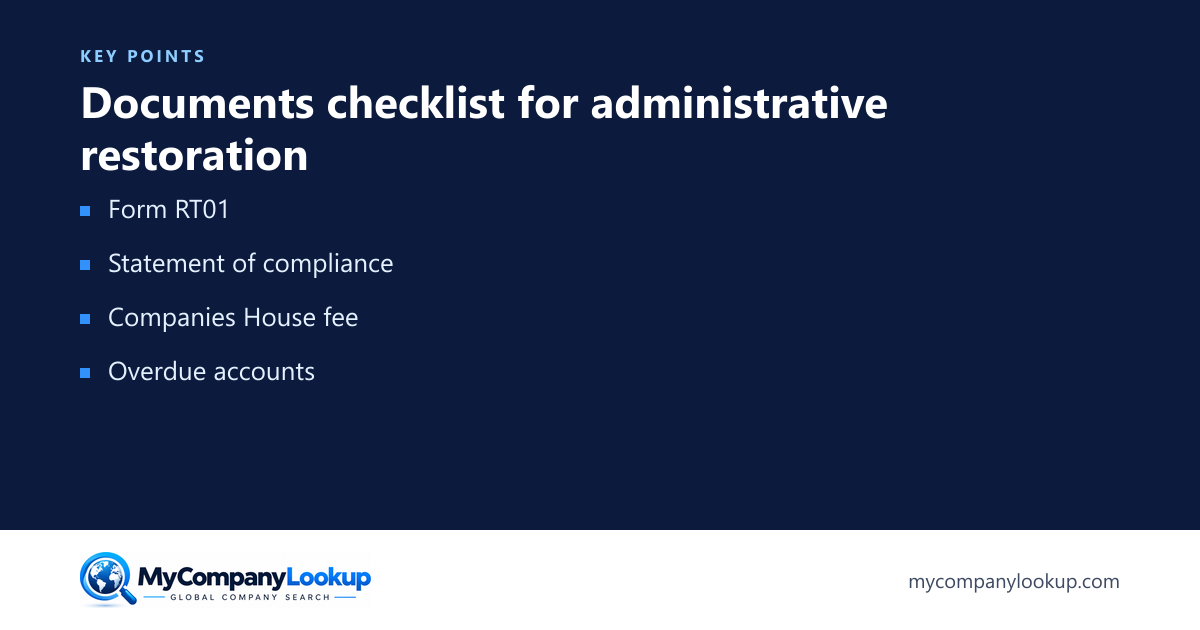
Documents checklist for administrative restoration
Use this list to put the pack together before you send anything. Companies House returns incomplete applications, and each return costs weeks.
| Item | Notes |
|---|---|
| Form RT01 | Signed by the applicant (former director or member) |
| Statement of compliance | Confirms the legal conditions for administrative restoration are met |
| Companies House fee | Check the current fee |
| Overdue accounts | Every set that was overdue at dissolution. Dormant companies can file dormant accounts |
| Confirmation statements | Each one that was overdue, with its fee |
| Officer and address changes | Anything that changed and was never filed |
| Late filing penalties | Those outstanding at dissolution |
| Crown consent letter | Only if the company held property (cash, property, IP, debts owed to it) |
Tip: prepare the accounts first. They usually take longest, and the Crown representative will often want to know the company's financial position before giving consent.
How to show the company was "in operation"
Administrative restoration needs a statement that the company was carrying on business or was in operation when it was struck off. Evidence that helps includes:
- bank statements showing payments in or out around the date of strike off;
- invoices, contracts or a lease in the company's name;
- VAT, PAYE or Corporation Tax registrations and returns; and
- correspondence with customers or suppliers.
A company that existed purely on paper, with no activity at all, may not meet this condition. In that case, court restoration may still be possible.
What happens on the day the company is restored
When Companies House restores a company:
- The status returns to Active on the register, under the same company number. You can check it the same day.
- The company is treated as having continued in existence throughout the period it was dissolved. Contracts and liabilities from that period are in the company's name.
- Any property returned by the Crown comes back to the company, normally less the Crown representative's costs.
- Filing deadlines start running again. Accounts or confirmation statements that fell due while the company was dissolved are now overdue, so file them quickly to avoid a new strike-off.
- Your bank, payment providers and HMRC do not update automatically. Send each one evidence of restoration.
Restoring the company versus starting a new one
Sometimes forming a new company is the better business decision. Compare the two:
| Restore the old company | Form a new company | |
|---|---|---|
| Recover money or property held by the Crown | Yes | No |
| Keep the company number, history and contracts | Yes | No |
| Collect debts owed to the old company | Yes | No |
| Cost | Restoration plus overdue filings | Formation fee only |
| Time | Weeks (administrative) to months (court) | Usually same or next day |
If you decide to start again, Biz E-Formations Inc. can register a new UK company, provide a registered office address and help you open a business bank account. Make sure the new company does not use a name that suggests it is the same business as the dissolved one if that company had debts, because directors can be personally liable when re-using the name of an insolvent company.
Directors' identity verification and restoration
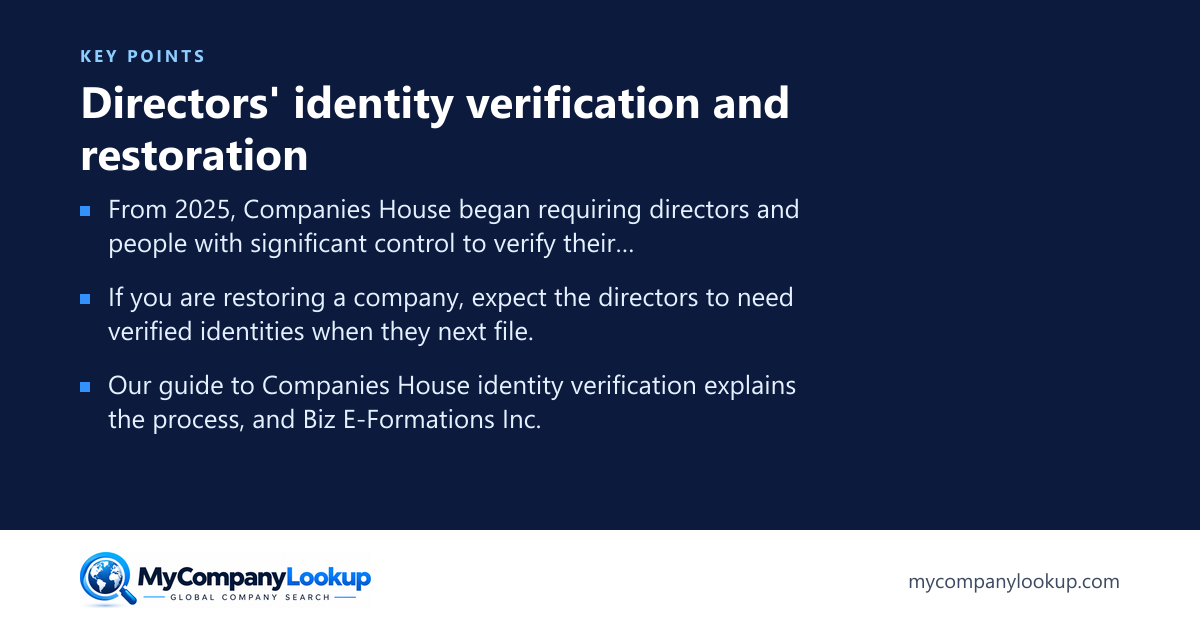
From 2025, Companies House began requiring directors and people with significant control to verify their identity, with the requirement phased in over the following years. If you are restoring a company, expect the directors to need verified identities when they next file. Our guide to Companies House identity verification explains the process, and Biz E-Formations Inc. can act as an authorised agent to verify your identity for you.
The law behind restoration
Restoration is governed by Part 31 of the Companies Act 2006. The key sections are:
| Section | What it covers |
|---|---|
| s1000 and s1001 | The registrar's power to strike off a company that is not carrying on business |
| s1003 | Voluntary strike off on the company's application (DS01) |
| s1012 | Property of a dissolved company passes to the Crown as bona vacantia |
| s1024 to s1028 | Administrative restoration: who can apply, conditions, and effect |
| s1029 to s1032 | Restoration by court order: who can apply, time limits, and effect |
Two points matter most in practice. First, s1028 and s1032 say a restored company is treated as having continued in existence as if it had not been dissolved. Second, s1030 sets the general six-year time limit for court applications, with an exception for personal injury claims.
Scotland and Northern Ireland
The Companies Act 2006 applies across the UK, so the same two routes exist everywhere, with local differences:
- Scotland: court applications go to the Court of Session or a sheriff court. Property of a dissolved Scottish company passes to the Crown and is dealt with by the King's and Lord Treasurer's Remembrancer (KLTR), whose consent you need instead of the Bona Vacantia Division's.
- Northern Ireland: court applications go to the High Court in Northern Ireland, and the Crown Solicitor's Office deals with bona vacantia.
Companies House handles administrative restoration for companies registered in all three jurisdictions.
Mistakes that delay restoration
These are the problems we see most often when an application is returned or held up.
- Accounts made up to the wrong date. Overdue accounts must cover the company's accounting reference periods, not a date of your choosing.
- Missing confirmation statements for periods that fell due before dissolution.
- No Crown consent letter when the company held money, so Companies House cannot proceed.
- Applicant not eligible. Only a former director or member can apply for administrative restoration; an accountant or relative cannot apply in their own name.
- Wrong route. Applying administratively for a company that was closed with a DS01.
- Unpaid penalties from before dissolution.
- Out-of-date officer details, such as a director who resigned years ago but was never removed.
After restoration: a 10-point checklist
| # | Task | Why |
|---|---|---|
| 1 | Check the register shows Active | Evidence for banks and providers |
| 2 | File anything due during the dissolved period | Avoid a new strike off |
| 3 | Update the registered office | Make sure post reaches you |
| 4 | Update the registered email address | Reminders go here |
| 5 | Verify directors' and PSCs' identity | Required under the new rules |
| 6 | Tell the bank and send restoration evidence | Reactivate the account or release funds |
| 7 | Tell HMRC and file missing tax returns | Avoid HMRC penalties and objections |
| 8 | Update payment providers and marketplaces | Lift restrictions |
| 9 | Diary the next accounts and confirmation statement dates | Prevent a repeat |
| 10 | Turn on Company Monitor | Instant alerts on the register |
Restoration and the company name
When a company is restored, it normally comes back under its original name. If another company has registered the same name in the meantime, the restored company must change its name, and the restoration process deals with this (see section 1033 of the Companies Act 2006). The restored company is usually given a temporary name based on its company number until a new name is chosen. Check whether the name is still free with our company name check before you apply.
How long each step takes
| Step | Typical time | How to speed it up |
|---|---|---|
| Gather records and confirm the route | A few days | Start with the company's filing history |
| Prepare overdue accounts | 1–4 weeks | Use dormant accounts where the company didn't trade |
| Crown consent letter (if property held) | Several weeks | Request it at the same time as preparing the accounts |
| Companies House processing (administrative) | A few weeks | Send a complete pack with the correct fee |
| Court restoration | 1–3 months | Agree the conditions with Companies House and the Crown early |
| Bank or provider releases funds | 1–4 weeks after restoration | Send restoration evidence straight away |
Restoring a company that was in liquidation
If a company was dissolved at the end of a liquidation, only court restoration is available. These applications are usually made to pursue a claim the liquidator didn't know about, to deal with an asset that was missed, or to let a creditor bring proceedings. The court can also direct that the company is put back into liquidation, so a liquidator can deal with the matter. Because insolvency is involved, take advice from a solicitor or licensed insolvency practitioner before applying.
After restoration: protect the company
Most compulsory strike-offs happen because reminders went to an address nobody checks. Once the company is back:
- Update the registered office and registered email address.
- Put the next accounts and confirmation statement dates in a calendar.
- Turn on Company Monitor, which alerts you the moment a strike-off notice, overdue filing or address change appears on the register.
Common mistakes
- Waiting too long. The six-year limit is strict for administrative restoration, and assets held by the Crown can be sold in the meantime.
- Sending an incomplete pack. Missing accounts are the most common reason an application is returned.
- Using a DS01 to "pause" a company. A voluntarily struck-off company can only come back by court order.
- Trading while dissolved. A dissolved company cannot enter contracts; directors who carry on can be personally exposed.
Need help? Our team prepares restoration packs, including the overdue accounts. Contact us about a restoration.
Frequently asked questions
+Can a dissolved UK company be restored?
Usually, yes. A company struck off by Companies House can often be restored administratively within six years. Companies dissolved after a DS01 or a liquidation need a court order.
+Who can apply for administrative restoration?
A person who was a director or member (shareholder) of the company at the time it was struck off.
+How long do I have to restore a company?
Generally six years from the date of dissolution, for both administrative and court restoration. Claims for personal injury damages are the main exception.
+Does the company keep the same number after restoration?
Yes. A restored company keeps its original number and is treated as if it had never been dissolved.
+Will I get the money in the company bank account back?
If the money passed to the Crown as bona vacantia and has not been dealt with, it is normally returned to the company after restoration, less any costs the Crown representative is entitled to.
+Can I restore a company I closed with a DS01?
Yes, but only by applying to court, usually within six years of dissolution.