How to Work Out the Cost of Restoring a Dissolved Company in 2027 and 2028
The fee on the form is only part of the bill. Here is every cost involved in restoring a dissolved UK company, and how to keep the total down.
MyCompanyLookup Editorial TeamUpdated 10 Oct 2026 13 min read
In this article
- Company restoration cost components
- Typical cost profile by situation
- Cost walk-through: three realistic scenarios
- Costs people forget
- Restoration versus a new company: the real comparison
- Getting a fixed quote
- Late filing penalties: how they are calculated
- Who pays: the company or the director?
- Getting the order right saves money
- Fixed-fee or hourly?
- Budget checklist
- Restoring a company that has debts
- Tax after restoration
- Example budgets: what to price
- How to pay
- Questions to ask before you hire anyone
- Other ways a company can be closed or revived
- Why acting early is cheaper
- Is restoration worth it?
- Key takeaways
- How to keep the cost down
When a company has been dissolved, the first question is usually "can I get it back?" and the second is "what will it cost?". The honest answer is that the Companies House fee is a small part of the total. The real company restoration cost depends on which route you use, how many filings are overdue and whether the company held money or property when it was dissolved.
This guide lists every cost you may face, explains which ones apply to each route, and shows how to avoid paying more than you need. For the process itself, see how to restore a dissolved UK company.
Government fees change. We link to the official fee pages rather than quote figures that may be out of date. Always check the current amount before you pay.
Company restoration cost components
| Cost | Administrative restoration | Court restoration |
|---|---|---|
| Companies House restoration fee | Yes (current fee) | Paid as part of the registrar's conditions |
| Court issue fee | No | Yes (court fees) |
| Overdue accounts and confirmation statements | Yes | Yes |
| Late filing penalties outstanding at dissolution | Yes | Usually a condition |
| Crown representative's costs (bona vacantia) | If the company held property | Yes, normally |
| Registrar's costs | No | Yes, normally |
| Solicitor's or agent's fees | Optional | Usually needed |
| Advertising | No | Sometimes |
1. Government fees
- Administrative restoration: one Companies House fee paid with form RT01.
- Court restoration: a court issue fee, plus the costs that Companies House and the Crown representative ask you to pay as conditions of not opposing the application.
2. Bringing the filings up to date
Companies House will not restore a company with gaps in its record. You must deliver every document that was overdue at dissolution, typically:
- one or more sets of annual accounts (dormant accounts if the company did not trade);
- confirmation statements for each missed year, each with its Companies House fee; and
- any changes of officers or registered office that were never filed.
For a company that stopped filing two or three years before it was struck off, this is often the largest single cost. Dormant companies are the cheapest to bring up to date. Our Filing Centre prepares dormant accounts and confirmation statements at fixed prices.
3. Late filing penalties
Penalties for late accounts that were outstanding when the company was dissolved usually have to be paid before restoration. Penalties double if accounts were late two years in a row. See Companies House late filing penalties for the scale.
4. Bona vacantia (Crown) costs
If the company held money or property when it was dissolved, that property passed to the Crown. The Crown representative (in most of England and Wales, the Government Legal Department's Bona Vacantia Division) normally:
- charges its costs for dealing with the file and giving consent; and
- returns the property after restoration less those costs, if it has not already been sold.
5. Professional fees
Administrative restoration is often handled without a solicitor if the company's affairs are simple. Court restoration usually needs a solicitor to draft the claim, witness statement and consent order. Fixed-fee services are common for straightforward cases.
Typical cost profile by situation
| Situation | What drives the cost |
|---|---|
| Dormant company, struck off for one missed filing | Restoration fee plus one set of dormant accounts and a confirmation statement |
| Trading company, two years of missed accounts | Full accounts for each year, penalties, restoration fee |
| Company with money in the bank at dissolution | All of the above plus Crown costs and the time to obtain consent |
| Company closed by DS01, now needed back | Court fee, solicitor, registrar's and Crown costs, plus filings |
Cost walk-through: three realistic scenarios
The figures for government fees change, so the scenarios below describe which costs apply rather than exact totals. Use the Companies House fees page and court fees guidance to price the government elements on the day you apply.
Scenario A: Dormant company, struck off nine months ago
- Restoration route: administrative.
- Overdue documents: one set of dormant accounts and one confirmation statement.
- Penalties: a late filing penalty may have been outstanding at dissolution.
- Crown costs: none if the company held no property.
- Professional help: optional. Many directors prepare dormant accounts themselves, or use a fixed-fee service such as our dormant accounts filing.
This is the lowest-cost restoration. The main cost is time: getting the paperwork right first time.
Scenario B: Trading company with two years of missing accounts and a bank balance
- Restoration route: administrative, if the company was in operation when it was struck off.
- Overdue documents: two sets of full or micro-entity accounts, two confirmation statements, and any director or address changes.
- Penalties: late filing penalties for both years, and they double if accounts were late in consecutive years.
- Crown costs: the Crown representative's costs for giving consent, deducted from the returned balance or paid separately.
- Professional help: an accountant to prepare the accounts, and possibly an agent to assemble the restoration pack.
Here the accounts usually cost more than the restoration itself. If the company also owes Corporation Tax for those years, the tax and any HMRC penalties are on top. See our guide to late filing penalties.
Scenario C: Company closed with a DS01, needed back for a large receivable
- Restoration route: court.
- Costs: court issue fee, solicitor's fees for the claim and witness statement, the registrar's costs and the Crown representative's costs, plus any documents the registrar requires.
- Time: typically one to three months.
Court restoration is the most expensive route, but it is often worth it when a significant payment, property or claim depends on the company existing.
Costs people forget
These items rarely appear in a quote but add up:
- Confirmation statement fees for every missed year. Each confirmation statement has its own fee.
- Filings that fall due while the company is dissolved. When the company is restored, it is treated as having existed all along, so accounts and confirmation statements that would have been due during the dissolved period become due too.
- Bank reactivation. Some banks close the account permanently on dissolution, so you may need to open a new business account after restoration. If you need one, Biz E-Formations Inc. can help you open a business bank account for a UK company.
- Tax returns. Corporation Tax returns (CT600) for the missing periods, even if nil. Our CT600 filing service covers dormant and nil returns.
- Identity verification. Directors and people with significant control must now verify their identity with Companies House. Budget the time, or use an authorised agent such as Biz E-Formations Inc. to verify for you. Our identity verification guide explains the rules.
- Updating third parties. Payment providers, marketplaces and insurers may ask for fresh documents before they lift restrictions. See what to do when PayPal, Stripe, Wise or Amazon freeze funds.
Restoration versus a new company: the real comparison
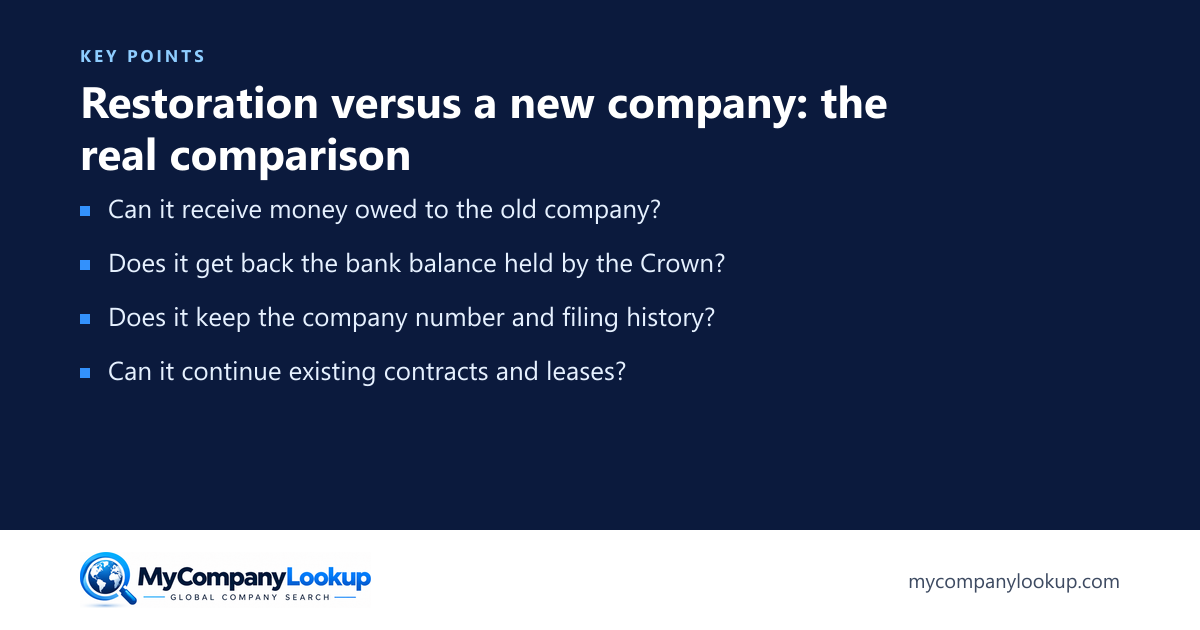
Forming a new company is cheap and quick, but it does not recover anything that belonged to the dissolved company. Compare the outcomes, not just the fees.
| Question | Restore | New company |
|---|---|---|
| Can it receive money owed to the old company? | Yes | No |
| Does it get back the bank balance held by the Crown? | Yes, less Crown costs | No |
| Does it keep the company number and filing history? | Yes | No |
| Can it continue existing contracts and leases? | Yes | Usually needs new contracts |
| Typical cost | Restoration + overdue filings | Formation fee |
| Typical time | Weeks to months | Same or next day |
If the answer to the first three questions doesn't matter to you, a new company is usually the better choice. Biz E-Formations Inc. offers UK company formation with a registered office address and help setting up a business bank account. Be careful with names: if the dissolved company was insolvent, re-using its name for a new company can make directors personally liable.
Getting a fixed quote
To price a restoration accurately, a provider needs:
- the company number (they can look it up for the dissolution date and last filings);
- whether the company traded in the missing years (dormant accounts are much cheaper);
- whether it held money or property at dissolution (Crown consent and costs); and
- whether it was struck off by Companies House or closed with a DS01 (administrative or court).
With those four answers, the cost can be worked out precisely. Send us the company number and we will list every filing and fee that applies.
Late filing penalties: how they are calculated
Late filing penalties are often the biggest surprise in a restoration bill. They are charged by Companies House on the company, based on how late the accounts were delivered. For a private company, the scale is:
| How late the accounts were | Penalty |
|---|---|
| Up to 1 month | £150 |
| More than 1 month, up to 3 months | £375 |
| More than 3 months, up to 6 months | £750 |
| More than 6 months | £1,500 |
The penalty doubles if the accounts were also late in the previous financial year. For public companies the amounts are higher. A company that missed two years in a row can therefore face several thousand pounds in penalties before any other cost. Our late filing penalties guide explains appeals and the limited circumstances in which Companies House will cancel a penalty.
Who pays: the company or the director?
Restoration costs are normally costs of the company. In practice, a director often pays them personally at first, because the company's bank account is frozen. If you do this:
- Keep receipts for every payment.
- Record the payments as a loan from the director to the company once it is restored.
- The company can then repay the director from its own funds when they are released.
Talk to your accountant about how the costs are treated for tax. Professional and filing costs incurred by a trading company are often deductible, but penalties are generally not.
Getting the order right saves money
The order of work affects both cost and time. This sequence avoids paying for the same thing twice:
- Confirm the route (administrative or court) from the company record. Search the company for the dissolution date and how it was struck off.
- Ask the Crown representative whether the company held property, and request consent if needed. This often takes the longest, so start early.
- Prepare the accounts for every missing period, choosing dormant accounts where the company genuinely didn't trade.
- Prepare confirmation statements and any officer or address changes.
- Submit the restoration with everything in one pack.
- After restoration, file anything that fell due while dissolved, plus Corporation Tax returns.
Fixed-fee or hourly?
For administrative restoration of a simple company, a fixed fee is usually available and sensible: the work is predictable. For court restoration, many solicitors also offer fixed fees for uncontested consent-order cases, with extra charges if a hearing is needed. Ask what is included:
- drafting and filing the RT01 or court claim;
- preparing overdue accounts and confirmation statements;
- liaising with the Crown representative;
- Companies House and court fees (are they included or extra?); and
- post-restoration filings and tax returns.
Budget checklist
| Item | Applies to you? | Notes |
|---|---|---|
| Companies House restoration fee | Administrative route | |
| Court issue fee | Court route | |
| Accounts for each missing year | Dormant or full/micro | |
| Confirmation statement fees | One per missing year | |
| Late filing penalties | See the table above | |
| Crown representative costs | If the company held property | |
| Registrar's costs | Court route | |
| Solicitor or agent fees | Optional for simple cases | |
| Corporation Tax returns | Nil returns for dormant years | |
| New business bank account | If the old one was closed |
Once you've ticked the boxes, you can compare the total with what you stand to recover and decide whether restoration is worth it.
Restoring a company that has debts
Restoration brings the company back with its liabilities as well as its assets. Before you spend money on it, list what the company owes:
- HMRC: Corporation Tax, VAT and PAYE for the periods before and during dissolution, plus any penalties and interest.
- Trade creditors and lenders, including bounce back or other loans.
- Landlords, if a lease was in the company's name.
If the company cannot pay its debts once restored, it is insolvent, and the directors must act in the interests of creditors. In that case, restoration may be followed by a formal insolvency process run by a licensed insolvency practitioner, which adds cost. Take advice before restoring an insolvent company.
Tax after restoration
Because a restored company is treated as never having been dissolved, its tax obligations continue too.
- Corporation Tax returns (CT600) are needed for every accounting period, including the dissolved period. Dormant periods can usually be dealt with simply. Our CT600 service covers nil and dormant returns.
- VAT and PAYE registrations may have been cancelled by HMRC when the company was dissolved. If the company is trading again, check whether they need to be reinstated or re-registered.
- Tell HMRC the company has been restored, so its records are updated. HMRC's Corporation Tax guidance explains the filing and payment rules.
Example budgets: what to price
Rather than a single figure, build your budget from these lines. Fill in today's fees from the official pages.
Dormant company, struck off for one missed year, administrative route:
- Companies House restoration fee
- One set of dormant accounts
- One confirmation statement fee
- Any late filing penalty outstanding at dissolution
- Nil CT600 for the period
Trading company, two missed years, money in the bank, administrative route:
- Companies House restoration fee
- Two sets of accounts (accountant's fees)
- Two confirmation statement fees
- Late filing penalties for both years (possibly doubled)
- Crown representative's costs
- Two CT600 returns, plus any tax due
- Optional agent fee for assembling the pack
Company closed with a DS01, court route:
- Court issue fee
- Solicitor's fees
- Registrar's costs and Crown representative's costs
- Any documents the registrar requires
- Post-restoration filings and tax returns
How to pay
Companies House fees and penalties are paid by card or bank transfer, and court fees are paid when the claim is issued. If the company's own account is frozen, a director usually pays and records it as a loan to the company, as explained above. Keep every receipt so the company can reimburse the director after the funds are released.
Questions to ask before you hire anyone
Restoration providers range from accountants to specialist agents and solicitors. Ask these questions so you can compare like with like:
- Which route do you think applies, and why?
- Is your fee fixed, and exactly what does it include?
- Are Companies House fees, court fees and penalties included or extra?
- Will you prepare the overdue accounts, or do I need an accountant as well?
- Will you contact the Crown representative for consent?
- How long do you expect it to take, and what usually causes delays?
- Will you handle the filings that fall due after restoration?
- Do you deal with Corporation Tax returns for the missing periods?
A provider who can answer all eight clearly is likely to get the application right the first time.
Other ways a company can be closed or revived
Restoration isn't the only option when a company's status needs to change.
| Situation | Option |
|---|---|
| Company still on the register with a strike-off proposal | Stop the strike off by filing what is overdue: far cheaper than restoration |
| Solvent company you want to close with significant assets | Members' voluntary liquidation (MVL) through a licensed insolvency practitioner |
| Solvent company with modest assets you want to close | Voluntary strike off with a DS01 after distributing everything |
| Insolvent company | Creditors' voluntary liquidation through a licensed insolvency practitioner |
| Dissolved company with assets or claims | Restoration (administrative or court) |
If your company has a strike-off proposal but isn't yet dissolved, act now: the cost of clearing a notice is a fraction of the cost of restoration.
Why acting early is cheaper
Every month a company stays dissolved tends to add cost:
- More filings fall due. When the company is restored, it is treated as having existed throughout, so accounts and confirmation statements for the dissolved period are due too.
- Assets may be sold. The Crown can sell property other than cash, and the company then gets the sale proceeds, which may be less than the asset was worth to you.
- Relationships suffer. Customers, suppliers and payment providers may move on while the company can't trade.
- The court route becomes the only route after six years in most cases, and eventually even that closes.
If the company is still on the register with a strike-off proposal, the cheapest option of all is to file what is overdue now.
Is restoration worth it?
Restoration usually makes sense when:
- there is money in a bank, payment provider or HMRC account that you want back;
- the company has contracts, a lease, intellectual property or a trading history you need;
- someone needs to sue or be sued in the company's name; or
- the company name and number matter to clients, marketplaces or lenders.
If none of these apply, it may be cheaper to form a new company. A new company does not recover assets that went to the Crown, though.
Key takeaways
- The Companies House or court fee is usually a small part of the total company restoration cost.
- Overdue accounts and the late filing penalties attached to them are often the biggest items.
- Crown costs apply when the company held money or property at dissolution.
- Administrative restoration avoids court fees, so check whether it is available first.
- Clearing a strike-off notice before dissolution costs far less than restoring the company afterwards.
How to keep the cost down
- Act early. The longer you wait, the more filings fall overdue and the greater the risk that Crown property is sold.
- Check whether administrative restoration is available. It avoids court fees entirely.
- Prepare all overdue documents in one go, so the application is not returned.
- Use dormant accounts where the company genuinely did not trade.
- Prevent it happening again with Company Monitor, which warns you about overdue filings and strike-off notices before the company is dissolved.
Want a fixed quote? Send us the company number and we will list exactly which filings and fees apply.
Frequently asked questions
+What is the cheapest way to restore a dissolved company?
Administrative restoration through Companies House, if the company was struck off by the registrar and you were a director or shareholder. It avoids court fees.
+Do I have to pay old late filing penalties to restore my company?
Penalties that were outstanding when the company was dissolved generally have to be paid as part of restoration.
+Why is court restoration more expensive?
You pay a court fee, usually a solicitor, and the costs of Companies House and the Crown representative, as well as bringing the filings up to date.
+Will I get my bank balance back if I restore the company?
Usually, if it passed to the Crown and has not been dealt with. It is normally returned less the Crown representative's costs.
+Is it cheaper to start a new company instead?
Often, yes, if there is nothing to recover. But a new company cannot claim money or assets that belonged to the dissolved one.