How to Stop a Compulsory Strike Off After a First Gazette Notice in 2027 and 2028
A first Gazette notice means Companies House intends to dissolve your company in about two months. Here is how to stop it and keep the company active.
MyCompanyLookup Editorial TeamUpdated 8 Oct 2026 13 min read
In this article
- Why Companies House issues the notice
- The timeline
- How to stop a strike off
- After you have filed
- If your company was a "ghost" company
- What The Gazette notice actually says
- Who gets hurt if you ignore it
- Step-by-step: clearing a strike-off notice this week
- When you need more time
- If you want the company closed anyway
- Objecting to someone else's company being struck off
- Strike-off notices and identity verification
- Why reminders get missed
- Three cases and how they were resolved
- Timeline in detail
- Checklist: clearing a strike-off notice
- Key terms
- The legal basis
- Starting fresh after a strike off
- Strike off and directors' responsibilities
- Directors of several companies
- Using dormant accounts correctly
- If you are outside the UK
- Late filing penalties after you clear the notice
- What Companies House looks for before it stops the action
- Tell the people who noticed
- Keep evidence of what you filed
- Prevent the next notice
A First Gazette notice for compulsory strike off is a formal warning that Companies House intends to remove your company from the register. If nothing changes, the company is dissolved about two months later, its bank account is frozen and its assets pass to the Crown. This guide explains how to stop a strike off before the second notice is published.
Banks, payment providers and marketplaces watch for these notices, so even before dissolution you may see accounts restricted. This guide explains what the notice means, how long you have and how to stop the strike off.
Why Companies House issues the notice
The registrar starts compulsory strike off when it has reason to believe a company is not carrying on business or in operation. The usual triggers are:
- Overdue accounts or confirmation statements;
- letters returned undelivered from the registered office; or
- no response to reminders sent to the registered office or registered email address.
You can see the notice on the register: the company status changes to "Active – proposal to strike off". Check your company now.
The timeline
| Stage | What happens |
|---|---|
| Reminders | Companies House writes about overdue filings |
| First Gazette notice | Published in The Gazette; status becomes "proposal to strike off" |
| About 2 months | Window to file, object or ask for more time |
| Second Gazette notice | The company is struck off and dissolved |
Act within the two-month window. Once the company is dissolved, you need restoration, which costs far more.
How to stop a strike off
1. File what is overdue
The most effective fix is to deliver the overdue documents. When Companies House receives them, it normally stops the strike off action.
- Accounts: file the overdue annual accounts. A company that did not trade can file dormant accounts.
- Confirmation statement: file any missing confirmation statement with the fee.
- Registered office: if mail was being returned, update the registered office to an address where post is received.
2. Ask for more time if you cannot file immediately
If the accounts cannot be ready in time, contact Companies House before the second notice, explain why, and ask for the strike off to be suspended while you prepare them. Suspensions are at the registrar's discretion and are not guaranteed, so file as soon as you can.
3. Objections by others
Creditors, HMRC and other interested parties can object to a strike off, for example because the company owes them money. That keeps the company on the register, but it does not fix your overdue filings.
After you have filed
- Check the register again after a few days. The status should return to Active.
- If a bank or payment provider restricted your account, send them a link to the updated record and confirm the filings are up to date.
- Make sure the registered email address is one you monitor, so reminders reach you.
If your company was a "ghost" company
If the company never traded and you do not need it, letting it be struck off may seem easiest. It is better to close it properly with a voluntary strike off (DS01): it is cleaner, avoids exposing directors, and lets you deal with any money first.
What The Gazette notice actually says
The Gazette is the UK's official public record. A first notice for compulsory strike off is short and standard. It names the company, gives its number, and states that, unless cause is shown to the contrary, the company will be struck off the register and dissolved at the end of the notice period. Anyone can search The Gazette, which is why banks, lenders, credit agencies and payment providers pick these notices up so quickly.
You may also see two other kinds of notice that are easy to confuse:
| Notice | What it means | Who started it |
|---|---|---|
| First Gazette notice for compulsory strike off | Companies House believes the company is no longer operating | Companies House |
| First Gazette notice for voluntary strike off | The directors have applied (DS01) to close the company | The company |
| Final Gazette notice | The company has been struck off and dissolved | Companies House |
If the notice is for a voluntary strike off that you did not apply for, contact Companies House immediately, because it may mean someone filed a DS01 without authority.
Who gets hurt if you ignore it
A compulsory strike off does more than remove a name from a list.
- The company's bank account is frozen and the balance passes to the Crown. See what happens to a dissolved company's bank account.
- All other assets pass to the Crown too, including property, intellectual property and money owed to the company. Our guide to bona vacantia explains what that means.
- Contracts are disrupted. A dissolved company cannot enforce a contract or receive payment.
- Directors may face questions. Failing to file accounts and confirmation statements is an offence, and a pattern of strike-offs can be taken into account in director disqualification proceedings.
- Restoring the company later costs much more than filing now. Compare the costs in our restoration cost guide.
Step-by-step: clearing a strike-off notice this week
Follow this order. Each step removes a reason for the strike off and gives you evidence for banks and payment providers.
Day 1: confirm the facts
- Look up the company and confirm the status says "Active – proposal to strike off".
- Check the filing history for the last accounts and confirmation statement.
- Check the registered office address. Is it an address where post reaches you today?
- Note the date of the first Gazette notice, so you know roughly when the two months end.
Days 1–3: fix the address and email
If letters were not reaching you, that is probably why you missed the reminders.
- Change the registered office to an address where post is received and opened. If you don't have a suitable UK address, Biz E-Formations Inc. provides registered office address services for UK companies.
- Make sure the registered email address held by Companies House is one you check.
Days 1–7: file the overdue documents
- Accounts: if the company did not trade during the period, file dormant accounts. If it did trade, prepare full or micro-entity accounts.
- Confirmation statement: file each missing confirmation statement.
- Tax: if accounts were missing, the Corporation Tax return is probably missing too. File the CT600 so HMRC does not object to the company's existence later.
Day 7 onwards: confirm the action has stopped
- Check the register again. The status should return to Active once Companies House has processed the filings.
- If it hasn't changed and the end of the notice period is close, contact Companies House, explain what you have filed, and ask for the strike off to be suspended.
When you need more time
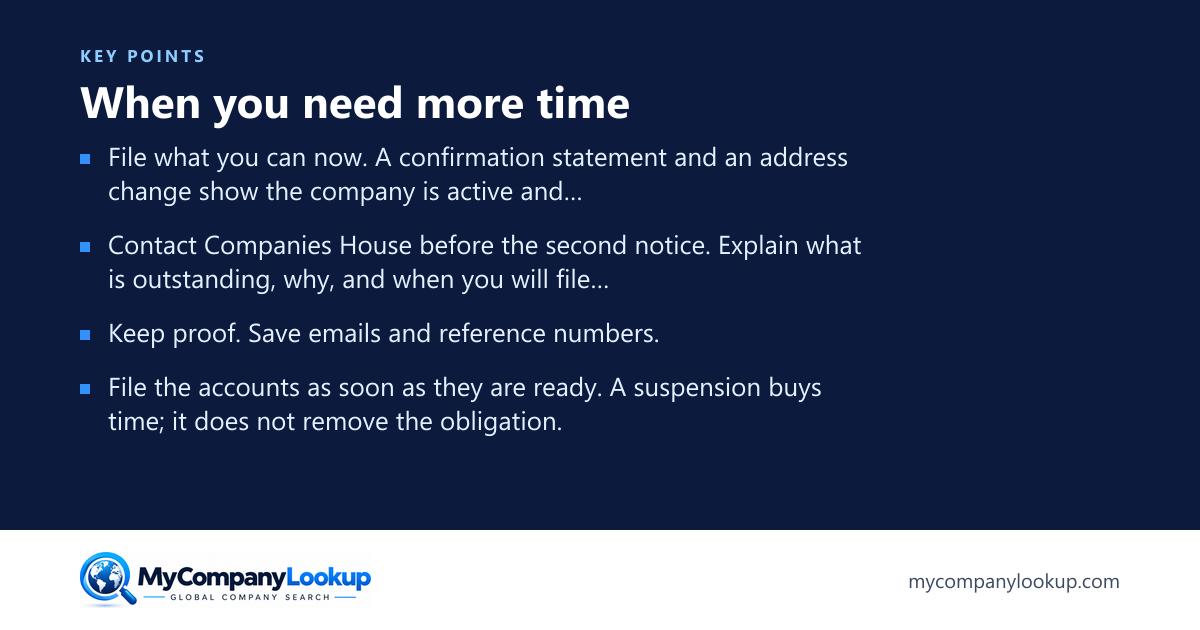
Sometimes the accounts can't be finished in two months, for example because the company's records are with a former accountant. In that case:
- File what you can now. A confirmation statement and an address change show the company is active and responsive.
- Contact Companies House before the second notice. Explain what is outstanding, why, and when you will file it. Ask for the strike-off action to be suspended.
- Keep proof. Save emails and reference numbers.
- File the accounts as soon as they are ready. A suspension buys time; it does not remove the obligation.
A suspension is at the registrar's discretion. Do not rely on it as your only plan.
If you want the company closed anyway
If the company is genuinely finished, it is still better to close it properly than to let compulsory strike off happen. A voluntary strike off with a DS01:
- gives you control over the timing;
- lets you distribute money to shareholders first, rather than losing it to the Crown; and
- avoids the reputational marks of a compulsory strike off.
You can't apply for a DS01 while some proceedings are under way, and you must tell creditors, employees and HMRC. Our guide to closing a UK company with a DS01 covers the eligibility rules and order of steps.
Objecting to someone else's company being struck off
If a company owes you money and you see a strike-off notice, you can object. Contact Companies House before the notice period ends, explain the debt and provide evidence. An objection can delay the strike off and give you time to pursue the debt. Once the company is dissolved, you would have to restore it by court order to sue it.
Strike-off notices and identity verification
Under the Economic Crime and Corporate Transparency Act 2023, Companies House has stronger powers to query and remove information, and directors and people with significant control must now verify their identity. As these rules phase in during 2025–2027, failing to complete verification is likely to become another reason for compliance action. Our identity verification guide explains who must verify and how. If you prefer, Biz E-Formations Inc. can verify your identity as an authorised agent.
Why reminders get missed
Almost every compulsory strike off we see started with a communication problem, not a decision to stop running the company. The usual causes:
- The registered office is an old address: a former home, an accountant who has moved, or a virtual office that was cancelled.
- The registered email address is unmonitored, for example a former employee's inbox.
- The accountant left and nobody took over the filing calendar.
- The director moved abroad and post isn't forwarded.
- The company was assumed to be closed when it wasn't.
- Companies House moved the office to its default address after post was returned, so letters now go nowhere useful.
Fixing the cause matters as much as filing the overdue documents. Otherwise the next notice is only a year away.
Three cases and how they were resolved
The dormant company with no accountant
A director's dormant company had filed nothing for 18 months after their accountant retired. A first Gazette notice appeared and their bank flagged it within days. They filed dormant accounts and the overdue confirmation statement within a week, updated the registered office to their current address, and the status returned to Active before the notice period ended.
The trading company with records stuck elsewhere
A trading company's records were with a former bookkeeper and the accounts couldn't be finished in time. The director filed the confirmation statement immediately, changed the registered office, contacted Companies House to explain and asked for more time, then filed the accounts five weeks later. Because the company showed it was active and responsive, the strike off didn't go ahead.
The company nobody needed
A company had been set up for a project that never started. The shareholders decided they didn't need it. Rather than let compulsory strike off happen, they filed the overdue documents to clear the notice, closed the bank account, then applied for a voluntary strike off on their own timetable.
Timeline in detail
| Point in time | What you should have done |
|---|---|
| Accounts or confirmation statement becomes overdue | File it. Late filing penalties start immediately for accounts |
| Companies House reminder letters | Reply and file; update the address if letters were delayed |
| First Gazette notice published | File everything overdue this week |
| Halfway through the notice period | If filing isn't possible, contact Companies House and ask for a suspension |
| Close to the end of the notice period | Confirm the status has returned to Active |
| Second (final) Gazette notice | Company dissolved: restoration required |
Checklist: clearing a strike-off notice
| Task | Done? |
|---|---|
| Confirmed the status on the register | |
| Updated the registered office to an address that receives post | |
| Confirmed the registered email address is monitored | |
| Filed overdue accounts (dormant or full) | |
| Filed overdue confirmation statements | |
| Filed Corporation Tax returns for the same periods | |
| Contacted Companies House if more time is needed | |
| Told the bank and payment providers it is resolved | |
| Put next deadlines in a calendar | |
| Turned on monitoring |
Key terms
- Compulsory strike off: removal of a company from the register by Companies House because it appears not to be operating.
- Voluntary strike off (DS01): removal on the company's own application.
- First Gazette notice: public notice that a company will be struck off unless cause is shown.
- Second (final) Gazette notice: confirmation the company has been struck off and dissolved.
- Suspension: a pause in strike-off action at the registrar's discretion.
- Restoration: bringing a dissolved company back to the register.
The legal basis
Compulsory strike off is governed by section 1000 of the Companies Act 2006, which lets the registrar strike off a company it has reasonable cause to believe is not carrying on business or in operation, after sending letters and publishing a notice in The Gazette. Companies House explains the process in its guidance on strike off and dissolution.
Starting fresh after a strike off
If the company is dissolved and you decide not to restore it, you can form a new one. Biz E-Formations Inc. can register a new UK company with a registered office address that receives post and help open a business bank account, which avoids the most common causes of missed reminders.
Strike off and directors' responsibilities
Directors are legally responsible for making sure the company delivers its accounts and confirmation statement on time, even if an accountant does the work. A first Gazette notice is a sign those duties have slipped. In practice:
- Failing to file accounts or a confirmation statement is a criminal offence for the company and every director, although prosecution is usually reserved for persistent cases.
- A history of compulsory strike offs can be taken into account if the Insolvency Service considers director disqualification, particularly where creditors lost money.
- Letting a company with assets be struck off means those assets go to the Crown. That can harm shareholders and creditors, and directors may be asked why they let it happen.
Clearing the notice promptly, and fixing the reason it happened, is the best evidence that the company is properly run.
Directors of several companies
If you are a director of more than one company, a missed filing in one can affect how banks and payment providers view you. They check the director's other appointments as part of their due diligence. Keep a single calendar for every company you're responsible for, and consider Company Monitor for all of them, so one forgotten company doesn't cause problems for the others.
Using dormant accounts correctly
Dormant accounts are the quickest way to clear a strike-off notice, but only if the company really was dormant: no significant accounting transactions during the period. Paying the Companies House fee for the confirmation statement doesn't stop a company being dormant, but trading, paying salaries or receiving income does. If the company traded, file the correct type of accounts instead. Our guide to dormant company accounts and nil CT600 explains the rules in detail.
If you are outside the UK
Many companies with strike-off notices have directors living abroad, who never see post sent to the registered office. If that's you:
- Use a UK registered office service that scans and forwards post the same day.
- Set the registered email address to an inbox you check daily.
- Make sure someone in the UK, such as your accountant or formation agent, has your filing deadlines.
Biz E-Formations Inc. works with non-UK directors to provide a UK registered office, file on time and help with opening a UK business bank account.
Late filing penalties after you clear the notice
Clearing the strike-off notice doesn't cancel late filing penalties. Companies House charges a penalty automatically when accounts are delivered late, and the amount depends on how late they were: for a private company it ranges from £150 for up to a month to £1,500 for more than six months, and it doubles if the previous year's accounts were also late.
Penalties can be appealed only in limited circumstances, such as serious illness or events genuinely outside the directors' control. Not knowing the deadline, an accountant's mistake or cash-flow problems are not usually accepted. Our guide to Companies House late filing penalties explains the appeal process and what evidence to include.
Pay penalties promptly. Unpaid penalties can be passed to debt collectors, and they must be paid if the company is ever dissolved and you later need to restore it.
What Companies House looks for before it stops the action
The registrar starts strike-off action because it believes the company isn't operating. Anything that shows the company is operating and is dealing with its obligations helps:
- delivered accounts for the overdue period;
- a confirmation statement with current officers, PSCs and shareholders;
- a registered office where post is received; and
- a response to Companies House if you need time, with a realistic date.
The quickest and most reliable route is simply to file everything that is overdue.
Tell the people who noticed
Banks, payment providers, lenders and credit agencies may have seen the Gazette notice. Once the status is back to Active, send each one a short note with the company number, a link to the updated record and a one-line explanation, for example: "Our overdue accounts were filed on 4 March 2027 and the strike-off action has been discontinued." This avoids restrictions lingering after the problem is fixed.
Keep evidence of what you filed
Save the Companies House acceptance emails and the transaction reference for every document you file while clearing a notice. If a bank, lender or payment provider asks why the company had a strike-off proposal, these give a clear, dated record of when each overdue document was delivered and accepted. They also help if a late filing penalty is later disputed, or if you need to show Companies House exactly what was filed before the end of the notice period.
Prevent the next notice
Strike-off notices nearly always follow a missed reminder. Company Monitor watches the register and emails you the moment a strike-off proposal, overdue filing or address change appears, with your accounts and confirmation statement deadlines in one list.
Frequently asked questions
+What does "Active – proposal to strike off" mean?
Companies House has published a first Gazette notice and intends to dissolve the company in about two months unless the reason is dealt with.
+How long do I have after a first Gazette notice?
Usually about two months before the second notice dissolves the company. Act immediately.
+How do I stop a compulsory strike off?
File the overdue accounts and confirmation statements, update the registered office if needed, and contact Companies House if you need more time.
+Will my bank freeze my account during the notice period?
Some banks and payment providers restrict accounts as soon as a strike-off proposal appears. Clearing the notice quickly is the best way to get restrictions lifted.
+What if the company has already been dissolved?
You need to restore it, usually by administrative restoration if Companies House struck it off and you were a director or shareholder.