How to Release Funds from a Dissolved Company's Bank Account in 2027 and 2028
When a UK company is dissolved, its bank balance legally belongs to the Crown. Here is how to get the funds released back to the company, step by step.
MyCompanyLookup Editorial TeamUpdated 9 Oct 2026 13 min read
In this article
- First, confirm what happened
- Where the money goes: bona vacantia
- How to release a dissolved company's bank funds
- What the bank will ask for
- Time limits that matter
- Why the bank acted so quickly
- Different situations, different steps
- What to prepare before you call the bank
- Documents banks typically ask for after restoration
- Payment providers and e-money accounts
- HMRC refunds and other money owed to the company
- Timeline: from frozen account to released funds
- Three real-world patterns
- What not to do
- Scotland and Northern Ireland
- The legal basis, briefly
- Opening a new account while you restore
- Checklist: getting the money released
- Writing to the Crown representative
- Interest, charges and payments received after dissolution
- Directors' loan accounts
- Banks, e-money accounts and building societies
- Joint signatories and former directors
- How to stop it happening again
Partner links: some links in this guide are partner (referral) links. If you sign up through them we may earn a commission or referral reward, at no extra cost to you. It doesn't change what we recommend.
A business bank account that suddenly stops working is one of the most common signs that a company has been dissolved. Banks check the Companies House register, and once a company is dissolved they must stop the account, because the company no longer legally exists and cannot give instructions. This guide explains how to release a dissolved company's bank funds step by step.
If this has happened to you, the money has not disappeared. This guide explains where a dissolved company's bank account balance goes, why the bank cannot simply pay it to the directors, and the steps to get the funds released.
First, confirm what happened
Search the company and check its status:
- Dissolved: the company has been removed from the register. This guide applies.
- Active – proposal to strike off: the company is not yet dissolved. Act now to stop the strike off; the bank may only be cautious at this stage.
- Active: the freeze is for another reason, such as identity checks or a mismatch between your details and the register. Ask the bank exactly what it needs.
Where the money goes: bona vacantia
When a company is dissolved, any property it still owns, including cash at the bank, passes automatically to the Crown as bona vacantia ("ownerless goods"). Who deals with it depends on where the company's registered office was:
| Registered office | Crown representative |
|---|---|
| Most of England and Wales | Government Legal Department, Bona Vacantia Division |
| Duchy of Lancaster area | Solicitor for the Duchy of Lancaster |
| Duchy of Cornwall area | Solicitor for the Duchy of Cornwall |
| Scotland | King's and Lord Treasurer's Remembrancer |
| Northern Ireland | Crown Solicitor's Office |
The bank holds or transfers the balance on the Crown's behalf. It cannot pay it to former directors or shareholders, even if they are the only people involved, because the money no longer belongs to them or to the company.
How to release a dissolved company's bank funds
Option 1: Restore the company (the usual route)
Restoring the company reverses the dissolution. Property that passed to the Crown is returned to the company, normally less the Crown representative's costs, as long as it has not already been dealt with.
- Check whether administrative restoration is available (struck off by Companies House, you were a director or shareholder, within six years). If not, apply to court. Our restoration guide explains both routes.
- Contact the Crown representative for a waiver or consent letter. You will need it for administrative restoration when the company held property.
- Bring the company's filings up to date and apply.
- Once restored, send the bank the restoration evidence (the Companies House record showing the company is active again, and the restoration notice) and ask it to reactivate the account or release the funds.
Option 2: The account was closed, and the money already went to the Crown
If the bank has already paid the balance to the Crown, restoration still works: after the company is restored, you ask the Crown representative to return the funds to the company.
Option 3: You do not want the company back
Restoration is the normal way to recover a dissolved company's money. If restoration is not worth it, speak to the Crown representative about your circumstances, but do not assume funds will be paid out without the company being restored.
What the bank will ask for
Banks differ, but expect to provide:
- the company number and evidence that the company is active again;
- identity verification for the directors, often repeated;
- up-to-date details: registered office, directors and people with significant control (PSCs) that match Companies House exactly; and
- in some cases, recent accounts or an explanation of the gap.
A mismatch between what the bank holds and what the register shows is one of the most common reasons accounts stay restricted, so update the register first.
Time limits that matter
- Six years from dissolution is the usual limit for restoration.
- The Crown representative can sell or deal with property during that time. Cash is generally held, but other assets may be sold.
- Interest, cheques and payments into the account after dissolution can complicate matters, so act quickly.
Why the bank acted so quickly
Many directors are surprised that the bank froze the account on the very day the company was dissolved, sometimes before they received any letter. There are three reasons.
- Banks monitor the register. Business banks routinely check Companies House for status changes on their customers, and a dissolution is one of the most important.
- The company can no longer give instructions. A dissolved company has no legal existence, so nobody can authorise payments on its behalf. Directors' authority ends with the company.
- The money now belongs to someone else. The balance has passed to the Crown as bona vacantia. If the bank paid it out to a director, it could be liable to the Crown.
Some banks also restrict accounts earlier, when a proposal to strike off appears on the register. If your company is at that stage, it is not yet dissolved, and you can usually stop the strike off by filing what is overdue.
Different situations, different steps
The company is dissolved and the money is still in the account
This is the most common case. The bank has frozen the account but has not yet transferred the balance.
- Tell the bank you intend to restore the company. Ask it to note the account and confirm the balance and the date it was frozen.
- Restore the company through administrative or court restoration. See how to restore a dissolved UK company.
- Send the bank proof of restoration and ask it to reactivate the account. Some banks will reopen the original account; others will release the funds to a new account in the company's name.
The balance has already gone to the Crown
If the bank has transferred the money to the Crown representative, the process is the same, but after restoration you ask the Crown representative to return it. It will normally deduct its costs. Keep the reference number from any letter the Crown representative sent.
The bank has closed the account permanently
After restoration, open a new business account in the company's name and ask for the funds to be paid into it. Expect full onboarding checks: identity verification for directors and people with significant control, proof of business address and an explanation of the gap in the company's history. If you need help, Biz E-Formations Inc. assists UK companies with opening a business bank account.
Customers are still paying into the old account
Payments made to a dissolved company's account after dissolution can be returned to the payer or held. Tell your customers to stop paying until the company is restored and the account is active, and give them new details if the account changes.
The company was closed on purpose and money was left behind
If the directors applied for a DS01 strike off and forgot a balance, a refund or a late payment, the company can only be restored by court order. Weigh the amount against the cost of a court restoration, which is set out in our restoration cost guide.
What to prepare before you call the bank
Have this ready so the conversation is short and productive:
| Item | Where to get it |
|---|---|
| Company name and number | Company search |
| Date of dissolution | Company record, "Filing history" |
| Account number and sort code | Old statements |
| Last known balance | Online banking (if you still have read access) or statements |
| Names of authorised signatories | Bank mandate |
| Your plan | "We are restoring the company through Companies House" or "by court order" |
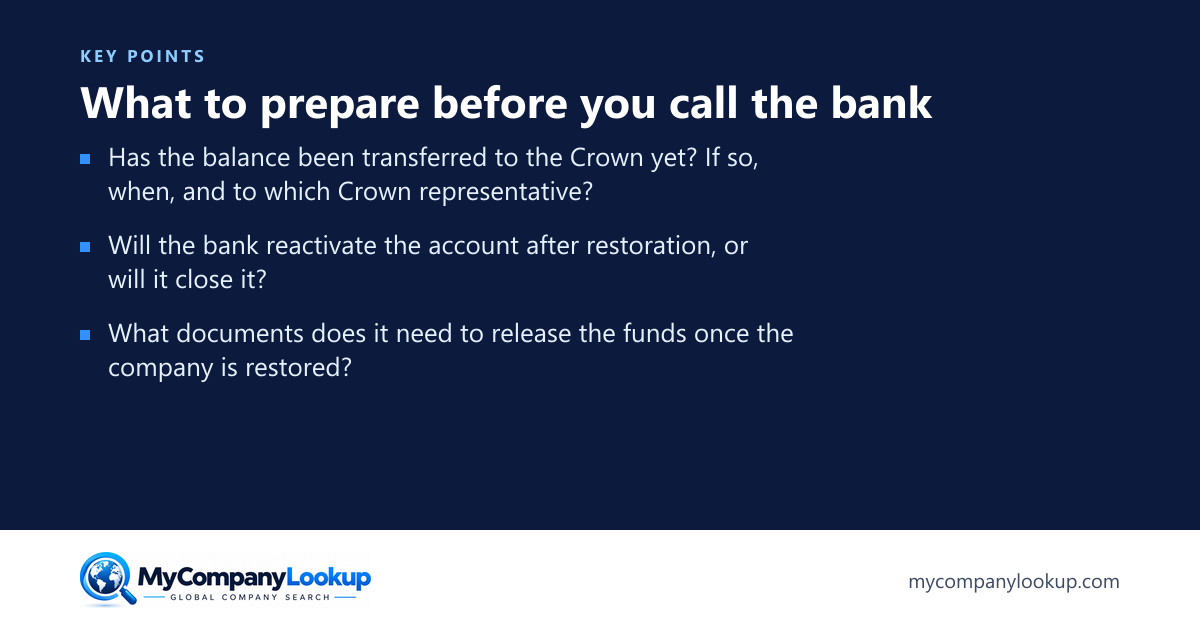
Ask the bank three specific questions:
- Has the balance been transferred to the Crown yet? If so, when, and to which Crown representative?
- Will the bank reactivate the account after restoration, or will it close it?
- What documents does it need to release the funds once the company is restored?
Write the answers down, with the name of the person you spoke to and the date.
Documents banks typically ask for after restoration
- Evidence of restoration: the company's Companies House page showing it is Active, and the restoration notice or court order.
- Certificate of incorporation and any change of name certificate.
- Identity documents for every director and for people with significant control, often re-checked even for long-standing customers.
- Proof of address for directors.
- Accounts or management information explaining the dissolved period.
- A board minute authorising the release or transfer of funds, if the bank asks for one.
Details on the register must match what you give the bank exactly: names, dates of birth, addresses and the registered office. Fix the register first if anything is out of date.
Payment providers and e-money accounts
The same rules apply to money held by PayPal, Stripe, Wise, Amazon and other providers. When a company is dissolved, a balance it holds with an e-money institution is still company property, so it passes to the Crown. Providers usually restrict the account as soon as they see the change on the register. Our guide to funds frozen by payment providers covers what to send them.
HMRC refunds and other money owed to the company
A dissolved company may also be owed money, such as a Corporation Tax or VAT refund, a deposit, or unpaid invoices. These debts belong to the Crown after dissolution too. Once the company is restored, it can claim them again in its own name. If a refund cheque or payment arrives while the company is dissolved, do not pay it into a personal account.
Timeline: from frozen account to released funds
| Step | Typical time |
|---|---|
| Confirm status, call the bank, gather documents | 1 week |
| Prepare overdue accounts and confirmation statements | 1–4 weeks |
| Obtain Crown consent letter (if needed) | Several weeks |
| Administrative restoration by Companies House | A few weeks |
| Bank or Crown releases the funds | 1–4 weeks after restoration |
Court restoration adds time. Starting the accounts and the Crown consent request in parallel saves the most.
Three real-world patterns
The forgotten account
A company stopped trading years ago and the director assumed it had been closed. Companies House struck it off for missing accounts. Nobody noticed the dormant business account still held £3,200 until a bank letter arrived about the balance being transferred. With only a modest sum involved, the director compared the cost of administrative restoration (dormant accounts, a confirmation statement and the restoration fee) with the balance, and went ahead because the filings were simple.
The trading company that lost its address
A small e-commerce company used an accountant's address as its registered office. When the accountant moved, post was returned, reminders went unanswered and the company was struck off. Its bank account held £41,000 of customer receipts and its payment provider account was restricted the same week. The directors restored the company administratively after obtaining the Crown representative's consent, filed two years of accounts, then sent both the bank and the payment provider the restored company record.
The DS01 with a surprise refund
Two directors closed a company with a DS01. Six weeks after dissolution, HMRC issued a Corporation Tax refund, and a supplier refunded an overpayment into the old bank account. Because the company was closed voluntarily, it could only be restored by court order. The directors decided the refunds justified the court route; if the amounts had been small, they might have let them go.
What not to do
Directors under pressure sometimes take shortcuts that make things worse.
- Don't move the money to a personal account. If you still have access, transferring company money after dissolution can mean dealing with Crown property without authority.
- Don't keep trading in the company's name. A dissolved company cannot enter contracts, and directors who carry on can be personally liable.
- Don't open a new company with the same name to receive the old company's payments, especially if the old company owed money. Re-using the name of an insolvent company can make directors personally liable.
- Don't ignore the bank's letters. They often contain the Crown representative's reference, which speeds up consent.
- Don't wait. Assets other than cash may be sold, and the six-year limit is strict.
Scotland and Northern Ireland
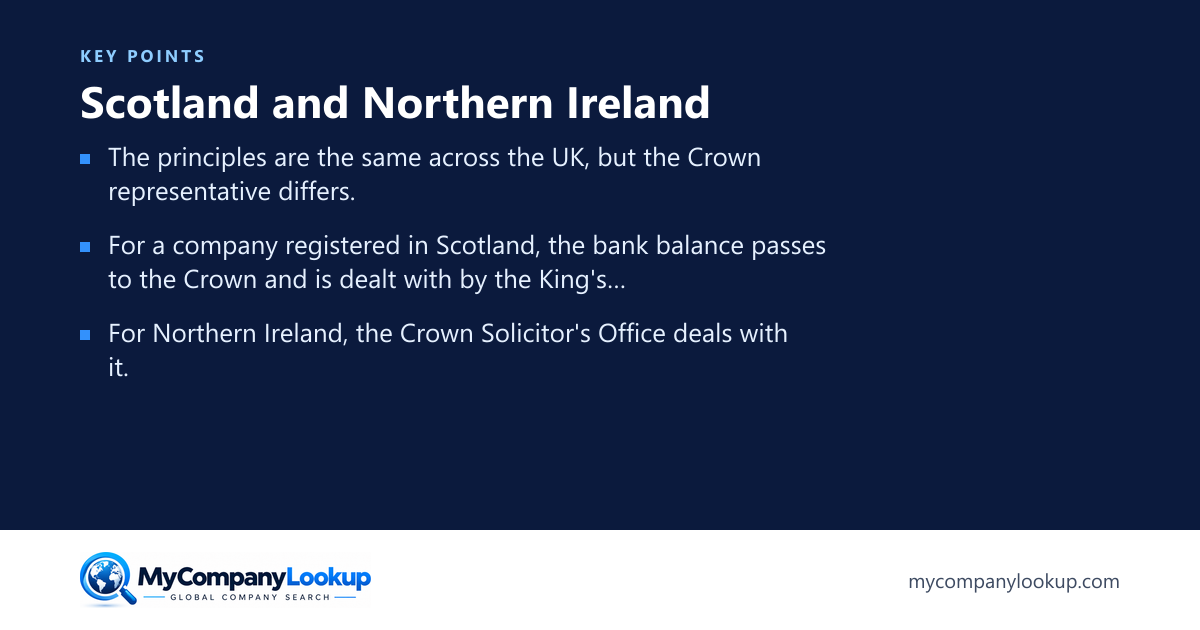
The principles are the same across the UK, but the Crown representative differs. For a company registered in Scotland, the bank balance passes to the Crown and is dealt with by the King's and Lord Treasurer's Remembrancer (KLTR). For Northern Ireland, the Crown Solicitor's Office deals with it. Ask the right body for consent before applying for administrative restoration.
The legal basis, briefly
- Companies Act 2006, section 1012: property of a dissolved company, including money held on its behalf, is deemed bona vacantia and belongs to the Crown.
- Section 1028: after administrative restoration, the company is deemed to have continued in existence as if it had not been dissolved.
- Section 1034: where the Crown has disposed of property before restoration, the company is generally entitled to the value received for it instead.
These rules are why the bank can't pay the directors, and why restoration is the normal way to get the money back.
Opening a new account while you restore
If you need to keep trading during restoration, the cleanest option is usually a new company with its own bank account, used only for new business. Keep the two companies' money and contracts separate, and don't route the old company's receivables into the new one. Biz E-Formations Inc. can form a UK company and help you open a business bank account quickly while the old company is being restored.
Checklist: getting the money released
| Step | Done? |
|---|---|
| Confirmed the company status and dissolution date | |
| Asked the bank whether the balance has gone to the Crown | |
| Identified the correct Crown representative | |
| Requested consent (waiver) letter | |
| Prepared overdue accounts and confirmation statements | |
| Applied for administrative or court restoration | |
| Sent the bank or Crown evidence of restoration | |
| Updated payment providers and HMRC | |
| Turned on monitoring so it doesn't happen again |
Writing to the Crown representative
A clear first letter or email to the Crown representative saves weeks. Include:
- The company's full name and number, and the date of dissolution.
- Your relationship to the company (former director or shareholder).
- What property you believe the company held: the bank, account number (last four digits) and approximate balance.
- What you are asking for: consent to administrative restoration (a waiver letter), or confirmation of the conditions for court restoration.
- Any reference number from earlier correspondence or from the bank.
A short example:
I was a director of Example Trading Ltd (company number 12345678), which was struck off by Companies House and dissolved on 2 May 2027. At dissolution the company held approximately £14,000 at [bank], account ending 1234. I intend to apply for administrative restoration and request the Crown's consent. Please let me know any conditions and your costs.
For England and Wales, the Government Legal Department publishes contact details and guidance on its Bona Vacantia pages.
Interest, charges and payments received after dissolution
- Interest earned on the balance after dissolution generally follows the money: it is Crown property while the company is dissolved.
- Bank charges may continue to be applied to a frozen account. Ask the bank to suspend them while restoration is in progress.
- Direct debits and card payments out of the account will fail. Tell suppliers so they don't keep retrying and charging fees.
- Payments received after dissolution may be held by the bank or returned to the payer. Keep a list of who has paid, so the restored company can reconcile its records.
Directors' loan accounts
If the company owed you money through a director's loan account, that debt is still a liability of the company, not of the Crown. After restoration, the company can repay you in the ordinary way. If the company was dissolved and not restored, the Crown does not pay its debts. If you owed the company money (an overdrawn director's loan account), that debt passes to the Crown on dissolution and becomes due to the company again after restoration.
Banks, e-money accounts and building societies
The rule is the same wherever the money is held: it belongs to the company, so on dissolution it passes to the Crown. The practical differences are in how each kind of institution handles it.
- High-street and business banks usually freeze the account quickly and may transfer the balance to the Crown representative after a period.
- E-money institutions and payment providers, such as those offering business accounts and merchant services, usually restrict the account and hold the balance while they review it. Our guide to payment provider holds covers this in detail.
- Building societies and savings providers follow the same principle for any deposit in the company's name.
Whichever applies, ask the institution whether it still holds the money or has paid it to the Crown, and record the answer. It decides whom you ask for the funds after restoration.
Joint signatories and former directors
If the account had more than one signatory, the bank will usually want to hear from the current directors of the restored company. Former directors who resigned before dissolution can't give instructions. If the people on the bank mandate have changed, file the officer changes at Companies House first, then update the mandate with the bank, so the register and the bank agree on who can authorise payments.
How to stop it happening again
Most dissolutions start with a missed filing and an unread letter. After restoration:
- update the registered office and registered email address at Companies House;
- put your accounts and confirmation statement due dates in a calendar; and
- turn on Company Monitor, which alerts you by email as soon as a strike-off notice or overdue filing appears, before the bank sees it.
Need help getting funds released? We prepare restoration applications and the overdue filings. Contact our filing team.
Frequently asked questions
+Why did my bank freeze the account when the company was dissolved?
A dissolved company no longer legally exists, so it cannot operate a bank account. Its remaining money passes to the Crown as bona vacantia.
+Can the bank pay the money to the directors or shareholders?
No. After dissolution the money belongs to the Crown, not to the former directors or shareholders.
+How do I get the money back?
Usually by restoring the company to the register. The funds are then returned to the company, normally less the Crown representative's costs.
+How long do I have to recover the funds?
Generally six years from dissolution, the time limit for restoration. Act sooner, because Crown property can be dealt with in the meantime.
+My company is still active but the account is frozen. Why?
Common reasons are a proposal to strike off on the register, identity checks, or details that do not match Companies House. Check the register and ask the bank for its exact requirements.