How to Get Funds Released by PayPal, Stripe, Wise or Amazon in 2027 and 2028
Many payout holds start on the Companies House register, not with the payment provider. Here is how to find what the provider saw and fix it.
MyCompanyLookup Editorial TeamUpdated 7 Oct 2026 13 min read

In this article
- The register problems that trigger holds
- Step 1: Check exactly what the register shows
- Step 2: Fix the register before contacting the provider
- Step 3: Send the provider clear evidence
- How long does it take to release PayPal, Stripe or Wise funds?
- Why payment providers check the register at all
- Provider by provider: what usually triggers a review
- The default address problem
- A ready-to-use reply to a verification request
- Fixing mismatches between your account and the register
- When the company is dissolved
- When the problem is the people, not the company
- Setting up correctly from the start
- Holds, reserves and limitations: know which one you have
- Three cases
- Evidence checklist
- Mistakes that keep accounts restricted
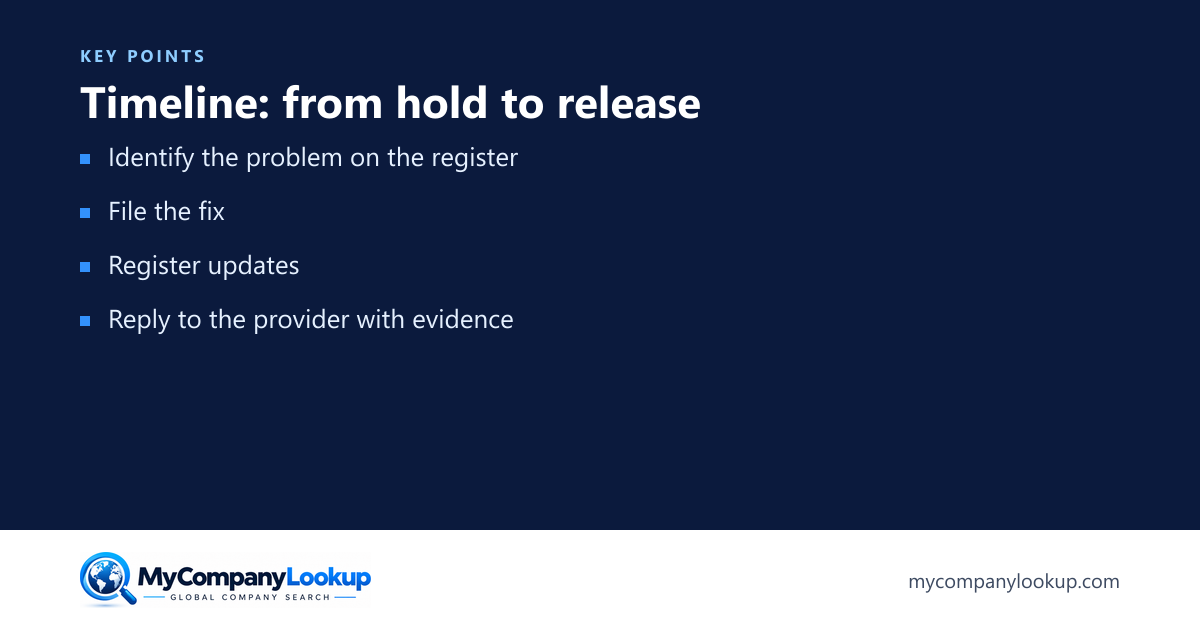
- Timeline: from hold to release
- A compliance calendar that keeps providers happy
- Non-UK directors and UK companies
- Marketplace sellers: extra points
- How to read your company's record like a provider does
- Official sources worth knowing
- When a hold looks like fraud
- Keeping records ready
- If the provider won't lift the hold
- Stop it happening again
Partner links: some links in this guide are partner (referral) links. If you sign up through them we may earn a commission or referral reward, at no extra cost to you. It doesn't change what we recommend.
Payment providers and marketplaces such as PayPal, Stripe, Wise and Amazon are regulated businesses. They must know who they are paying, so they check business accounts against official sources, including the Companies House register. When something on the register changes or does not match, payouts can be held or the account restricted, often with a vague message asking you to "verify your business". This guide explains how to release PayPal, Stripe, Wise and Amazon funds held because of a company-status problem.
This guide explains the company-status problems that most often trigger a hold, how to find out which one applies to you, and what to send to get funds released.
The register problems that trigger holds
| What the provider sees | Why it matters | What to do |
|---|---|---|
| Dissolved | The company no longer exists and cannot receive money | Restore the company |
| Active – proposal to strike off | The company may be dissolved within about two months | Stop the strike off by filing what is overdue |
| Overdue accounts or confirmation statement | A sign the company may not be properly run | File the overdue documents |
| Registered office moved to the Companies House default address | The company has no valid address of its own | Set a new registered office |
| Directors or PSCs differ from your account | Ownership and control can't be verified | Update the register or the account so they match |
| Company name changed | Account name no longer matches the legal name | Update the account with the new name and certificate |
| Identity verification outstanding | Directors and PSCs must now verify their identity with Companies House | Complete identity verification |
Step 1: Check exactly what the register shows
Search your company and look at:
- Status: Active, Active – proposal to strike off, or Dissolved.
- Registered office address: is it yours, or a Companies House default address?
- Accounts and confirmation statement: any marked overdue?
- Officers and PSCs: do the names, dates of birth and addresses match what you gave the provider?
- Recent filings: has anything changed recently that you didn't expect?
Our company profiles show an at-a-glance health score and flag overdue items and strike-off proposals at the top of the page.
Step 2: Fix the register before contacting the provider
Providers re-check the register when you respond. If the problem is still showing, the review usually fails. Fix the cause first:
- Overdue filings: file the accounts and confirmation statement.
- Strike-off proposal: filing the overdue documents normally stops it.
- Dissolved: restoration is required; payouts cannot go to a dissolved company.
- Mismatched people or addresses: file the officer, PSC or address changes so the register is correct.
Step 3: Send the provider clear evidence
Once the register is correct, reply to the provider's request with:
- a link to the company's Companies House page showing it is Active;
- the certificate of incorporation and any change of name certificate;
- ID and proof of address for directors and beneficial owners, matching the register;
- proof of business address if it differs from the registered office; and
- a short, factual explanation, for example: "Our accounts were overdue; they were filed on 3 October 2027 and the strike-off proposal has been removed."
Keep it short and match every detail exactly to the register.
How long does it take to release PayPal, Stripe or Wise funds?
That depends on the provider and on whether the hold is a verification review (usually resolved once evidence is accepted) or a risk reserve (which may run for a set period). Fixing the register removes the most common trigger, but each provider makes its own decision.
Why payment providers check the register at all
Payment providers, e-money institutions and marketplaces are regulated for anti-money laundering (AML) and must carry out know your business (KYB) checks. For a UK limited company, the register at Companies House is the official source for:
- whether the company exists and is active;
- its registered office address;
- its directors and people with significant control (PSCs); and
- whether it is keeping up with its legal filings.
Providers check at onboarding and keep checking afterwards. Many use automated services that watch the register and flag changes. That is why a hold can arrive weeks after a change you made, or after a change you didn't notice, such as Companies House moving your registered office to its default address.
Provider by provider: what usually triggers a review
Every provider has its own rules and they change, so treat this as a guide to what to look at, not a statement of any provider's policy.
| Provider | What tends to trigger a business review |
|---|---|
| PayPal | Business details that don't match the register, a change of legal name, unusual volume, or a status change on the register |
| Stripe | Account information that no longer matches the company record, changes to owners or directors, or a company that no longer appears as active |
| Wise | Verification of directors and owners against the register, address mismatches, or a change of ownership |
| Amazon (seller accounts) | Seller identity and business verification, including matching the legal entity and its address to official records |
In each case, the fastest route out of a review is the same: make the register correct and complete, then give the provider documents that match it exactly.
The default address problem
Since the Economic Crime and Corporate Transparency Act 2023, Companies House can move a company's registered office to a default address when the current address is not appropriate, for example when post is returned. A company at the default address is easy for providers to spot, and many treat it as a red flag.
If this has happened:
- Set a new appropriate registered office as soon as possible. You must also provide evidence that the new address is appropriate. Our registered office change service handles the filing.
- If you don't have a suitable UK address, Biz E-Formations Inc. provides registered office services for UK companies.
- Once the register shows the new address, send the provider the updated company record.
A ready-to-use reply to a verification request
When a provider asks you to "verify your business", a clear, factual reply speeds things up. Adapt this template:
Subject: Business verification – [Company name], company number [number]
Hello,
Thank you for your request. Our company's details on Companies House are up to date and match our account:
- Company status: Active. Record: https://find-and-update.company-information.service.gov.uk/company/[number]
- Registered office: [address, exactly as on the register]
- Directors: [names]
- People with significant control: [names]
[If something was fixed:] Our confirmation statement was overdue. It was filed on [date] and the record now shows no overdue filings.
I have attached our certificate of incorporation, ID and proof of address for each director and PSC, and proof of our trading address.
Please let me know if you need anything else.
Keep the reply short and specific. Long explanations rarely help.
Fixing mismatches between your account and the register
Mismatches are the most common reason a review fails. Compare these fields one by one.
| Field | Common mismatch | Fix |
|---|---|---|
| Company name | Old name after a change of name | Update the account with the new name and change of name certificate |
| Registered office | Old address, or default address | File an address change; update the account |
| Directors | Former director still on the account, or a new one missing | File the appointment or resignation; update the account |
| PSCs | Owner on the account not shown as a PSC on the register | File the PSC notification |
| Date of birth / name spelling | Typos | Correct whichever record is wrong |
Our PSC register guide explains who must be listed as a person with significant control.
When the company is dissolved
If the provider froze funds because the company is dissolved, no amount of verification will release them to the old company until it is restored. The balance is company property and has passed to the Crown. The steps are:
- Restore the company, usually through administrative restoration if Companies House struck it off.
- Send the provider evidence that the company is active again.
- Ask the provider to lift the restriction or release the balance to the company.
The costs are explained in our restoration cost guide.
When the problem is the people, not the company
Sometimes the company record is fine and the issue is identity verification of directors or owners. Since 2025, Companies House has been phasing in mandatory identity verification for directors and PSCs. Providers increasingly expect verified identities too. Our identity verification guide explains the process, and Biz E-Formations Inc. can complete verification as an authorised agent.
Setting up correctly from the start
Many holds come from companies that were set up quickly with details that never quite matched: a home address used as the registered office, a nominee that doesn't appear on the account, or a trading name that differs from the legal name. If you are starting a new business, Biz E-Formations Inc. can form the company with the right registered office and help you open a business bank account, so the details providers check are consistent from day one.
Holds, reserves and limitations: know which one you have
Providers use different words, and the fix depends on which one applies.
| Term | What it usually means | What releases it |
|---|---|---|
| Verification request / limitation | The provider needs information before the account can continue normally | Providing documents that match the register |
| Payout hold | Funds are kept for a period, often for new or changed accounts | The end of the hold period, or a successful review |
| Rolling reserve | A percentage of each payment is kept for a fixed time as security | Time; sometimes renegotiable after a review |
| Account closure | The provider has ended the relationship | Remaining balance released after a set period, if the company is active |
A company-status problem most often shows up as a verification request or limitation. Fixing the register is what releases it.
Three cases
The default address hold
An online retailer's payouts stopped with a request to "confirm your business address". The register showed Companies House had moved the registered office to its default address after post was returned to the old virtual office. The director filed a new registered office with evidence it was appropriate, waited for the register to update, then sent the provider the new record and proof of the trading address. The limitation was lifted after the provider re-checked.
The overdue confirmation statement
A consultancy's account was restricted pending a business review. The only issue on the register was a confirmation statement three months overdue. The director filed it the same day and replied to the provider with a link to the company record showing no overdue filings.
The dissolved company
A marketplace seller's company had been struck off for missing accounts. The marketplace suspended payouts and the balance was held. Because the company no longer existed, verification couldn't succeed. The directors restored the company administratively, then provided evidence that it was active again. See our restoration guide.
Evidence checklist
Prepare these before you reply to any verification request:
| Document | Notes |
|---|---|
| Link to the Companies House record | Must show Active and no overdue filings |
| Certificate of incorporation | And any change of name certificate |
| Directors' ID | Passport or driving licence, matching the register |
| PSCs' ID | For everyone listed as a person with significant control |
| Proof of address for directors/PSCs | Recent utility bill or bank statement |
| Proof of trading address | If different from the registered office |
| Business bank statement | In the company's legal name |
| Recent invoices | Showing the business activity you described to the provider |
Mistakes that keep accounts restricted
- Replying before fixing the register. The provider re-checks and the problem is still there.
- Sending documents in a director's personal name instead of the company's legal name.
- Trading names that don't match the legal name. Explain the relationship clearly, or update the account.
- Leaving former directors on the account after they resigned on the register.
- Ignoring PSCs. If someone owns more than 25%, providers expect them on both the register and the account.
- Opening a new account under a new company to get around a hold. Providers link accounts, and it can lead to closure.
Timeline: from hold to release
| Step | Typical time |
|---|---|
| Identify the problem on the register | Same day |
| File the fix (address, confirmation statement, officers) | 1–7 days |
| Register updates | Usually within days of filing |
| Reply to the provider with evidence | Same day as the register updates |
| Provider review | Days to weeks, depending on the provider |
| Dissolved company: restoration first | Weeks to months |
A compliance calendar that keeps providers happy
Most holds can be avoided by keeping a short list of dates and acting on them.
| When | What to do | Why providers care |
|---|---|---|
| Every year, by the due date | File the confirmation statement | Overdue statements can lead to strike-off action |
| Every year, within 9 months of the year end | File annual accounts | Overdue accounts are the most common trigger |
| Within 14 days of a change | File officer, PSC and address changes | Keeps the register matching your account |
| When directors or owners change | Update every payment provider and bank | Mismatches trigger reviews |
| When asked | Complete identity verification | Verified people are increasingly expected |
| Continuously | Watch the register | Know about changes before your provider does |
Non-UK directors and UK companies
Many sellers on Amazon, and many Stripe and PayPal merchants, run UK companies from outside the UK. That's legal and common, but it adds friction:
- Post to the registered office is easily missed, so use a UK registered office service that forwards mail promptly.
- Providers may ask for extra proof of address and identity for non-UK directors.
- Banking can be harder. A UK business bank account in the company's name makes verification much smoother.
Biz E-Formations Inc. helps non-UK founders form UK companies, provides registered office addresses and assists with opening a business bank account, so the company's details are consistent everywhere a provider looks.
Marketplace sellers: extra points
Marketplaces verify the seller's legal entity, its address and the people behind it. A few practical tips:
- Use the company's exact legal name from the register on the seller account, not a trading name.
- Make sure the business address you give matches the documents you upload.
- If the marketplace asks for a bank statement, it should be for an account in the company's name.
- Keep a copy of the company's current register extract ready. Our company profiles show status, officers, PSCs and filing deadlines on one page.
How to read your company's record like a provider does
Open your company on the official Companies House service or in our company search and check each section the way a compliance team would.
- Overview: status, company type, incorporation date and the registered office. Anything other than "Active", or a default address, is an immediate flag.
- Accounts and confirmation statement: next due dates, and whether either is marked overdue.
- Filing history: recent changes. Unexpected filings, such as a change of director you didn't make, need urgent attention because they can indicate fraud.
- People – officers: current directors and secretaries. Compare names, dates of birth (month and year) and correspondence addresses with your provider account.
- People – persons with significant control: everyone who owns or controls more than 25%. Providers expect to see them on the account too.
- Charges: registered security, such as a bank's charge over the company's assets. Usually not a problem, but providers may ask about it.
If anything is wrong, fix it on the register first, then update the provider.
Official sources worth knowing
- Running a limited company: GOV.UK's summary of directors' responsibilities, filing and record-keeping.
- Companies House on GOV.UK: news, guidance and fee changes.
- Financial Services Register: check whether a payment or e-money provider is authorised by the FCA.
- Economic Crime and Corporate Transparency Act 2023: the law behind identity verification and the new registered office rules.
When a hold looks like fraud
Sometimes the trigger isn't a mistake but someone else's action: a director appointed without your knowledge, a registered office change you didn't file, or a PSC you don't recognise. These can be signs of corporate identity theft. Act immediately:
- Report it to Companies House and ask how to correct the record.
- Tell your bank and payment providers what happened.
- Report it to Action Fraud (England, Wales and Northern Ireland) or Police Scotland.
- Turn on monitoring so you're alerted to any further changes.
Identity verification for directors, being phased in by Companies House, is designed to make this kind of fraud harder.
Keeping records ready
A provider review is much faster when the documents are already to hand. Keep a single folder, shared with whoever runs the business day to day, containing:
- the certificate of incorporation and any change of name certificates;
- the latest confirmation statement and accounts;
- current ID and proof of address for each director and PSC;
- proof of the trading address and the registered office;
- recent business bank statements; and
- a one-page description of what the business sells, to whom and how.
Update the folder whenever something changes on the register. When the next verification request arrives, you can reply the same day with documents that match the record exactly.
If the provider won't lift the hold
If the register is correct, you have sent matching documents and the hold continues, ask the provider in writing for the specific reason and the documents it still needs. Keep your messages factual and dated. If you believe a regulated UK payment or e-money provider has handled your case unfairly, it should have a complaints process, and unresolved complaints from eligible businesses can sometimes be referred to the Financial Ombudsman Service. Check eligibility before relying on it.
Stop it happening again
The best protection is to know about a register change before the payment provider does. Company Monitor watches your company on the live register and emails you about strike-off notices, overdue filings, officer and PSC changes, and address moves, with all your deadlines in one list.
Frequently asked questions
+Why would PayPal, Stripe, Wise or Amazon check Companies House?
They are regulated and must verify business customers. The Companies House register is the official source for a UK company's status, address, directors and owners.
+My company is active but my funds are held. Why?
Common causes are overdue filings, a strike-off proposal, a default registered office address, or directors and owners that don't match your account details.
+Can I receive payouts to a dissolved company?
No. A dissolved company cannot receive money. You need to restore the company first.
+What should I send the provider?
Evidence that the company is active and up to date: the Companies House link, certificates, and ID and address proof for the people named on the register.
+How can I avoid future holds?
Keep filings up to date and monitor the register so you can fix any change before your payment provider notices it.